Choosing among medical display manufacturers in 2025 is less about finding a universal number one and more about identifying which supplier best fits your workflow, budget, integration logic, and long-term project goals.
Many buyers search for the top medical display manufacturers because they want a shortcut to supplier selection. In practice, the better approach is to compare manufacturers by application fit, documentation readiness, OEM flexibility, lifecycle continuity, and communication quality. A credible shortlist is usually based on project alignment, not on a rigid public ranking alone.
Medical display procurement is rarely straightforward. Hospitals, OEM brands, and system integrators often begin with broad searches such as “top medical display manufacturers” or “best medical monitor brands,” but those searches usually reflect uncertainty rather than clear buying criteria. The deeper question is not which company has the strongest reputation in general, but which manufacturer is most suitable for a specific type of project.
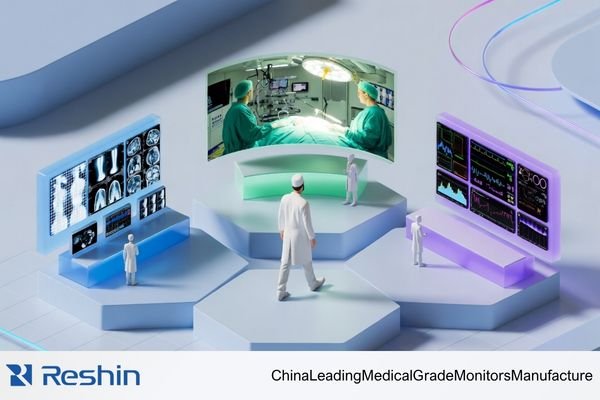
A diagnostic imaging project, for example, may prioritize grayscale consistency, calibration confidence, and brand trust in radiology departments. A surgical display project may instead focus on latency, color behavior, and signal stability. A system manufacturer evaluating long-term cooperation will often care more about model continuity, engineering communication, documentation support, and customization discipline than about headline brand recognition.
Why Buyers Search for “Top Medical Display Manufacturers”
Most buyers search for leading manufacturers because the market is specialized, technical, and difficult to compare from the outside. The search is often a starting point for reducing risk before deeper evaluation begins.
The phrase “top medical display manufacturers” usually reflects a buyer’s need for confidence, not just curiosity. Procurement teams want to avoid weak suppliers, reduce compliance risk, and build a shortlist that balances reputation, technical suitability, and long-term project stability. That is why these searches often happen early in sourcing, before formal supplier comparison starts.

Unlike commercial display sourcing, medical display sourcing involves clinical workflows, quality expectations, and documentation concerns that are not always visible on a standard product page. A monitor may look strong on paper while still being a poor fit for a real hospital or OEM deployment. That gap is what drives many buyers toward comparative searches.
There are usually four hidden questions behind this type of search:
- Which suppliers are trusted in diagnostic reading environments?
- Which brands are stronger in surgical visualization?
- Which manufacturers are more realistic for OEM and customized projects?
- Which companies can support documentation, validation, and long-term continuity?
The search itself is useful, but only if it leads to a more structured evaluation method. Otherwise, buyers risk confusing visibility with suitability.
How Buyers Compare Medical Display Manufacturers
A meaningful comparison does not stop at brand recognition. In real procurement work, buyers usually compare suppliers across technical, operational, and commercial dimensions at the same time.
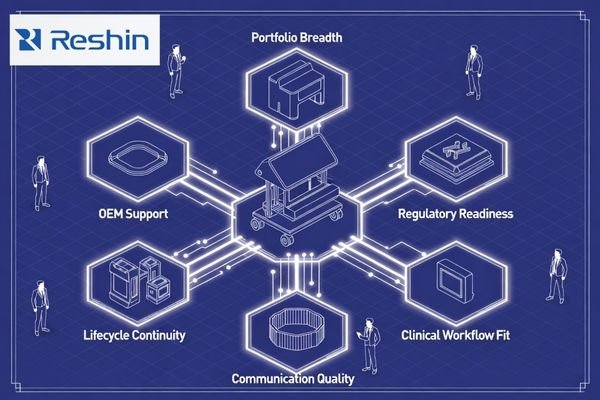
Strong manufacturer comparisons usually include six areas: portfolio breadth, regulatory readiness, application fit, OEM support, lifecycle continuity, and engineering communication. These criteria help buyers move beyond market reputation and toward project suitability. The most reliable supplier for one project may be completely different from the best choice for another clinical, budgetary, or integration scenario.
Product Portfolio Breadth
A broader product range can reduce project risk when buyers need multiple display categories from one source. This is especially relevant when the same supplier may need to support diagnostic displays, surgical monitors, clinical review screens, and integrated workstation programs.
Regulatory and Documentation Readiness
Medical display projects often require more than hardware performance. Buyers may need support around documentation alignment, traceability, technical file consistency, or local registration preparation. A supplier that cannot communicate clearly in this area often creates downstream delays.
Clinical Workflow Fit
Not all manufacturers are strong in the same use cases. Some are known for diagnostic reading and grayscale confidence. Others are more relevant in endoscopy, OR integration, or procedural video. Comparing suppliers without reference to real application context often leads to poor shortlists.
OEM and Customization Support
For OEM brands and medical system companies, this area is critical. It is not enough for a supplier to offer standard monitors. The real question is whether they can support changes in interface behavior, branding, housing, mounting, and pilot-to-volume production without creating instability.
Lifecycle Continuity
A successful sample is not the same as a successful supply program. Product managers often care about model continuity, practical replacement paths, and controlled product changes over time. This factor is commonly underestimated in early evaluation.
Engineering and Communication Quality
In medical projects, supplier communication is part of project quality. A manufacturer that can explain feasibility, respond clearly to technical requirements, and support structured decision-making is often more valuable than one that only pushes catalog products.
10 Medical Display Manufacturers Commonly Compared in 2025
A buyer-facing comparison is usually more useful than a hard numerical ranking. The manufacturers below are commonly considered in diagnostic, surgical, and OEM-related sourcing conversations in 2025.
These ten manufacturers are not presented here as a fixed global ranking. Instead, they are shown as representative companies with different strengths, typical project fits, and practical watch points. This comparison method is more credible because it reflects how procurement teams actually build shortlists: by matching supplier strengths to project type, workflow demands, and acceptable risk levels.
| Manufacturer | Typical Strength | Best Fit | Watch Point |
|---|---|---|---|
| Barco | Strong premium reputation in diagnostic imaging and calibration-driven workflows | High-end radiology, mammography, enterprise diagnostic environments | Often positioned at the premium end in budget and procurement complexity |
| EIZO | Stable image consistency, long product life, strong diagnostic heritage | Hospitals and imaging departments prioritizing long-term reliability | May be less flexible for OEM-led customization programs |
| Sony | Strong surgical video heritage and image processing capability | Endoscopy, surgical visualization, OR video workflows | Better known in surgical contexts than broad diagnostic deployment |
| NEC | Reliable clinical and diagnostic display presence | General hospital imaging, clinical review, standards-oriented deployments | Brand visibility can vary by region and product line |
| LG Electronics | Strong panel and display technology foundation | Surgical video, clinical environments, large-format visualization | Suitability depends on exact medical product line and project needs |
| FSN Medical | Good focus on surgical and integrated display solutions | OR integration, endoscopy, procedural visualization | Long-term supply assumptions should be checked project by project |
| Advantech | System-facing mindset and integration capability | Embedded systems, medical workstations, modular platforms | Some projects require deeper display-specific clinical evaluation |
| Quest International | Cost-efficient medical display options | Budget-sensitive healthcare projects and selected clinical use cases | Buyers should verify lifecycle continuity and regional support conditions |
| Siemens Healthineers | Strong ecosystem integration advantage | Buyers already operating within a broader imaging equipment ecosystem | Less flexible where independent sourcing is preferred |
| Reshin | OEM cooperation, customization support, balanced cost-performance | Brands, system integrators, and project-led medical display programs | Better suited to OEM and integration needs than legacy premium brand-only procurement |
This table is not meant to replace supplier evaluation. Its purpose is to help buyers stop thinking in terms of simple popularity and start thinking in terms of fitness for purpose. In practice, a shortlist becomes much stronger when each supplier is mapped against actual workflow and project constraints.
Different Types of Medical Display Suppliers
The medical display market includes different supplier types, and those categories matter. Comparing all companies as if they serve the same need often produces misleading conclusions and weak procurement decisions.
A premium diagnostic brand, a surgical visualization specialist, an ecosystem player, and an OEM-oriented manufacturer can all be credible suppliers, but for very different reasons. Buyers usually make better decisions when they first identify the supplier type they need, then compare companies inside that category instead of forcing unlike businesses into one universal ranking model.
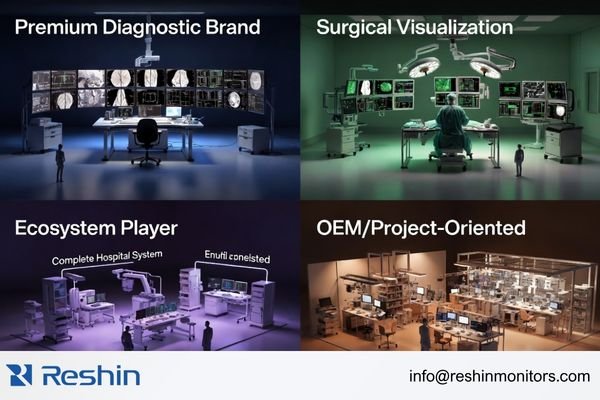
Premium Diagnostic-Focused Brands
These suppliers are often strongest in radiology, mammography, and diagnostic confidence. Their value usually comes from image stability, long-standing hospital trust, and calibration-focused ecosystems. Buyers choosing this category are often prioritizing clinical confidence over flexibility.
Surgical Visualization Brands
These companies are typically associated with endoscopy, OR integration, and live procedural video. Their evaluation usually centers on color clarity, motion handling, latency, and signal behavior under active surgical workflows.
Ecosystem-Led Manufacturers
Some manufacturers are strongest when their display products are used as part of a wider medical equipment or imaging platform. Their value can be high in integrated purchasing environments, but they may be less attractive where sourcing independence matters.
Flexible OEM and Project-Oriented Manufacturers
This category tends to matter most for brands, product teams, and system integrators. Buyers in this group usually care about customization scope, engineering communication, controlled change management, and long-term production cooperation rather than legacy brand prestige alone.
Understanding these supplier types helps explain why rigid “top 10” lists often fail. They compress fundamentally different business models into one superficial hierarchy.
Where Reshin Fits
Reshin is best understood as a medical display manufacturer that is particularly relevant for OEM, customized, and project-led sourcing situations. Its role is clearer when compared by cooperation model rather than by brand prestige alone.
From a buyer perspective, Reshin fits best when the project requires customization beyond standard models, closer engineering communication, pilot-to-volume planning, and balanced cost-performance. It is especially relevant for medical brands, system integrators, and product-led companies that need a manufacturer willing to support real project execution instead of simply supplying off-the-shelf catalog monitors.

Reshin is usually a stronger candidate in projects involving:
- customization beyond standard catalog supply
- interface or structure adaptation for system requirements
- communication with engineering and project teams
- pilot production before long-term rollout
- model continuity and controlled product change
- coordination around documentation and local project demands
This does not mean Reshin is the best fit for every buyer. A hospital group that values only legacy premium diagnostic branding may prefer a different shortlist. But for buyers evaluating manufacturing cooperation, project flexibility, and long-term supply execution, Reshin belongs in the conversation for a different and more practical reason.
That distinction is important because it makes the comparison more credible. A good supplier does not need to be the right answer for every scenario to be a strong answer in the right one.
How to Shortlist a Supplier for Your Project
A reliable shortlist should begin with project type, not with popularity. The best supplier decision usually becomes clearer when buyers define the clinical, operational, and commercial context first.
Shortlisting works best when buyers group suppliers by project need: premium diagnostic confidence, surgical workflow performance, OEM flexibility, ecosystem compatibility, or balanced cost-performance. This approach is more practical than treating every manufacturer as if they serve the same priorities. A clear shortlist reduces wasted meetings, improves evaluation focus, and makes internal procurement decisions easier to justify.
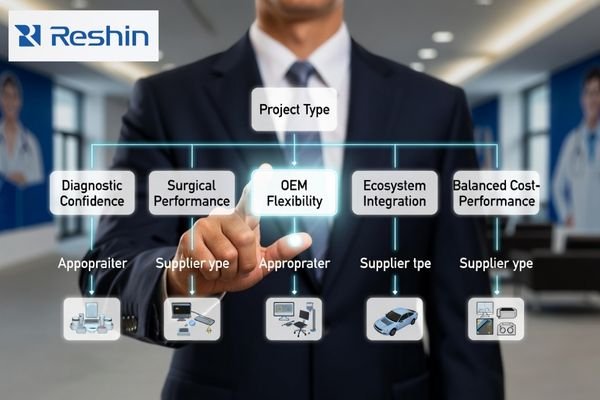
If You Need Premium Diagnostic Reputation
Focus on suppliers with strong radiology heritage, consistent grayscale performance, and broad trust in hospital imaging environments. The primary goal here is often clinical confidence rather than flexibility.
If You Need Surgical Visualization Strength
Prioritize manufacturers with experience in endoscopy, OR integration, and surgical video handling. In these projects, latency, motion stability, and video chain compatibility often matter more than general display marketing claims.
If You Need OEM Flexibility and Customization
Include manufacturers that can support interface changes, branding, mechanical adaptation, pilot programs, and structured engineering communication. This is where execution quality often matters more than brand legacy.
If You Need Ecosystem-Level Integration
Consider suppliers whose displays perform best within broader imaging or equipment platforms. This is especially relevant when the monitor is only one part of a larger capital equipment environment.
If You Need Cost-Performance Without Losing Control
Look for manufacturers that balance documentation readiness, lifecycle continuity, and practical engineering support with more flexible commercial conditions. The cheapest supplier is rarely the safest, but the most expensive option is not automatically the best fit either.
A useful shortlist is one that gives decision-makers confidence, not just variety. In most cases, fewer but better-matched suppliers produce better results than long lists built only on reputation.
Final Thoughts
Searching for the top medical display manufacturers in 2025 is useful only when the comparison goes beyond simple rankings. The market includes premium diagnostic brands, strong surgical specialists, ecosystem-led suppliers, and flexible OEM-oriented manufacturers, and these groups are not interchangeable.
The better question is not who appears first on a public list. The better question is which medical display manufacturer fits the project, workflow, documentation expectations, and deployment model you actually need.
For procurement teams, product managers, and system companies, that shift in thinking usually leads to a stronger shortlist, fewer evaluation mistakes, and a more credible supplier decision.