An ENT surgeon struggles to differentiate a subtle mucosal change on a generic office monitor. From my experience supporting ENT teams, I’ve seen how this seemingly small uncertainty can delay diagnosis—or lead to unnecessary, more invasive follow-up procedures.
For modern ENT departments, the most appropriate endoscopic display resolution is 4K (UHD) for operating rooms and teaching spaces, complemented by high-quality FHD in high-volume outpatient clinics. In my field evaluations, 4K consistently provides the micro-level detail required for sinus surgery and microlaryngeal work, while FHD remains clinically sufficient for routine diagnostic endoscopy and patient communication—helping departments balance clarity with workflow and budget.
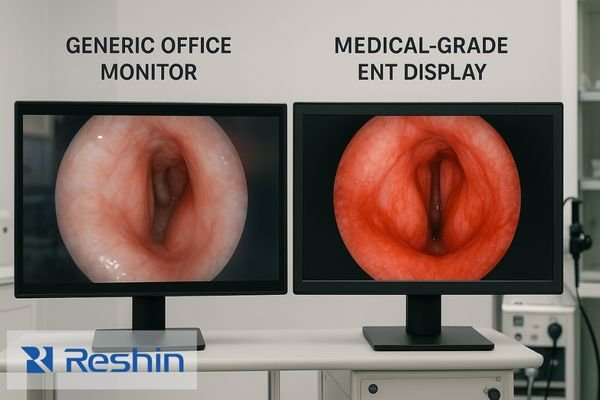
As an engineer who has assessed ENT visualization systems across many facilities, I’ve learned that choosing the right endoscopic display1 involves far more than picking the highest pixel count. ENT endoscopy relies on capturing extremely small structures—microvascular networks, mucosal textures, early-stage lesions. Purpose-built medical displays strengthen the clinical imaging chain with calibrated color, optical bonding, and low latency. Through repeated evaluations, these factors have consistently proven essential in ensuring that resolution delivers real diagnostic value.
This article reflects my engineering observations on how ENT departments should match display resolution to specific clinical scenarios to achieve better diagnostic outcomes and controlled long-term costs.
Why ENT Endoscopy Needs Purpose-Built Endoscopic Displays Rather Than Generic Monitors?
Using a standard computer monitor for ENT endoscopy is like a musician using a toy piano. The basic function exists, but the precision is missing.
Purpose-built ENT endoscopic displays ensure that resolution truly contributes to diagnostic accuracy through medical-grade safety, calibrated color, low latency, and stable performance—capabilities generic monitors cannot guarantee.
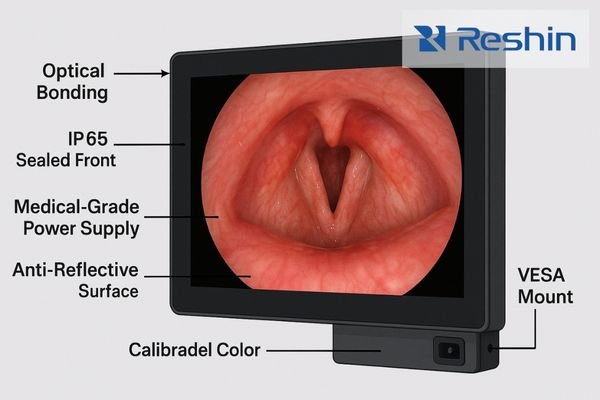
Across my technical assessments of ENT clinics and ORs, I’ve repeatedly observed that subtle lesion identification depends heavily on image clarity and color accuracy. Consumer monitors lack the engineering required for medical imaging—IEC 60601-1 electrical safety, optical bonding to eliminate internal reflections, and calibrated color aligned with BT.709/BT.2020. These engineering differences ensure reliable visualization during long clinical sessions and enable both FHD and 4K resolutions to perform at their full potential.
Decision takeaway: Choose purpose-built ENT endoscopic displays2 to guarantee medically compliant color, stability, and latency.
How HD, FHD, and 4K Resolutions Change ENT Endoscopic Display Visibility?
The jump between resolutions isn’t just pixel count—it reveals clinical information that lower resolutions hide.
While HD and FHD support basic ENT exams, 4K endoscopic display resolution provides four times the pixel density of FHD, enabling clearer visualization of microvascular patterns and subtle mucosal changes.
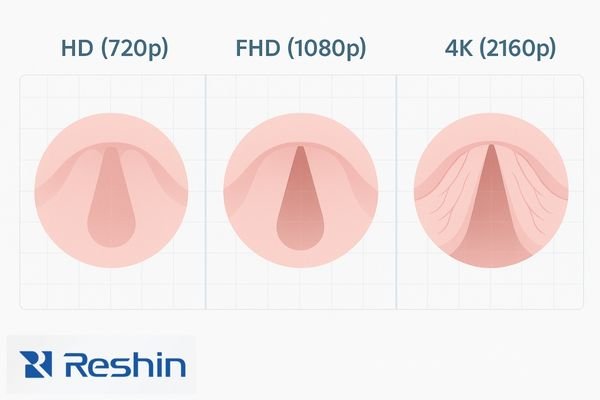
During client demonstrations and visualization tests, I’ve directly compared HD/FHD and 4K images of the same ENT anatomy. HD and FHD (1080p)3 provide adequate clarity for routine nasal or basic laryngeal exams—but they compress fine textures and weaken contrast in stroboscopy or narrow-band imaging. Every time I review the same content on a 4K display, lesion margins, mucosal granularity, and vascular details become significantly more apparent. The improvement isn’t subjective—4K consistently strengthens early detection and increases diagnostic confidence.
Decision takeaway: FHD remains suitable for routine ENT diagnostics, while 4K is essential where detail is tied to clinical outcomes.
Matching Display Resolution to ENT Clinical Scenarios
A single standard across all rooms often leads to budget waste and misallocation of high-resolution displays.
A practical strategy is to equip high-volume outpatient clinics with cost-efficient FHD endoscopic displays while reserving 4K displays for ENT operating rooms and teaching labs.
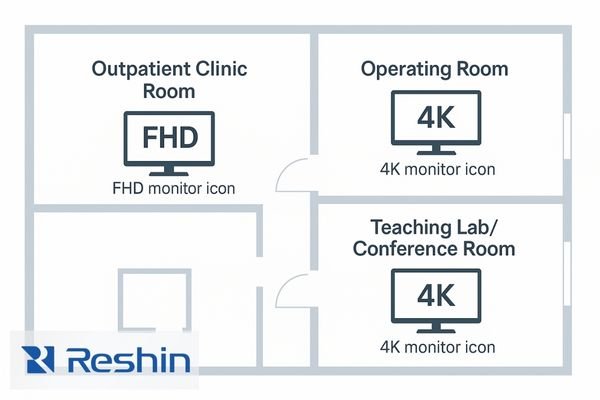
Outpatient ENT Endoscopic Display Requirements
In my site evaluations, FHD displays have consistently proven sufficient for routine nasal and laryngeal exams. They offer balanced clarity and cost efficiency—ideal for high-throughput outpatient rooms.
ENT OR 4K Endoscopic Display Requirements for Surgery
In contrast, ENT ORs benefit disproportionately from 4K. The added detail improves navigation in sinus surgery and microlaryngeal procedures—where precision is non-negotiable.
ENT Teaching & Collaboration Endoscopic Display Requirements
As I’ve seen in academic hospitals, 4K displays4 help trainees interpret cases at the same level of detail as the operator, supporting more accurate learning.
Decision takeaway: Match FHD to routine rooms and 4K to high-acuity or educational environments.
Beyond Resolution: Color, Contrast and Latency in ENT Endoscopic Display Visualization
High resolution cannot compensate for inaccurate color or motion delay.
Endoscopic display resolution must be evaluated alongside color accuracy (BT.709/BT.2020), high contrast, and low latency for real-time ENT tool control.
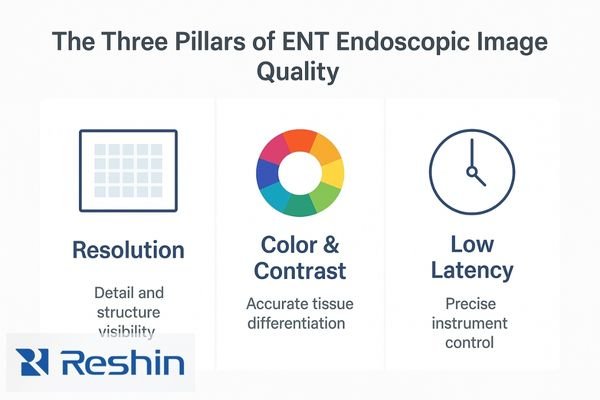
During calibration checks and performance audits, I’ve seen how differences in color accuracy directly affect interpretation of erythema, vascular prominence, or mucosal texture. High contrast helps differentiate transparent fluid layers from underlying tissue. Low latency is equally critical—especially in narrow anatomical spaces—where even small delays disrupt precise control. These engineering realities reinforce that resolution is only one part of overall ENT image quality.
Decision takeaway: Evaluate resolution together with color accuracy5, contrast, and latency.
Hygiene, Mounting and Workflow Requirements for ENT Endoscopic Displays
A clinically powerful display will still fail if it complicates hygiene or positioning.
Flat, sealed front surfaces and flexible VESA mounting are essential for hygiene, ergonomics, and efficient ENT workflows.

In high-turnover ENT rooms I’ve audited, cleaning speed and surface durability are major concerns. Optically bonded front glass avoids residue accumulation and withstands repeated disinfection. Mounting flexibility ensures eye-level positioning and multi-viewer visibility—important when trainees or assistants are present. Departments focusing solely on resolution often overlook these practical constraints until workflow issues appear.
Decision takeaway: Prioritize easy cleaning and ergonomic positioning6 alongside image quality.
Recommended ENT Endoscopic Display Models
Based on my years of engineering work with hospitals and OR integrators, I’ve learned that selecting the right ENT endoscopic display is not just about specifications—it requires dependable manufacturing, long-term supply stability, and a partner who understands the realities of clinical workflows. At Reshin, our engineering team designs and validates each display specifically for endoscopic and surgical environments, with a focus on color accuracy, latency control, electrical safety, and long-term serviceability. This shortlist reflects the models I most frequently recommend to ENT departments because they balance clinical performance with lifecycle reliability, backed by a support structure built for hospital procurement and standardization.
| Model | Resolution | Size | Best for |
|---|---|---|---|
| MS275PA | 4K UHD | 27" | ENT ORs & teaching rooms |
| MS321PC | 4K UHD | 32" | High-detail surgical ENT visualization |
| MS270P | FHD | 27" | ENT outpatient endoscopy |
| MS325P | FHD | 31.5" | Routine ENT diagnostics & mixed-use OR/clinic |
This blended mix supports progressive deployment across clinics, ORs, and teaching environments.
Recommended Selection Process & ENT-Focused Endoscopic Display Shortlist
A structured process prevents over-specification and ensures consistent diagnostic visibility.
Map clinical use cases to resolution tiers (FHD vs. 4K), then shortlist displays that also meet color, latency, and hygiene requirements.
From my experience supporting procurement teams, the most effective selection method follows these steps:
- Map Clinical Use Cases: Group rooms by diagnostic or procedural intensity.
- Align Resolution Tiers: Assign FHD to routine diagnostics and 4K to high-acuity and educational spaces.
- Shortlist Compliant Displays: Select models with verified performance in resolution, color accuracy, sealing, and latency.
Decision takeaway: Use structured, scenario-based planning to avoid mismatched equipment.
FAQ: Resolution Choices for ENT Procurement Teams
Is FHD still “good enough” as an ENT endoscopic display resolution for modern clinics?
For high-volume outpatient diagnostics, yes. High-grade FHD remains cost-efficient and clinically sufficient.
How much does 4K endoscopic display resolution improve daily surgical practice?
In surgical ENT work, 4K enhances margin definition, vascular visibility, and instrument control.
What is the best way to begin a mixed-resolution ENT deployment?
Start with the main OR and primary teaching room—where 4K delivers the highest clinical value.
Conclusion
Based on my experience supporting ENT teams with visualization planning, the most effective display strategy uses FHD for routine diagnostics and 4K for ORs and teaching. Aligning resolution with clinical need delivers clarity where it matters most while maintaining efficient workflows and cost control.
If your ENT department is evaluating resolution choices or planning a phased upgrade path, my engineering team at Reshin can assist in reviewing clinical requirements, integration needs, and long-term standardization strategies.
Email: consulting@reshinmonitors.com
Website: https://reshinmonitors.com
-
Explore this link to discover top-rated endoscopic displays tailored for ENT needs, enhancing diagnostic accuracy. ↩
-
Explore how specialized displays enhance visualization and accuracy in ENT procedures, ensuring better patient outcomes. ↩
-
Learn about the effectiveness of FHD in routine diagnostics and its limitations compared to higher resolutions. ↩
-
Learn about the advantages of 4K displays for complex surgeries and training in ENT. ↩
-
Understanding color accuracy is crucial for interpreting medical images correctly, ensuring accurate diagnoses. ↩
-
Exploring ergonomic positioning can improve efficiency and comfort in clinical environments, benefiting both staff and patients. ↩