Surgeons frequently report difficulties identifying critical biliary structures during laparoscopic cholecystectomy due to poor visualization. Could your current display technology be compromising surgical precision and patient safety?
The most suitable surgical monitor for laparoscopic cholecystectomy is a 4K medical-grade display equipped with AR anti-reflective glass, optical bonding, high brightness uniformity, and low-latency 4K60 signal processing. These features ensure clear identification of Calot’s triangle, the biliary ducts, and other critical structures while maintaining safe, precise hand-eye coordination throughout the procedure.

As an engineer specializing in medical-grade displays1, I’ve collaborated with hundreds of surgical teams across multiple regions to optimize visualization for minimally invasive procedures. Through this experience, I’ve identified specific monitor requirements that directly impact cholecystectomy outcomes. This article examines the critical relationship between display quality and surgical performance during gallbladder removal procedures.
What is laparoscopic cholecystectomy and why does it require a dedicated surgical monitor?
Laparoscopic gallbladder removal involves operating in a confined space with limited visual perspective. Why can’t standard commercial displays handle this specialized visualization requirement?
From my OR integration experience, cholecystectomy is a procedure that relies heavily on precise anatomical visualization. Pneumoperitoneum alters tissue appearance, while intense OR lighting creates glare that can obscure critical structures. This is why consumer displays are insufficient, and dedicated surgical monitors with medical certification, anti-reflective optics, and uniform brightness are essential for consistent anatomical identification.
Unique Visualization Challenges
Laparoscopic cholecystectomy presents several specific visualization challenges:
- Altered Anatomical Appearance: CO₂ insufflation creates an unnatural operating field
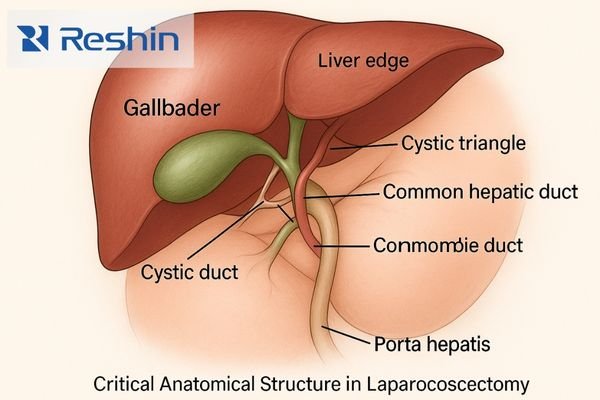
- Critical Structure Identification: Cystic duct, cystic artery, and common bile duct must be clearly distinguished
- Limited Field of View: Laparoscope provides a narrow visual perspective
- Variable Lighting Conditions: Intense OR lighting demands strong anti-glare performance
- Team-Based Visualization: Entire team must maintain clear viewing angles
Medical-Grade Requirements
For surgical monitors used in laparoscopic cholecystectomy, the following certifications are essential:
| Requirement | Standard | Relevance to Cholecystectomy |
|---|---|---|
| Electrical Safety2 | IEC 60601-1 | Protection in fluid-rich OR environments |
| EMC Compliance | IEC 60601-1-2 | Prevents interference with OR systems |
| Risk Management | ISO 14971 | Addresses visualization-related safety risks |
| Quality Management | ISO 13485 | Ensures consistent, regulated manufacturing |
| Performance Standards | FDA Class I Medical Device | Confirms suitability for clinical environments |
Why is a 4K surgical monitor the preferred choice?
Many facilities continue using Full HD monitors despite advancements in medical visualization. So why do laparoscopic teams increasingly prefer 4K?
Surgeons performing cholecystectomy must visualize fibrous bands, micro-vessels, and tissue layers with high precision. 4K resolution preserves these details even under magnification, particularly in inflamed or adhesed cases. Compared with FHD, 4K consistently improves identification speed and reduces reliance on subjective interpretation.
Resolution Impact on Structure Identification
- Enhanced tissue differentiation3
- Improved depth perception
- Better preservation of details during zoom
- Reduced eye strain
- Clearer visibility for the entire OR team
Clinical Evidence for 4K Visualization
Multiple independent evaluations report tangible improvements when upgrading from HD to 4K surgical visualization systems:
- Faster and more confident identification of biliary structures
- Reduced visualization-related near-miss errors
- Higher surgeon confidence, especially in inflamed or anatomically complex cases
What essential features must a surgical monitor provide for cholecystectomy?
Which technical characteristics genuinely impact surgical performance?
When evaluating surgical monitors, I first assess their suitability for the OR: anti-glare capability, brightness stability, color accuracy, and compatibility with OR-grade video interfaces. A flat, sealed, easy-to-sanitize design and full medical electrical safety certification are also mandatory.
Critical Performance Specifications
| Feature | Minimum | Optimal | Clinical Impact |
|---|---|---|---|
| Resolution4 | Full HD | 4K UHD | Accurate biliary structure recognition |
| Brightness | 350 cd/m² | ≥500 cd/m² | Visibility under intense OR lighting |
| Contrast Ratio | 1000:1 | ≥1500:1 | Layer and tissue differentiation |
| Response Time | ≤16ms | ≤8ms | Smooth instrument motion |
| Color Accuracy | sRGB >85% | sRGB >100% | True-to-life tissue tones |
| Viewing Angle | ≥170° | ≥178° | Consistent team visibility |
Physical Design Requirements
- AR anti-glare cover glass
- Optical bonding for clarity and durability
- Sealed, fluid-resistant housing
- Low heat emission
- Flexible mounting options
- Clean cable routing
How do image quality and latency directly affect surgical accuracy?
Cholecystectomy demands precise hand-eye synchronization. Excess latency causes mismatch between instrument movement and visual feedback, while poor brightness uniformity or glare can obscure critical anatomy. This is why I require fully validated low-latency 4K60 video pipelines in OR deployments.
Impact of Display Latency
- Real-time movement accuracy
- Reduced cognitive and physical strain
- Better instrument control
- Improved training outcomes
Critical Image Quality Factors
- Brightness uniformity
- Color accuracy
- Contrast performance
- Dynamic range
- Motion clarity
What risks arise from using an unsuitable monitor?
Using consumer-grade or outdated displays introduces risks such as misidentifying biliary structures, lengthened procedure times, and increased surgeon fatigue. These issues directly affect clinical safety.
Clinical Risks
- Misidentification of biliary structures
- Missed anatomical variations
- Difficulty locating bleeding sources
- Increased procedure time
- Higher likelihood of conversion to open surgery
Operational & Economic Risks
| Impact | Description | Consequence |
|---|---|---|
| Extended OR Time | Visualization delays | Lower throughput |
| Team Discordance | Inconsistent viewing clarity | Reduced workflow efficiency |
| Cognitive Load | Compensating for poor image quality | Higher fatigue risk |
| Equipment Variability | Mixed display types | Poor standardization |
| Failure Rates | Consumer monitors in OR environments | Unexpected downtime |
How do Reshin surgical monitors meet these requirements?
Reshin is one of China’s leading developers and manufacturers of medical-grade surgical displays. Our engineering team focuses specifically on visualization solutions for laparoscopic and endoscopic surgery, delivering 4K clarity, optical bonding, AR anti-reflective glass, and long-life OR-grade reliability. Reshin monitors are now deployed in operating rooms across Asia, Europe, and other global regions.
Model-Specific Advantages for Cholecystectomy
MS275PA (27" 4K) – Primary Recommendation
- Ideal viewing distance for the primary surgeon
- AR glass + optical bonding
- True 500 cd/m² brightness uniformity
- <8 ms response time
- Fully compatible with modern OR imaging systems
MS322PB (32" 4K) – Best for Team Collaboration
- Larger screen for multi-role visibility
- Enhanced anti-glare performance
- Superior color reproduction
- Low-latency processing
- Ideal for brighter, larger ORs
MS321PB (31.5" 4K) – Teaching & Complex Cases
- PIP/PBP for dual-image workflows
- Side-by-side pre-op imaging
- Excellent off-axis color fidelity
- Robust signal compatibility
MS430PC (43" 4K) – Teaching ORs
- Large format for observers
- Clear visibility at greater distances
- Quad-view support
- High brightness for large surgical suites
Implementation Considerations
- Monitor height and ergonomic placement
- Full 4K60 signal path verification
- Calibration protocols
- Integration with OR control systems
- Redundancy plans for critical surgeries
To evaluate which Reshin monitor best fits your OR configuration, contact our technical team for a tailored assessment: info@reshinmonitors.com
Conclusion
In laparoscopic cholecystectomy, the surgical monitor directly influences visualization stability, anatomical accuracy, and surgical workflow. Only medical-grade displays with 4K resolution, low latency, and advanced anti-reflective design can meet the precision demands of modern minimally invasive biliary surgery.
Reshin’s surgical display portfolio is engineered specifically for procedures like cholecystectomy—providing clarity, color accuracy, ergonomic reliability, and OR-grade durability for both routine and teaching environments.
For professional guidance on selecting the best surgical monitor for your cholecystectomy workflow, feel free to reach out:
📧 Email: info@reshinmonitors.com
🌐 Website: https://reshinmonitors.com
-
Explore how medical-grade displays enhance surgical precision and outcomes, crucial for minimally invasive procedures. ↩
-
Exploring electrical safety standards ensures that surgical monitors are safe and effective in fluid-rich environments, crucial for patient safety. ↩
-
Explore how enhanced tissue differentiation can significantly improve surgical outcomes and decision-making. ↩
-
Understanding the significance of resolution can enhance your knowledge of imaging technologies and their clinical applications. ↩