Medical facilities frequently report inconsistent tissue color reproduction and limited viewing angles on displays, potentially leading to clinical misinterpretation. Could your current visualization technology be compromising diagnostic accuracy and team collaboration?
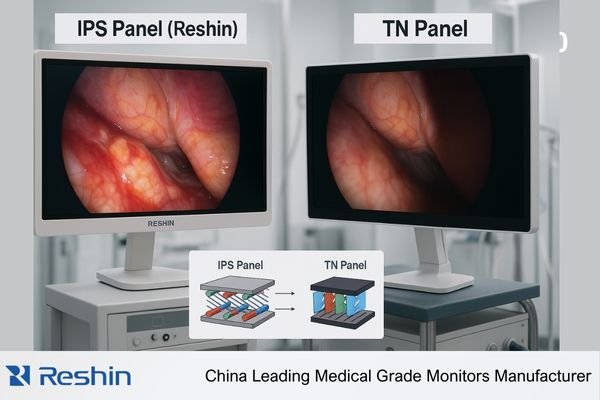
IPS panels improve color performance in medical displays by delivering more accurate color reproduction, wider viewing-angle stability, and smoother grayscale response. In my engineering work with surgical and PACS systems, IPS consistently provides more reliable and clinically consistent imaging than VA or TN technologies.
As an engineer specializing in medical display calibration and implementation, I’ve observed how panel technology directly impacts clinical interpretation across surgical rooms, PACS workstations, and diagnostic review settings.
Different panel technologies significantly affect color accuracy, viewing-angle stability, and grayscale precision—factors that influence diagnostic confidence, surgeon coordination, and reading room efficiency. For OR managers, radiology directors, PACS administrators, and medical equipment procurement teams, understanding IPS technology is essential for selecting the right medical displays.
In this article, I’ll explain how In-Plane Switching (IPS) panels1 address long-standing visualization issues in medical environments and why IPS has become the preferred foundation for modern medical displays.
What Makes IPS Technology Superior for Medical Color Accuracy?
Many healthcare facilities struggle with inconsistent color representation across their display fleet, causing uncertainty about true tissue appearance and potentially affecting clinical decisions. How does the underlying panel technology contribute to this problem?
In my medical display calibration projects, I often find that IPS technology consistently delivers more reliable color reproduction than VA or TN alternatives. The inherent panel structure of IPS allows liquid crystals to rotate in a plane rather than tilting vertically, resulting in improved chromatic consistency across the entire luminance range.
This characteristic benefits surgical displays, PACS clinical review monitors, and endoscopy visualization, where stable color is essential for accurate interpretation.
Reshin’s medical displays integrate IPS modules with calibrated color engines, ensuring that grayscale and color responses align with clinical imaging standards.
Technical Architecture and Color Reproduction
IPS (In-Plane Switching) panels use a fundamentally different liquid crystal arrangement than TN or VA technologies:
| Panel Technology | Liquid Crystal Arrangement | Color Accuracy Characteristics | Clinical Impact |
|---|---|---|---|
| IPS | Crystals rotate horizontally (in-plane) | Consistent color across viewing angles, superior color volume | Reliable tissue color representation |
| VA | Crystals tilt vertically | Good contrast but visible color shift off-axis | Inconsistent team visualization |
| TN | Crystals twist 90° | Limited color accuracy; severe off-axis shift | Potential misinterpretation |
Because IPS crystals rotate in-plane, light transmission remains more stable across voltage levels. This yields several advantages:
- Expanded Color Gamut—98–100% sRGB and 90–95% DCI-P3
- Reduced Color Shift Across Luminance Levels
- Smoother Color Transitions for Tissue Boundary Recognition
In surgical visualization systems I calibrate, IPS displays consistently show lower Delta-E color error2 values than VA or TN panels under the same calibration conditions.
Decision takeaway: For hospital decision-makers, IPS medical displays translate to more consistent and clinically reliable tissue color reproduction across the entire fleet.
How Does IPS Improve Viewing-Angle Stability in Clinical Environments?
Operating rooms and reading environments frequently involve multiple clinicians viewing the same display from different positions. How significant is the impact of viewing angle on clinical image interpretation?
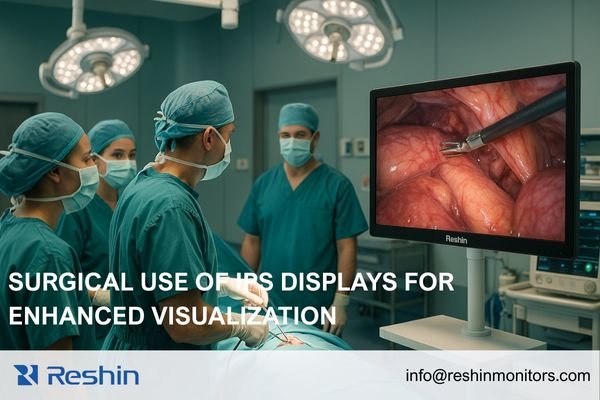
In surgical theatres and endoscopy suites, clinicians often view displays from multiple angles. IPS maintains luminance and chromatic accuracy up to 178°, ensuring surgeons, nurses, and anesthesiologists see the same image regardless of viewing position.
Reshin’s IPS-based monitors undergo viewing-angle uniformity testing to minimize off-axis discrepancies that could affect clinical decisions.

Clinical Impact of Viewing-Angle Stability3
Medical environments often involve:
- Surgical teams positioned around a patient
- Ceiling-mounted displays on moving boom arms
- Teaching scenarios with multi-observer viewing
- Non-optimal viewing height or lateral offset positions
TN and VA panels commonly exhibit color inversion or gamma shift beyond 30–45°, while IPS maintains stable brightness and color.
Decision takeaway: IPS ensures that all clinicians—surgeons, assistants, anesthesiologists—see identical visual information, reducing communication errors and saving repositioning time.
Why Is IPS Better for Multi-Modality Medical Imaging?
Healthcare facilities increasingly consolidate multiple imaging modalities on the same display. But images often appear inconsistent when switching between modalities.
In my deployments involving ultrasound, endoscopy, DR, CT, and pathology viewers, IPS consistently delivers more predictable grayscale and color behavior across modalities. The wider color gamut, stable gamma, and lower color shift ensure consistent interpretation when switching between imaging types.

Reshin enhances IPS performance through modality-specific presets that tune color temperature4, gamma, and contrast for each application.
Color and Grayscale Consistency Across Modalities
Different modalities require different visual characteristics:
- Endoscopy: Accurate mucosal color
- Ultrasound: Grayscale precision & Doppler clarity
- Digital Pathology: Faithful stain color reproduction
- Nuclear Medicine: Accurate pseudocolor mapping
IPS panels offer:
- Wider native color gamut
- Stable gamma curve across luminance range
- Better preservation of grayscale–to–color transitions
Decision takeaway: IPS reduces the need for manual adjustment between modalities and improves diagnostic agreement across clinical teams.
How Does IPS Support Accurate Grayscale and Low-Contrast Visualization?
Many facilities struggle to visualize subtle tissue boundaries and low-contrast structures. Panel technology affects the visibility of these critical details.
IPS panels deliver smoother grayscale transitions and more stable gamma curves compared with VA or TN types. This improves visibility of soft tissue boundaries, microstructures, and low-contrast anatomy—critical for laparoscopic surgery and PACS review.
Reshin uses 10–12-bit factory calibration on IPS panels, ensuring better DICOM GSDF compliance.
Grayscale Performance and Clinical Detection
IPS provides:
- Higher bit-depth rendering with reduced banding
- More consistent contrast across the full screen
- Easier and more accurate DICOM GSDF calibration
These directly improve clinical interpretation in CT, thoracic imaging, mammography, and interventional procedures.
Decision takeaway: IPS medical displays provide more reliable low-contrast detail visibility, reducing missed early-stage findings.
How Does IPS Improve Long-Term Reliability in Medical Applications?
Healthcare facilities frequently report that displays degrade in performance over time. IPS panel technology directly affects long-term visualization consistency.
In my experience, IPS panels demonstrate stronger long-term color stability and uniformity performance than other LCD technologies. Their planar liquid-crystal structure is less prone to degradation, reducing color drift and luminance inconsistency.
Reshin’s IPS medical displays incorporate reinforced optical bonding and uniformity compensation to maintain image consistency throughout the product lifecycle.
Panel Longevity and Stability Factors
IPS panels exhibit:
- Lower susceptibility to burn-in
- More uniform aging characteristics
- Higher temperature stability
- Better polarizer resistance to yellowing
Decision takeaway: IPS displays extend replacement cycles and reduce service calls, lowering total cost of ownership (TCO)5 for hospital imaging infrastructure.
Which Types of Medical Displays Benefit Most From IPS Panels?
Choosing the right panel technology is essential for consistent medical imaging. IPS panels significantly enhance color accuracy, viewing-angle stability, and multi-modality consistency.
In my work with operating rooms, endoscopy systems, and PACS workstations, IPS-based displays—such as those developed by Reshin—consistently deliver reliable, repeatable clinical clarity.
Priority Applications for IPS
- Surgical Visualization
- Multi-disciplinary Review Scenarios
- Color-Critical Diagnostics (Pathology, Dermatology, Doppler)
- Long-Duration Reading for Radiology
Decision takeaway: IPS technology delivers the greatest value in environments requiring consistent multi-observer visibility and accurate color reproduction.
Which IPS-Based Medical Display Models Are Most Suitable for Clinical Applications?
Healthcare facilities face increasingly complex choices in display selection.
Based on IPS performance characteristics and actual PACS/OR deployments, these Reshin models deliver the strongest clinical value:
| Model | Key Specifications | Optimal Applications | IPS-Specific Benefits |
|---|---|---|---|
| MD32C | 3MP Color IPS Diagnostic | PACS clinical review | Enhanced color stability with CBS luminance control |
| MD85CA | 8MP Color IPS | Consolidated radiology reading | Uniform color for multi-window workflows |
| MD120C | 12MP Color IPS | AI-assisted reading, advanced visualization | Exceptional IPS uniformity |
| MS430PC | 43" 4K IPS Surgical | Hybrid ORs | Wide-angle visibility for team procedures |
| MS550P | 55" 4K IPS Surgical | OR collaboration | Stable color under intense surgical lighting |
These selections are based on real deployment patterns of Reshin IPS medical displays across PACS reading rooms, hybrid ORs, and multi-modality review environments.
FAQ: IPS Panels in Medical Displays
Q1: Do all medical displays need IPS panels?
Not necessarily. But IPS provides the most consistent performance for surgery, PACS review, and multi-modality imaging—making it the preferred choice for critical clinical visualization.
Q2: Are IPS medical displays suitable for both surgery and PACS?
Yes. IPS benefits both environments because it provides wide viewing angles for OR teams and accurate grayscale/color performance for diagnostic review.
Q3: What is the main difference between IPS and VA for medical imaging?
IPS offers more stable color and luminance across angles, while VA panels may show gamma shifts that affect tissue visibility and team interpretation.
Conclusion
IPS panel technology has become the preferred foundation for medical displays due to its superior color accuracy, exceptional viewing-angle stability, reliable grayscale performance, and long-term consistency.
These technical advantages translate directly to clinical benefits: more accurate tissue visualization, better team collaboration, improved multi-modality interpretation, and enhanced diagnostic confidence.
In my engineering deployments across ORs, hybrid suites, and PACS environments, IPS-based medical monitors consistently demonstrate superior real-world performance and lower lifetime variability.
Reshin builds its diagnostic and surgical display portfolio around high-performance IPS modules combined with stabilized backlights, optical bonding, and medical-grade calibration systems—ensuring the inherent advantages of IPS are fully realized in clinical settings.
If your hospital is planning to standardize on IPS-based medical displays for surgical suites or PACS reading rooms, Reshin’s engineering team can help translate clinical requirements into optimized display configurations and lifecycle plans.
📧 info@reshinmonitors.com
🌐 https://reshinmonitors.com/
-
Explore this link to understand how IPS technology enhances color accuracy and viewing angles, crucial for medical diagnostics. ↩
-
Exploring Delta-E color error will help you grasp its significance in achieving precise color reproduction in medical displays. ↩
-
Understanding Viewing-Angle Stability is crucial for optimizing visual information in surgical settings, enhancing team communication. ↩
-
Learn about the importance of color temperature in achieving accurate visual representation in medical diagnostics. ↩
-
This resource will provide insights into how TCO affects budgeting and decision-making in healthcare technology investments. ↩