In modern operating rooms, display disruptions during critical procedures often stem not from the monitors themselves, but from subtle issues in the video distribution chain connecting imaging sources to surgical displays.
The stability of surgical displays is heavily influenced by the choice and implementation of video transport technologies—HDMI, DisplayPort (DP), and SDI each bring distinct behaviors in signal integrity, switching reliability, and failure patterns. Understanding these differences is crucial for designing OR video systems that maintain consistent image quality under real clinical conditions.
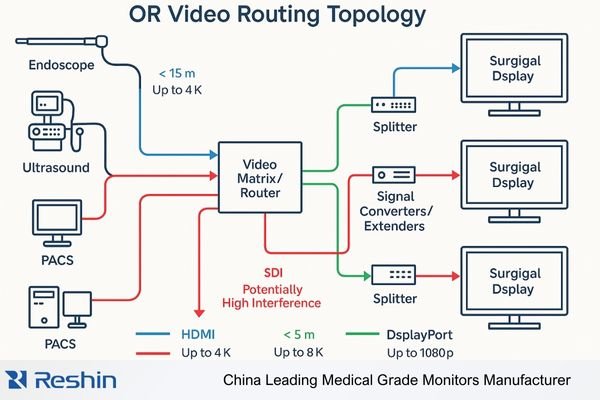
When I analyze display instability in ORs, I often discover that the root causes lie in the distribution infrastructure rather than the displays themselves. Seemingly random issues like black screens, image dropouts, or slow source switching usually trace back to negotiation behavior, signal margin1, or conditioning gaps across matrices, extenders, converters, cables, and power/ground environments. In practical terms, “stability” means predictable switching recovery, no intermittent dropouts, and consistent color/bit-depth under peak bandwidth and real-room interference.
Why surgical displays fail: symptoms traced to HDMI, DP, SDI distribution
Intermittent display issues in ORs frequently get misdiagnosed as monitor problems when they’re actually symptoms of distribution chain weaknesses.
Most surgical display failures manifest through specific patterns that point to video distribution problems: intermittent black screens from EDID/HPD events, image flicker from poor signal margin, slow recovery after switching due to negotiation delays, and frame drops from insufficient bandwidth headroom. These symptoms often map directly to how HDMI, DP, and SDI signals are conditioned and routed through the OR.

Common distribution-related symptoms include:
- No signal or intermittent blackouts (EDID/HPD events, retraining, connector intermittency)
- Image flicker or frame tearing2 (marginal link, EMI coupling, equalization limits)
- Color shifts or bit-depth reduction (format negotiation, conversion boundaries, bandwidth fallback)
- Slow source switching response (handshake/authentication delays, retraining behavior)
- Complete system lockups requiring power cycling (multi-device negotiation loops, unstable hot-plug behavior)
Physical Layer Vulnerabilities
From my engineering perspective, each transport technology has distinct physical-layer risk patterns under OR conditions. HDMI and DP are more sensitive to cable quality, connector wear, bend radius, and EMI exposure—especially when high data rates are pushed over longer copper runs or through multiple inline devices. SDI is often more tolerant of distance when the cable plant is built correctly, but it requires proper impedance, clean terminations, and appropriate signal conditioning so the recovered clock remains stable across the distribution chain.
System-Level Impact
Once marginal behavior enters the system, it tends to amplify through matrices, extenders, and conversions. The result is not just a “bad screen,” but unpredictable recovery time after switching, intermittent dropouts that resist replication, and longer troubleshooting cycles because the failure may depend on device power state, endpoint presence, or interference conditions. In a surgical workflow, the operational cost is measured in disruption, loss of confidence, and reduced ability to standardize rooms across a facility.
Signal integrity mechanics: link training, EDID, HDCP, and reclocking behavior
Modern video interfaces are negotiation-heavy, and stability depends on controlling that behavior rather than assuming “4K is 4K.”
The reliability of surgical video distribution depends heavily on managing each interface’s unique behavior: HDMI requires disciplined EDID and HDCP handling, DisplayPort adds link training that can trigger unexpected retraining, while SDI often delivers more deterministic distribution when signal conditioning and cabling are implemented correctly.
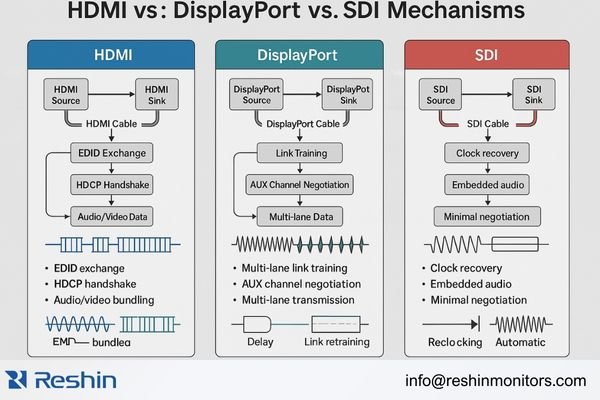
Through my field experience with unstable installations, this comparative view helps teams predict where instability is most likely to appear:
| Feature | HDMI | DisplayPort | SDI |
|---|---|---|---|
| Handshake/Negotiation | EDID/HPD, optional HDCP | Link training + AUX negotiation | Minimal negotiation; clock recovery |
| Switching Behavior | Can vary by sink/EDID/HDCP | Can retrain on topology changes | Typically predictable with proper routing |
| Distance Practicality | Often limited on copper at high bandwidth | Moderate; depends on extender design | Typically strong with correct cable plant |
| EMI Sensitivity3 | Higher on copper runs | Moderate on copper runs | Lower in well-built coax paths |
| Operational Predictability | Depends on EDID/HDCP control | Depends on training stability | Depends on conditioning and standards match |
The key engineering point is that identical resolution and frame rate do not guarantee identical behavior: negotiation timing, link margin, and how distribution devices retime/reclock determine both image continuity and recovery time when something changes.
Choosing the right transport: HDMI vs DisplayPort vs SDI for OR workflows
Selecting the optimal video transport requires aligning transport behavior with workflow demands, room constraints, and maintainability expectations.
The choice between HDMI, DisplayPort, and SDI should be driven by specific OR workflow demands: SDI commonly fits long-distance routing and multi-drop distribution, while HDMI and DP are often used at device and IT/PC edges. Stability depends on matching switching speed, distance, interference exposure, and recovery expectations to the transport and the distribution architecture.

When I design OR video systems, I evaluate each transport against operational constraints that directly affect stability:
Distance and Distribution Needs
SDI is frequently used as a facility-friendly backbone when long runs, multi-room routing, or multi-drop distribution4 needs to remain predictable, provided the cable plant and conditioning are done to standard. HDMI and DP remain common where sources are device outputs or workstation graphics, but they require disciplined EDID control, stable switching modes, and well-specified extender/matrix behavior to avoid renegotiation surprises.
Clinical Workflow Impact
Switching speed, recoverability, and output consistency must match how the surgical team works. A system that “works most of the time” in a lab can still fail clinically if switching recovery is unpredictable, if endpoints appear/disappear, or if distribution paths are modified during maintenance. The transport strategy should be chosen alongside a commissioning plan that proves worst-case switching and recovery behavior in the final room.
Implementation blueprint: splitters, matrices, extenders, and redundancy for stability
Even the best transport choice can fail without architecture discipline, controlled negotiation behavior, and a validation process that makes performance repeatable.
A stable OR video distribution system requires deliberate implementation of key components: strategic placement of signal conditioning, controlled EDID and hot-plug behavior, robust grounding and EMI mitigation, and planned redundancy for critical viewing positions. Treat video distribution as a complete engineered system with measurable acceptance criteria—not a set of independent cables and boxes.
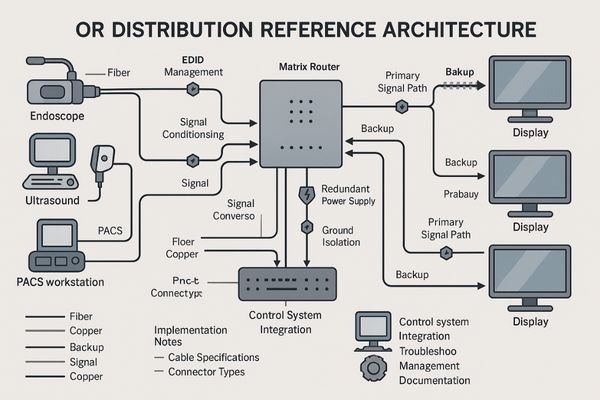
Implementation checklist:
- Constrain conversion boundaries and minimize uncontrolled multi-hop conversions across the path
- Specify where retiming/reclocking and equalization must occur at bandwidth-critical points
- Lock EDID profiles and define hot-plug behavior to prevent repeated renegotiation or retraining
- Treat HDCP5 as an explicit requirement (or explicitly excluded) and validate with all endpoints present
- Prefer fiber where distance, EMI zones, or ground-risk conditions can erode copper stability margins
- Define primary and backup routes for critical viewing positions and validate fast fallback behavior
- Commission with worst-case resolution/frame rate, repeated switching, power-sequence testing, and documented recovery-time expectations
If you want an engineering review to identify instability triggers and define commissioning acceptance criteria before go-live, contact our team.
Reshin surgical display portfolio for multi-input HDMI, DP, SDI ecosystems
Mixed-signal OR environments benefit when endpoint behavior is predictable, integration boundaries are clear, and routing plans support both daily operation and service maintenance.
Reshin’s surgical displays can be selected by clinical role and integration pattern so the overall system remains stable under switching, peak bandwidth, and real-room constraints. In many projects, HDMI/DP are used at endpoints, while SDI is handled as a backbone through routing and controlled conversion into the display-side interface; the practical goal is consistency in recovery behavior and maintenance repeatability rather than relying on assumptions about a single “best” transport.
| Clinical Role | Usage Pattern | Integration Pattern | Recommended Model | Engineering Considerations |
|---|---|---|---|---|
| Teaching/Overview | Frequent multi-source viewing | Backbone routing + controlled endpoints | MS550P | Validate switching recovery under peak routing load |
| Primary OR Display | Critical viewing continuity | Defined primary/backup routing plan | MS430PC | Plan redundancy at the routing layer and test failover behavior |
| Near-field Clinical | Consistent image evaluation | Stable endpoint negotiation behavior | MS321PB | Verify EDID profiles and endpoint stability across all sources |
| Auxiliary Display | Flexible positioning | Simple, well-bounded connections | MS270P | Reduce conversion hops and keep paths serviceable |
FAQ
Is SDI always more stable than HDMI or DisplayPort in the OR?
SDI is often more predictable for long runs and multi-drop distribution because it avoids complex endpoint handshakes, but stability still depends on correct standards matching, good terminations, and appropriate reclocking/conditioning. HDMI/DP can be highly stable when EDID, switching behavior, and extender/matrix design are engineered end-to-end.
Why do black screens happen when switching sources through a matrix?
Black screens typically come from renegotiation events such as EDID changes, HPD toggling, DP link retraining, or HDCP authentication delays. Stabilizing EDID profiles, controlling hot-plug behavior, and selecting predictable switching modes usually reduces recovery time dramatically.
Should HDCP be avoided in surgical video distribution?
If protected content is not required, HDCP often adds avoidable risk by blocking downstream devices or increasing handshake time during switching. The safer approach is to ensure sources and configurations do not unexpectedly enforce HDCP, and to validate switching behavior with all endpoints connected.
When is fiber a better choice than copper for distribution?
Fiber is typically preferred for long distance, strong EMI immunity, and reduced ground-loop sensitivity across electrically noisy OR zones. Copper can be adequate for shorter, controlled runs, but becomes more sensitive to connector wear, bend radius, and interference as bandwidth and distance increase.
How can we validate stability before go-live in an OR?
Run a worst-case acceptance plan: highest required resolution/frame rate, repeated source switching, power sequencing tests, simultaneous endpoint loads, and EMI-stress scenarios. Measure recovery-time behavior and then freeze the final EDID/switching configuration in commissioning documentation.
Conclusion
Achieving stable surgical display performance requires understanding how video transport behaviors interact with real OR distribution architectures. HDMI and DisplayPort stability depends on controlled negotiation (EDID, hot-plug behavior, training) and sufficient signal margin through extenders and matrices, while SDI-based routing can be more predictable when the cable plant and conditioning are correctly implemented.
At Reshin, we help integrators and healthcare facilities define transport boundaries, select distribution components for predictable switching behavior, and commission systems with repeatable acceptance criteria—contact our team to review your OR video distribution strategy.
✉️ info@reshinmonitors.com
🌐 https://reshinmonitors.com/
-
Exploring signal margin can enhance your knowledge of display technology and its reliability in critical environments. ↩
-
Understanding the causes of image flicker can help you troubleshoot and improve video quality in your systems. ↩
-
Exploring this topic can help you mitigate interference and improve signal integrity. ↩
-
Understanding multi-drop distribution can enhance your knowledge of AV systems and improve installation efficiency. ↩
-
Understanding HDCP is crucial for ensuring secure digital content transmission and preventing unauthorized access. ↩