In modern microsurgical visualization workflows, otologic procedures introduce uniquely demanding latency requirements due to extreme precision needs, confined surgical fields, and reliance on display‑based hand–eye coordination where millisecond delays can directly influence patient safety.
Otologic microsurgery relies more on low‑latency surgical monitors because even minimal delays of 50–100 milliseconds can cause surgical instruments to overshoot intended movements during high‑magnification operations within tight anatomical spaces. These procedures require instantaneous visual–motor synchronization, and latency disrupts precision, reduces surgeon confidence, and increases the risk of unintended trauma to delicate structures such as ossicles, cochlea, and facial nerve pathways.
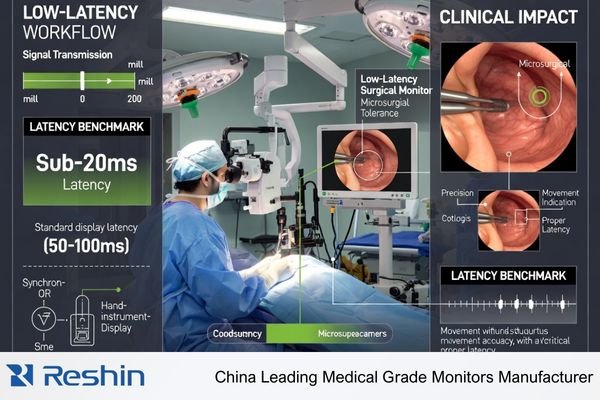
In clinical engineering support environments, successful otologic monitor selection1 depends on understanding that these procedures operate within surgical fields only a few millimeters in diameter. Surgeons rely on high-definition endoscopes or microscopes while manipulating micro-instruments in dynamic, space-constrained environments where any visual–motor mismatch can lead to disproportionate clinical consequences. These high-stakes environments make visualization tools not just auxiliary devices, but essential extensions of the surgeon’s perception.
What challenges are unique to otologic microsurgery?
Otologic microsurgery presents exceptional challenges due to anatomical constraints and extreme precision requirements.
Otologic microsurgery involves delicate anatomical structures such as the ossicles, cochlea, and facial nerve, often within surgical fields smaller than a few millimeters. Procedures demand precise hand–eye coordination and high-magnification visualization, where surgeons operate through microscopes or endoscopes while managing micro‑instruments in a confined area. Any delay or mismatch between the surgeon’s movement and the on-screen representation can cause micro‑scale errors with significant consequences, including hearing damage or nerve injury.
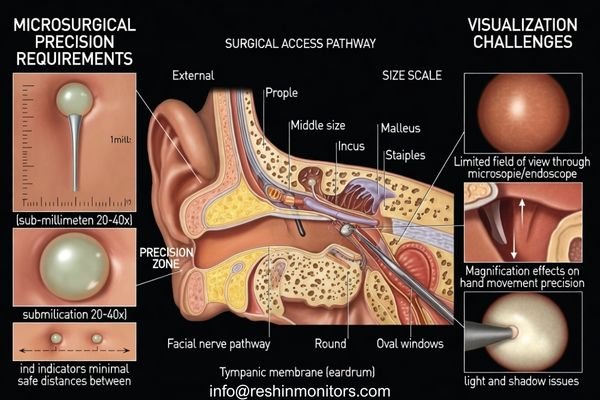
In such high-precision settings, even subtle hand tremors or timing discrepancies can be amplified by optical magnification systems. The inner ear’s complex anatomy offers little room for error, and visual accuracy becomes the difference between a successful procedure and permanent patient impact. These unique clinical demands place otologic microsurgery among the most latency-sensitive applications of surgical display technology.
Anatomical Precision Demands
The tightly confined surgical space means microscopic instrument movements must be represented on-screen without temporal deviation. Surgeons depend on real-time visual feedback2 that accurately reflects instrument position relative to critical structures, leaving no tolerance for display-induced lag. This real-time visual feedback loop must remain consistent throughout the operation to avoid momentary lapses in spatial awareness.
Magnification Amplification Effects
High-magnification systems amplify not only anatomical visibility but also any latency-driven disconnection between surgeon intention and visual confirmation. This amplification effect makes precise timing exponentially more important compared with conventional surgical procedures. A minor delay can become a major clinical deviation when working at 20x–40x magnification levels under otologic microscopes.
How does latency affect surgical precision and safety?
Latency creates a critical disconnect between visual input and tactile response during microsurgical operations.
In microsurgery, latency induces a visual–motor mismatch where delays of even 50–100 milliseconds can cause instruments to overshoot or lag behind intended movements. Under high magnification, small discrepancies become exaggerated, disrupting surgical rhythm and increasing the risk of unintentional trauma. In procedures involving the labyrinth or neurovascular pathways of the ear, such risks are further intensified, making latency minimization essential for patient safety.
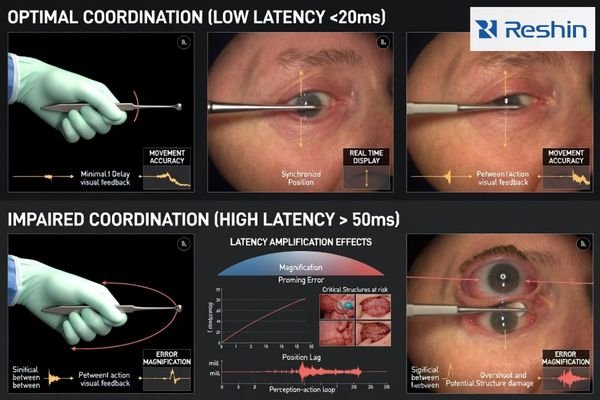
These latency-driven effects not only impair precision but also erode the surgeon’s situational confidence. In procedures requiring continuous micro-adjustments—such as navigating the round window during cochlear implantation—any latency forces the brain to compensate, which can lead to fatigue or decision hesitation. Ultimately, latency transforms from a technical specification into a safety-critical factor.
In latency‑sensitive procedures, any temporal offset between instrument action and displayed position can accumulate over repeated movements. During long or technically demanding phases of otologic surgery3, this cumulative effect can compromise positioning accuracy and disrupt workflow consistency, especially when reorienting instruments in complex three-dimensional ear anatomy.
What features define a low-latency surgical monitor?
Low-latency surgical monitors integrate specialized engineering optimized for real‑time signal processing and predictable visual response.
A low‑latency surgical monitor typically achieves sub‑20ms total delay through rapid A/D conversion, high‑speed video signal paths, and FPGA‑based processing pipelines. Complementary features include frame‑synchronous refresh, minimal image buffering, progressive-scan support, and optical bonding with anti‑glare coatings to maintain consistent visual clarity under OR lighting. These combined engineering factors ensure accurate color performance, stable luminance, and reliable real-time display behavior.
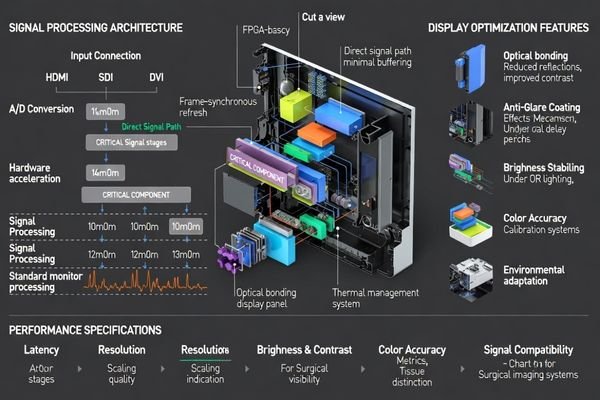
Such systems must not only minimize latency but also remain stable under variable OR lighting, complex signal chains, and prolonged use. Effective monitors use fanless cooling4 to reduce noise and particle generation while preserving thermal efficiency. They are also designed to support common OR input standards—HDMI, SDI, DVI—ensuring seamless integration with diverse surgical imaging systems.
Real-time surgical visualization depends on hardware-accelerated processing paths that minimize delay from input to display. When engineered properly, these components allow the monitor to keep pace with the surgeon’s instantaneous decision-making during microsurgical manipulation without introducing artifacts or temporal distortion.
In what clinical scenarios is low-latency most critical?
Low‑latency visualization is vital in procedures combining real-time imaging with precision instrument control.
Low‑latency display is essential not only in otologic microsurgery but also across endoscopic, microscopic, and image-guided procedures requiring precise visual–motor synchronization. This includes cochlear implantation, stapedectomy, tympanoplasty, skull-base neurosurgery, endonasal surgery, and robotic-assisted otolaryngology. Whenever surgeons rely on screen-based visualization to perform micro‑level movements in restricted spaces, low-latency monitors help minimize risk and preserve control.
In these workflows, visual-tactile alignment5 is not just a convenience—it’s a surgical control mechanism. High latency disrupts this feedback loop and can impair tissue dissection precision, especially near vascular or nerve-rich regions. For example, in robotic ENT procedures, where instrument movements are remotely actuated, display delay can magnify system lag and lead to coordination mismatches.
Latency becomes especially significant in surgeries requiring continuous, high‑accuracy movement under magnification. In such workflows, even small timing discrepancies can accumulate into clinically meaningful positioning deviations over time, particularly during delicate structure manipulation or device implantation.
Cochlear Implantation Procedures
Cochlear implant electrode insertion demands real-time visualization to prevent basilar membrane or cochlear structure damage. Latency can cause electrodes to advance before visual confirmation reflects the true position, increasing the risk of unintended penetration or misalignment. The feedback loop must be immediate for successful depth control within cochlear turns.
Stapedectomy and Ossicular Reconstruction
These procedures involve manipulating anatomical structures measured in fractions of millimeters. Latency‑related overshooting can compromise prosthesis stability or damage remaining ossicles, directly affecting postoperative auditory outcomes. Accurate real-time imaging helps surgeons preserve residual function and avoid iatrogenic harm.
Choosing the right monitor for otologic microsurgery
Monitor selection for otologic microsurgery requires balancing latency performance with clinical workflow integration.
Effective selection strategies prioritize real-time responsiveness, visual fidelity, and compatibility with the entire surgical imaging chain.
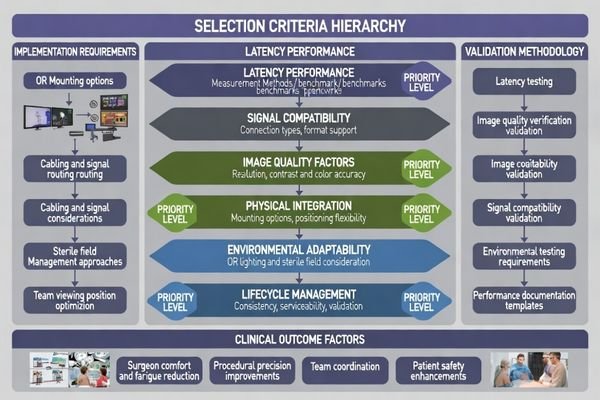
Selecting surgical monitors for otologic microsurgery requires evaluating multiple factors including latency, native resolution, color accuracy, compatibility with endoscope or microscope outputs, environmental adaptability, and mounting requirements within sterile zones.
In addition to technical performance, environmental integration matters—monitors must be suitable for boom-arm, ceiling, or wall mounting to maintain sterility and optimal ergonomics. Signal compatibility should support common modalities with seamless switching between video sources. Systems with optical bonding enhance image contrast and reduce glare, aiding focus under strong surgical lighting.
Serviceability, lifecycle consistency, and on-site calibration support further differentiate medical-grade displays from commercial alternatives. Institutions should ensure latency remains within safe margins even after long-term use, and that validation tests—such as input-to-display timing—can be repeated during preventive maintenance.
| Clinical Role / Application | Usage Pattern | Display Requirements | Recommended Model | Key Integration Considerations |
|---|---|---|---|---|
| Primary Microsurgery Display | Direct surgeon visualization | Ultra-low latency, precise scaling | MS192SA | Sub‑20ms response, stable processing |
| Assistant Coordination | Team surgical support | Consistent real-time display | MS220SA | Synchronized viewing, minimal lag |
| Multi-Position Flexibility | Various OR configurations | Reliable low-latency performance | MS270P | Predictable timing, mounting compatibility |
| Advanced Microsurgery | High‑magnification procedures | Superior latency optimization | MS321PB | FPGA processing, medical shielding |
| Comprehensive OR Integration | Multi-modal surgical support | Large-format low‑latency display | MS430PCMS192SA | Extended compatibility, stable performance |
FAQ
What is considered an acceptable latency range for surgical monitors?
Ideally below 20ms for real-time critical procedures; anything above 50ms may introduce visible lag.
Are low-latency monitors only necessary for otologic surgery?
No, they are essential in all high-precision surgeries involving real-time imaging and delicate manipulation.
Can standard commercial monitors be used instead?
No, commercial monitors lack medical certifications, appropriate shielding, and the latency optimization required for surgical workflows.
Is 4K resolution always better for otologic procedures?
Not always. While 4K can enhance detail, it must be paired with proper latency performance and signal compatibility.
How do I maintain the performance of a surgical monitor?
Regular cleaning with medical-grade disinfectants and periodic calibration help maintain consistent performance over time.
Conclusion
Otologic microsurgery demands extraordinary precision where visual and motor coordination must remain perfectly synchronized in real time. Low‑latency surgical monitors serve not merely as display devices but as clinical performance enablers that support surgical safety, reduce the risk of timing-related errors, and improve procedural consistency within anatomical spaces measured in millimeters.
Experience from integrated OR visualization projects shows that successful otologic surgery monitor implementations depend on combining ultra‑low latency processing, medical-grade environmental adaptation, and workflow-aligned integration that ensures reliable real-time performance. When visualization systems eliminate temporal disconnection between surgeon intention and screen representation, healthcare teams can achieve the precision that otologic microsurgery requires while advancing minimally invasive surgical standards and improving patient outcomes.
✉️ info@reshinmonitors.com
🌐 https://reshinmonitors.com/
-
Understanding otologic monitor selection is crucial for ensuring optimal surgical outcomes in complex environments. ↩
-
Discover the significance of real-time visual feedback in surgical procedures, ensuring accuracy and patient safety during operations. ↩
-
Exploring the challenges in otologic surgery can provide insights into improving techniques and patient outcomes. ↩
-
Explore how fanless cooling enhances monitor performance by reducing noise and improving thermal efficiency. ↩
-
Understanding visual-tactile alignment is crucial for improving surgical precision and outcomes, especially in delicate operations. ↩