A monitor’s declining contrast ratio isn’t just a minor inconvenience; it directly impacts image clarity. For medical professionals, this degradation can obscure vital details, potentially affecting clinical decisions and patient care outcomes.
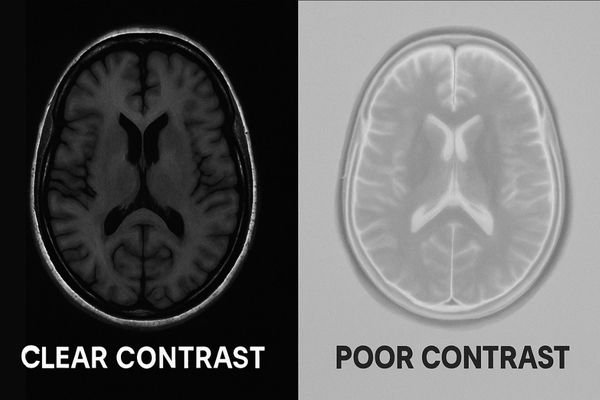
When a monitor’s contrast ratio declines, images appear washed out, and the ability to distinguish between subtle shades of gray or color diminishes significantly. This flattening of visual depth particularly compromises grayscale-heavy modalities like X-rays and CT scans, potentially leading to missed diagnoses or misinterpretations.
Understanding these changes is crucial for maintaining diagnostic accuracy and ensuring optimal patient care. Let’s delve into the implications.
How does contrast ratio affect the visibility of medical images?
Struggling to differentiate subtle tissues or anomalies on a screen? This could be a contrast issue, hindering your ability to see critical details clearly, which is vital.
Contrast ratio defines a display’s ability to show the brightest whites and deepest blacks. A higher ratio means better differentiation of subtle grayscale steps and color nuances, crucial for detailed medical image interpretation.
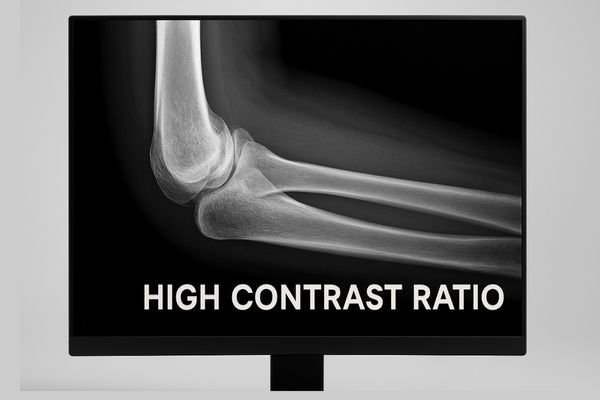
Contrast ratio is a fundamental specification of any display, measuring the luminance difference between the whitest white (Lmax) and the darkest black (Lmin) a monitor can produce (Lmax/Lmin). In medical imaging, this isn’t just a technical number; it’s a direct determinant of how well a clinician can perceive fine details. A high contrast ratio1 allows for a wider gamut of distinguishable shades, making subtle variations in tissue density or structure more apparent.
For grayscale-dominant modalities2 like X-ray, CT, and MRI, which form the backbone of diagnostics, the ability to discern minute differences in gray levels is paramount. For example, our Reshin MD26GA 2MP or MD33G 3MP diagnostic monitors3 are designed with high contrast to ensure these subtle findings are not lost. A declining contrast ratio would compress these grayscale steps, making it harder to identify faint nodules, hairline fractures, or subtle edemas. Similarly, in color imaging, such as endoscopy or ultrasound, a robust contrast ratio helps preserve the vividness and separation of colors, aiding in the identification of tissue vascularity, inflammation, or other chromatic cues. Our surgical displays, like the Reshin MS275P 27" 4K Surgical Monitor, leverage high contrast to provide surgeons with clear, distinct views of the operative field.
What clinical risks are associated with low contrast in displays?
Imagine subtle pathologies being overlooked due to a suboptimal display. This isn’t just a theoretical concern; low contrast introduces real clinical risks, potentially delaying crucial interventions.
Low contrast significantly increases risks of misinterpretation, missed pathologies, or delayed diagnoses, particularly in imaging studies where subtle density or texture differences are key diagnostic indicators.
The clinical risks stemming from insufficient contrast on a medical display are serious and can directly impact patient outcomes. When a monitor cannot accurately render the full spectrum of grays or colors present in an image, critical information can be effectively lost.
-
Misinterpretation and Missed Pathologies: This is the most significant risk.
- Radiology & Mammography: Subtle signs of early disease, such as faint microcalcifications in mammograms (critical for early breast cancer detection, a key application for our Reshin MD52G 5MP Grayscale Mammography Monitor) or low-density lesions in CT scans, might become indistinguishable from surrounding tissue.
- Neurology: Differentiating between gray and white matter, or identifying subtle ischemic changes in brain imaging, requires excellent contrast. Poor contrast can obscure these vital distinctions.
- Vascular Imaging: Clear delineation of vessel walls, plaque, or stenoses is essential. Low contrast can make these features indistinct, potentially leading to an underestimation of disease severity.
- Surgical Settings: During endoscopic or minimally invasive surgery, displays like our Reshin MS321PB 32" 4K Surgical Monitor must provide excellent contrast to help surgeons distinguish between different tissue planes, identify small bleeders, or assess tissue viability. Low contrast reduces this crucial visibility.
-
Delayed Diagnosis: If subtle findings are missed, diagnosis can be delayed, allowing a condition to progress.
-
Reduced Diagnostic Confidence: Clinicians may feel less confident in their interpretations, potentially leading to more tests, increased patient anxiety, and higher healthcare costs.
For diagnostic monitors, maintaining adherence to standards like DICOM Part 14 Grayscale Standard Display Function (GSDF)4 is crucial, as this standard ensures perceptually linear grayscale rendering, which relies heavily on stable contrast performance.
Can aging or long-term use reduce contrast performance?
Are your older monitors performing as well as they did new? It’s easy to assume consistent performance, but display components inevitably age, potentially compromising image quality unnoticed.
Yes, components like the backlight system and the liquid crystal panel itself degrade over time, leading to reduced peak brightness and potentially increased black levels, thereby lowering the contrast ratio.
Indeed, like most electronic components, medical displays are subject to aging and wear from long-term use, which can lead to a decline in contrast performance. This degradation is often gradual and might not be immediately obvious without specific testing, but it can significantly impact diagnostic accuracy over time.
Several factors contribute to this:
- Backlight Aging5: This is a primary contributor.
- Older CCFL (Cold Cathode Fluorescent Lamp) backlights were particularly prone to dimming significantly over their lifespan, directly reducing Lmax (maximum luminance). Their color temperature could also shift, affecting perceived image quality.
- Modern LED (Light Emitting Diode) backlights, while more durable and stable, also experience a gradual decrease in luminance over many thousands of hours of use. Even a slight reduction in peak brightness, if the black level remains constant or worsens, will lower the contrast ratio.
- Panel Fatigue and Degradation6: The liquid crystal material within the panel can degrade over time due to prolonged operation, heat, and electrical stress. This can manifest as an increase in Lmin (the black level), meaning blacks become less deep and more grayish. Polarizing films, essential for LCD operation, can also deteriorate.
- Pixel Defects: While not directly a contrast ratio decline for the entire panel, the appearance of stuck (always on) or dead (always off) pixels can locally disrupt image integrity and contrast perception in specific areas.
- Internal Dust Accumulation: Over time, dust can accumulate on internal optical surfaces7, scattering light and potentially reducing contrast by increasing the perceived black level.
To combat these aging effects, Reshin diagnostic monitors, such as the advanced MD120C 12MP High-Precision Diagnostic Monitor, often incorporate features like integrated front sensors and automatic calibration systems. These systems monitor luminance and adjust settings to maintain consistent image quality and DICOM compliance throughout the monitor’s lifespan, ensuring that contrast performance remains within acceptable clinical standards.
How does Reshin maintain high contrast across its surgical display lineup?
In the demanding OR, visual clarity is non-negotiable. Compromised contrast can hinder surgeons, so how do we ensure our displays consistently deliver the required image depth and sharpness?
Reshin employs high-specification panels, advanced proprietary image processing, uniform brightness technology, and robust designs to deliver and maintain superior contrast performance in its surgical displays for critical OR environments.
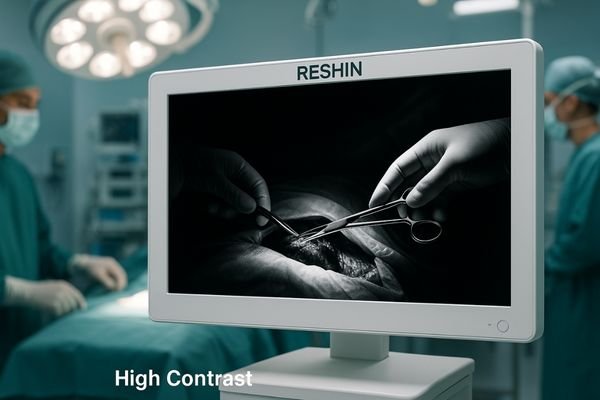
Maintaining consistently high contrast in our surgical displays, from the versatile MS220S 22" FHD Endoscopic Monitor to the large-format MS550P 55" 4K Surgical Monitor, is a cornerstone of Reshin’s design philosophy. We achieve this through a multi-faceted approach, leveraging our extensive R&D capabilities and over 100 technology patents:
-
Selection of High-Quality Panels8: We start by sourcing LCD panels with inherently high native contrast ratios and wide viewing angles (often utilizing IPS or VA-type technologies). These panels are chosen for their ability to produce deep blacks and brilliant whites, forming the foundation for superior image quality.
-
Advanced Image Processing9: Our displays incorporate Reshin’s "intelligent image processing" algorithms. These sophisticated systems analyze and optimize the incoming video signal in real-time to enhance detail, sharpness, and, crucially, dynamic contrast. This ensures that even subtle differences in tissue texture or color are clearly discernible.
-
Uniform Brightness Regulation10: Uneven brightness across a screen can negatively impact perceived contrast and lead to misinterpretation. Our surgical displays, like the MS430PC 43" 4K Surgical Monitor, feature specialized backlight systems and control mechanisms to ensure exceptionally uniform illumination. This eliminates "hot spots" or dimmer areas, providing a consistent canvas for critical imagery, directly addressing a common pain point of uneven brightness reported by users like heads of OR equipment procurement.
-
Robust Design for the Operating Room Environment:
- Anti-Glare/Anti-Reflective Coatings: Bright overhead surgical lights can easily wash out images on standard displays. Our monitors feature advanced coatings to minimize reflections and scatter, preserving contrast even in high ambient light conditions.
- Sealed and Durable Construction: Casings are designed to protect internal components from fluids and frequent cleaning, ensuring long-term performance stability.
This meticulous attention to detail in material selection, technological integration, and design ensures that Reshin surgical displays deliver the consistent, high-contrast images surgeons rely on for precision and safety.
What technologies help stabilize contrast ratio in high-usage environments?
Given that contrast can degrade, what stops medical displays from quickly becoming unreliable? Active technologies are crucial for maintaining performance through extensive daily use in busy clinical settings.
Technologies like integrated front sensors for auto-calibration, dynamic gamma/LUT adjustments, backlight stabilization, and ambient light sensing actively work to maintain consistent contrast and image quality over time.
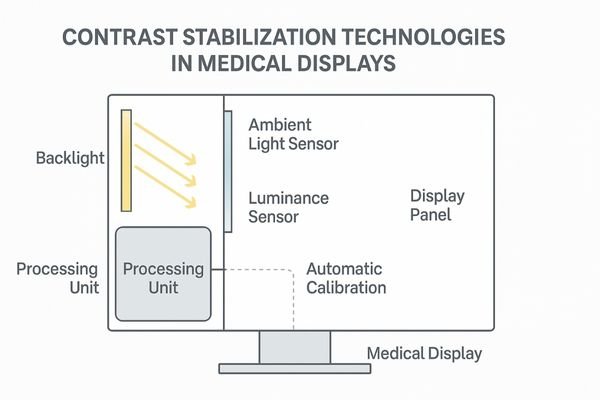
To counteract the natural tendency of contrast ratio to decline with age and usage, especially in high-demand environments like hospitals, medical display manufacturers, including Reshin, implement several sophisticated stabilization technologies. These are vital for ensuring long-term diagnostic and surgical image quality:
-
Integrated Calibration Sensors11: Many high-end diagnostic monitors, such as Reshin’s 8MP Diagnostic Display and MD51CHY 34" 5MP Diagnostic Monitor, feature built-in front sensors or photometers. These sensors periodically measure the screen’s luminance output (both white and black levels) and color accuracy. The system then automatically adjusts backlight intensity and Look-Up Table (LUT) values to compensate for any drift, ensuring continued compliance with standards like DICOM GSDF and maintaining a stable contrast ratio.
-
Backlight Stabilization and Uniformity Correction12: Sophisticated circuitry monitors and regulates the LED backlight output to maintain consistent brightness levels over thousands of hours and across varying ambient temperatures. Furthermore, uniformity correction technologies map the screen’s brightness at multiple points and make micro-adjustments to ensure even illumination, which is critical for accurate contrast perception across the entire display.
-
Dynamic Gamma and LUT Adjustments13: Beyond static calibration, some displays employ dynamic systems that can adjust gamma curves or LUTs in real-time based on the image content being displayed or feedback from sensors. This optimizes grayscale rendering and perceived contrast for different types of medical images.
-
Thermal Management: Overheating can accelerate the aging of display components. Effective thermal management systems, including strategically placed heat sinks and sometimes active cooling, help maintain stable operating temperatures. This not only prolongs the life of the backlight and panel but also contributes to more consistent performance, addressing a common pain point related to display overheating.
-
Ambient Light Sensors (ALS): While primarily for optimizing brightness for viewing comfort and accuracy, ALS can also work in conjunction with other systems to ensure that perceived contrast remains optimal under varying room lighting conditions.
These technologies, often part of our OEM/ODM solutions for partners, are crucial for delivering displays that medical professionals can trust for consistent, reliable performance throughout their extended operational life.
Conclusion
A declining contrast ratio severely degrades medical image quality, risking diagnostic accuracy. Reshin’s commitment ensures our displays maintain high, stable contrast, supporting precise clinical decisions and optimal patient care. To secure medical displays with consistently high contrast performance, contact Reshin at martin@reshinmonitors.com.
-
Understanding contrast ratio is crucial for evaluating display quality, especially in medical imaging where detail perception is vital. ↩
-
Learn about the significance of grayscale modalities like X-ray and MRI in diagnostics and their reliance on contrast for detail. ↩
-
Explore how advanced diagnostic monitors enhance image clarity and detail, essential for accurate medical assessments. ↩
-
Understanding GSDF is essential for ensuring accurate grayscale rendering in medical displays, which directly impacts patient outcomes. ↩
-
Understanding backlight aging is crucial for maintaining image quality in medical displays. Explore this link for in-depth insights. ↩
-
Panel fatigue can significantly impact diagnostic accuracy. Learn more about its effects and solutions by exploring this resource. ↩
-
Dust accumulation can degrade display performance. Discover how to mitigate this issue for better image quality in medical settings. ↩
-
Explore how high-quality panels enhance image quality and contrast in surgical monitors, crucial for precision in medical settings. ↩
-
Learn about the role of intelligent image processing in enhancing detail and contrast, vital for surgical accuracy. ↩
-
Discover the significance of uniform brightness in surgical displays to prevent misinterpretation and ensure clarity during operations. ↩
-
Explore how Integrated Calibration Sensors enhance image quality and compliance in medical displays, ensuring accurate diagnostics. ↩
-
Learn about the importance of backlight stabilization in maintaining consistent brightness and contrast in medical imaging. ↩
-
Discover how Dynamic Gamma and LUT Adjustments optimize image quality for various medical applications, enhancing diagnostic accuracy. ↩