A faint, lingering image can mimic a real finding, creating diagnostic confusion. This risk, known as image retention, erodes clinical trust and compromises patient safety if not properly managed.
Ghosting (temporary LCD persistence) and burn-in (permanent OLED damage) both erode clinical trust. Lower-quality panels need harder drive, age unevenly, and retain static UI sooner. Control the chain: medical-grade IPS, luminance stabilization, AR-bonded optics, ambient-light compensation, clean 12G-SDI/HDMI 4:4:4, and QA logs. Tie luminance to room lux and validate multi-view. Manage stress—not just brightness.
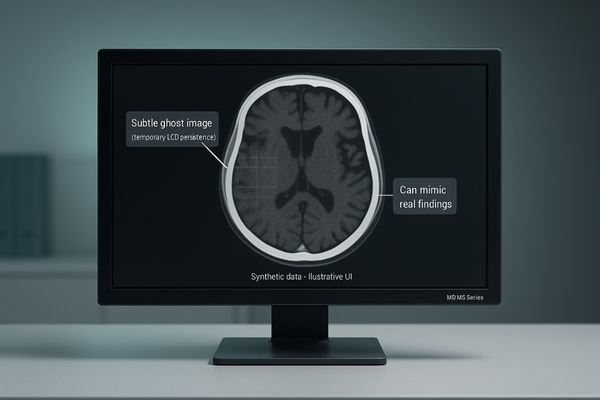
Image retention can manifest in two distinct ways: temporary "ghosting" common to LCD panels, and permanent "burn-in1" associated with OLED technology. While the underlying mechanisms differ, both issues degrade diagnostic confidence by introducing visual artifacts. This problem is exacerbated by the demanding nature of clinical workflows, where static user interfaces are often displayed at high brightness for extended periods. A proactive approach to managing this risk begins with understanding its root causes and extends to specifying displays with built-in resilience. The quality of the panel, its thermal management, and its calibration systems are all critical factors that determine a display’s ability to resist image retention2 over its service life.
Ghosting vs Burn-In in Healthcare: LCD IPS vs OLED Mechanisms
A faint afterimage on a screen can be mistaken for pathology. This image retention, whether temporary ghosting or permanent burn-in, directly undermines diagnostic reliability and clinical trust.
Ghosting is temporary pixel persistence on LCDs, while burn-in is permanent pixel degradation on OLEDs. In healthcare, prioritizing medical-grade IPS panels with luminance stabilization is key to managing retention risks.
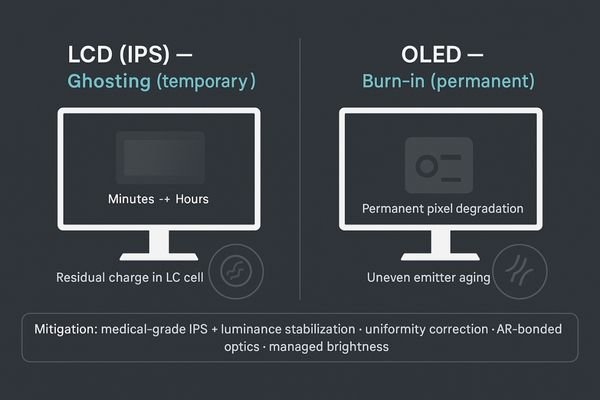
Understanding the difference between ghosting3 and burn-in is crucial for selecting the right display technology for a given clinical application. Ghosting, which primarily affects LCD IPS panels, is a temporary phenomenon where a faint trace of a previous image remains visible. It is caused by a residual charge buildup that affects the alignment of liquid crystals. In contrast, burn-in is a permanent change that occurs in self-emissive technologies like OLED, where organic compounds degrade unevenly over time, leading to a permanent change in light output. In medical environments, where displays like the MD33G are used for long static reading sessions, managing this risk is paramount. A high-quality IPS panel with robust luminance stabilization and uniformity correction is often the preferred choice for diagnostic imaging. These features help ensure that any temporary image persistence remains below the perceptible threshold, preserving the integrity of the diagnostic image and the confidence of the reader.
High-Luminance & Static UI: OR/PACS Workflows That Amplify Image Retention
Operating rooms and reading rooms often require high brightness. When combined with static UI elements for hours, this creates the perfect storm for image retention, especially on lower-grade panels.
High luminance combined with static overlays in OR and PACS workflows accelerates image retention. Managing this risk requires workflow adjustments, ambient light control, and displays designed to operate safely at high brightness.
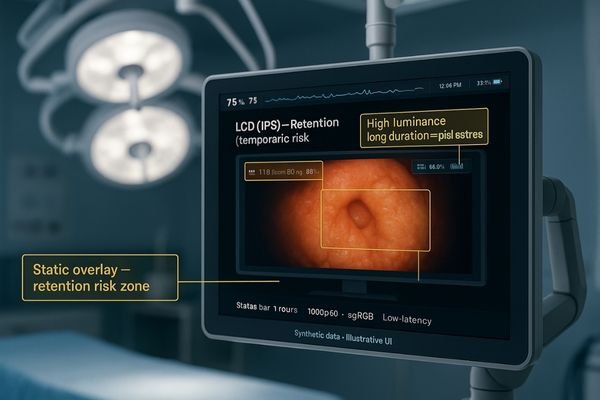
Certain clinical workflows significantly increase the risk of image retention4. In the operating room, surgical displays are often run at maximum brightness to overcome intense ambient light. When static overlays—such as port icons, patient vital signs, or a timeline—are displayed for the duration of a long procedure, the pixels in those areas are placed under constant stress. This is also true in PACS reading rooms, where UI elements and toolbars remain fixed for hours at a time. Lower-grade panels are particularly susceptible, as they may require more aggressive electrical drive to achieve and sustain high luminance, leading to faster thermal stress accumulation and more pronounced image persistence. To mitigate this, displays like the MS321PB are engineered with robust thermal management5 and superior optical designs, including AR glass and optical bonding. This allows them to produce a clear, bright image without being over-driven, reducing electrical stress and making them more resilient to the demands of these challenging workflows.
QA & DICOM Calibration: Luminance Stabilization to Curb Retention
A monitor that looks fine in the morning can show ghosting by evening. This drift occurs when luminance is not actively managed, placing uneven stress on the panel over a long day.
Automated luminance stabilization and routine QA are critical for curbing retention. These systems reduce electrical stress on the panel, ensuring pixels recover faster and performance remains consistent for long static sessions.
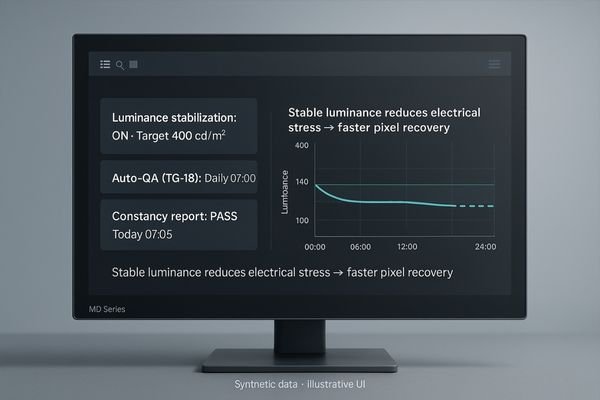
While DICOM Part 14 calibration ensures grayscale accuracy, it does not inherently prevent image retention. The key to mitigating this risk lies in active luminance management6. High-quality diagnostic monitors employ built-in stabilization systems that continuously monitor and adjust the backlight’s output. This ensures that the display maintains its target luminance consistently, preventing the need to "over-drive" the panel, which can accelerate aging and increase persistence. This technology is particularly valuable on multi-modality displays7 like the MD85CA, which are used for long sessions involving both static and moving images. By keeping the luminance stable and within its engineered targets, these systems reduce stress on the liquid crystals, allowing them to recover more quickly after displaying a static image. This active management, validated by routine quality assurance (QA) reports, is the most effective way to prevent the gradual onset of ghosting and maintain diagnostic confidence over the life of the display.
Optical Bonding, AR Glass & Thermal Path: Panel Design That Resists Retention
To compensate for glare, users often increase brightness to unsafe levels. This places excessive stress on the panel, accelerating image retention and shortening the display’s lifespan.
A superior panel design uses AR glass and optical bonding to improve clarity and thermal management. This allows the display to run at a lower, safer brightness level while reducing the risk of retention.
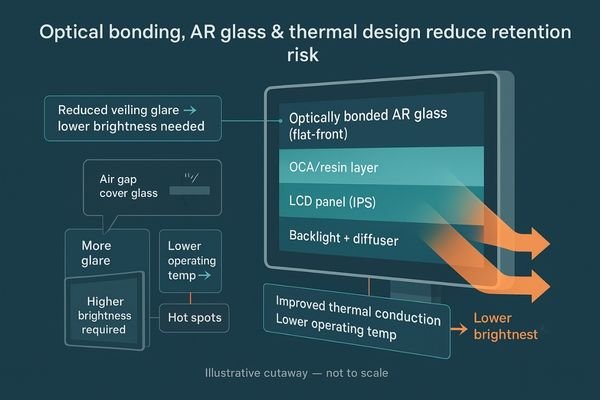
The physical construction of a medical display plays a significant role in its resilience to image retention. The process starts with a high-grade IPS panel8 that has well-aligned liquid crystals and finely tuned overdrive circuits to minimize "image sticking." This is then paired with a robust optical and thermal design. Anti-reflection (AR) glass9 reduces veiling glare from ambient light, which means users do not need to push the brightness to maximum levels to see the image clearly. When this glass is optically bonded to the panel, it further improves contrast and eliminates internal reflections. This bonding also creates a more efficient thermal path, helping to draw heat away from the LCD panel more effectively than an air gap would. For a surgical monitor like the MS322PB, this integrated design approach means it can deliver a bright, clear image with less electrical stress on its components. This reduces the operating temperature, which in turn minimizes the risk of temporary ghosting during long and demanding procedures.
Buyer’s Checklist: Specifying Medical Displays to Avoid Image Retention
Without clear specifications, you risk procuring displays that will develop retention issues. Generic marketing terms like "high brightness" do not guarantee long-term stability or performance.
To avoid image retention, use a detailed procurement checklist. Specify medical-grade IPS panels, luminance stabilization, AR-bonded optics, and automated QA features to ensure you acquire a resilient and reliable display fleet.
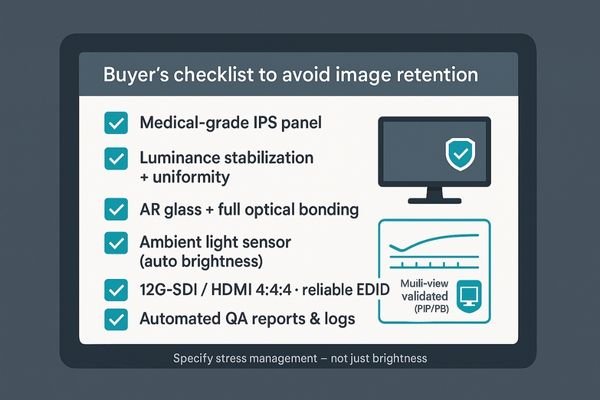
Turning the risk of image retention into a managed variable starts at the procurement stage. By including specific technical requirements in your tender documents, you can ensure that you are acquiring displays that are truly fit for clinical purpose. Your checklist should go beyond basic resolution and size to demand features that directly impact long-term reliability. Insist on high-grade IPS panels10 and active luminance stabilization with uniformity correction. Require displays with AR-coated glass and full optical bonding, and specify the need for integrated ambient light sensors11. Furthermore, the ability to export QA reports is crucial for auditing and lifecycle management. For high-demand applications like mammography, a monitor like the MD120C is designed with these principles at its core. By making these features non-negotiable requirements, you can build a display fleet that is resistant to image retention, ensuring consistent performance and protecting diagnostic confidence for years to come.
| Checklist Item | Why It Matters for Retention |
|---|---|
| Medical-Grade IPS Panel | Superior liquid crystal alignment and overdrive tuning reduce pixel "stickiness". |
| Luminance Stabilization | Prevents over-driving the panel, reducing electrical and thermal stress. |
| AR Glass & Optical Bonding | Reduces glare, allowing for lower, safer brightness levels and better thermal dissipation. |
| Automated QA Reporting | Provides auditable proof of long-term stability and performance consistency. |
| Ambient Light Sensor | Intelligently adapts brightness to room conditions, avoiding unnecessary stress. |
Conclusion
Managing image retention requires a focus on panel quality, active luminance stabilization, and a robust optical design that reduces the need for excessive brightness, ensuring long-term clinical trust. 🖥️
👉 For reliable, image-stable medical display solutions, contact martin@reshinmonitors.com.
-
Exploring burn-in prevention techniques can help maintain the longevity and performance of OLED displays in demanding environments. ↩
-
Understanding image retention is crucial for anyone using displays in clinical settings, as it impacts diagnostic accuracy. ↩
-
Understanding ghosting is essential for selecting displays that minimize image persistence, crucial in clinical settings. ↩
-
Understanding the causes of image retention can help improve display technology and enhance patient safety in clinical settings. ↩
-
Exploring thermal management techniques can provide insights into optimizing display longevity and performance in high-stress medical applications. ↩
-
Understanding active luminance management can help you appreciate how it prevents image retention and enhances display longevity. ↩
-
Exploring multi-modality displays will reveal their importance in handling diverse imaging tasks, ensuring accurate diagnostics. ↩
-
Understanding high-grade IPS panels can enhance your knowledge of medical display technology and its advantages. ↩
-
Exploring AR glass will reveal its crucial role in enhancing image clarity and reducing glare in medical environments. ↩
-
Explore this link to understand how high-grade IPS panels enhance image quality and reliability in clinical settings. ↩
-
Learn about the role of integrated ambient light sensors in optimizing display visibility and accuracy in varying lighting conditions. ↩