In surgery, blurry or trailing images on a monitor can obscure critical anatomy. This visual lag leads to uncertainty, increases cognitive strain, and heightens the risk of surgical errors.
Response time defines how quickly a medical-grade display reacts to visual changes, and in endoscopic surgery it directly impacts image clarity and surgical safety. A monitor with sub-30 ms response prevents blur and ghosting, ensuring that rapid camera motion, bleeding points, and delicate tissue structures remain sharp in real time.

In the world of medical displays, specifications like resolution and brightness often take center stage. However, a less-discussed but equally critical metric—response time1—plays a pivotal role in the safety and efficiency of dynamic procedures like endoscopy. This parameter determines how well a monitor can keep up with fast-moving video, directly influencing a surgeon’s ability to perceive motion without distracting artifacts. A slow display can introduce dangerous ambiguity, while a fast one provides the clarity needed for confident, precise action. This article will demystify response time, explaining what it is, why it matters in a clinical context, and how it differentiates a true medical-grade display2 from a standard consumer screen.
Understanding Response Time
The term "response time" is often used in marketing, but its clinical meaning is frequently misunderstood. This ambiguity can lead to purchasing decisions based on incomplete or misleading information.
In medical displays, response time is the speed at which a pixel can change color. Fast response preserves clarity in surgical video, while a slow response causes motion blur and ghosting.
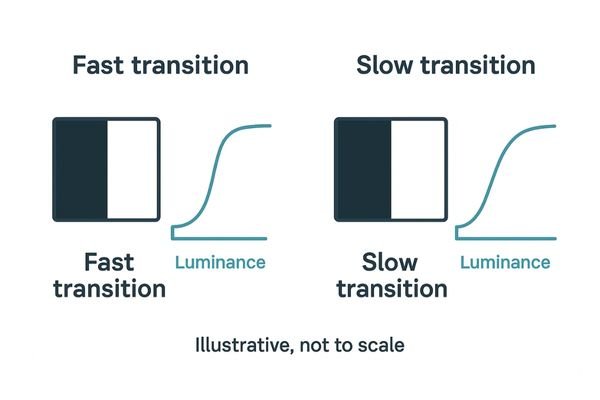
At its core, response time3 measures the speed of a display’s most fundamental action: a single pixel transitioning from one color or shade to another. In the context of an operating room, this technical detail has profound practical consequences. When an endoscope moves quickly, every pixel on the monitor must update instantly to render a sharp, clear image. If the pixels are too slow to keep up, they leave faint trails of their previous state, an effect known as "ghosting" or motion blur. This can obscure the fine edges of tissues, mask a small bleeding vessel, or make it difficult to track the tip of an instrument. For this reason, a key benchmark for surgical displays4 is a total response time under 30 milliseconds. Anything slower risks introducing visual artifacts that compromise the surgeon’s view. A monitor like the MS270P is engineered to meet this standard, ensuring that the image on the screen is a faithful, real-time representation of the surgical field, free from distracting motion-induced blur. This allows the surgical team to maintain focus and operate with a higher degree of precision and safety.
Consumer vs. Medical-Grade Monitors
Consumer gaming monitors often boast impressive response time figures, making them seem like a cost-effective alternative. However, these marketing claims can be dangerously misleading in a clinical environment.
Consumer monitors advertise fast response times but lack the calibration, stability, and durability for surgery. Medical-grade displays ensure consistent, accurate imaging through luminance stabilization and grayscale accuracy.
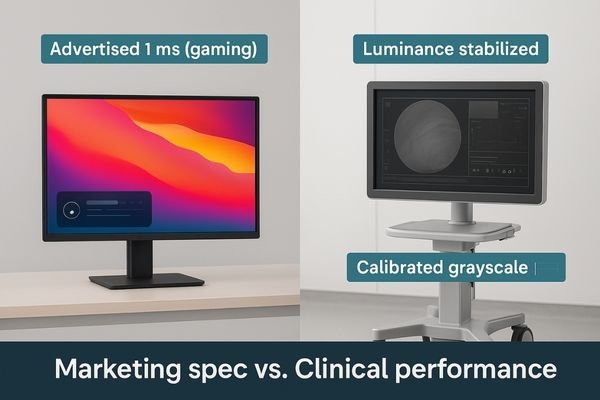
It is tempting to look at a consumer gaming monitor advertising a "1 ms" response time and consider it for clinical use. This would be a critical mistake. That figure is often based on ideal, non-clinical testing conditions and ignores the other essential performance characteristics required in surgery. A medical-grade display5‘s value comes from its holistic design for the clinical environment. It delivers not only a fast response time but also luminance stability, ensuring the screen’s brightness does not drift during a long operation. It maintains precise color and grayscale accuracy through factory calibration and adherence to medical standards, which is critical for accurate tissue identification. Furthermore, a surgical monitor6 like the MS220S features a sealed, durable housing designed to withstand rigorous cleaning protocols, along with a power supply and internal components built for 24/7 reliability. In contrast, a consumer monitor has none of these safeguards. Its performance is inconsistent, its colors are inaccurate, and it is not built to survive the rigors of the OR. Relying on it would introduce an unacceptable level of risk and variability.
Importance of Low Latency and Fast Pixel Response
In surgery, even a minuscule delay between the surgeon’s hand movement and the visual feedback on screen can be disorienting. This lag disrupts hand-eye coordination and increases the risk of error.
In endoscopic surgery, total latency must be extremely low, ideally under 50 ms. Fast pixel response and low input lag are essential for maintaining hand-eye coordination and ensuring surgical precision.

It is crucial to distinguish between two related but different concepts: pixel response time and input lag7. Response time, as discussed, is how quickly pixels can physically change. Input lag is the processing delay the monitor introduces as it receives the video signal and prepares it for display. The sum of these two factors creates the total latency—the perceptible delay between an event happening at the endoscope and it being shown on the screen. For endoscopic surgery, this total latency8 must be minimized. While there is no universal standard, a delay of over 100 milliseconds is generally considered disruptive, with an ideal target being under 50 milliseconds. High latency forces the surgeon to compensate for the lag, which increases cognitive strain and can lead to overcorrection or inaccurate movements. Therefore, a high-performance 4K surgical display like the MS275P is engineered to excel in both areas. It combines fast-switching pixels with an optimized, low-latency processing pipeline to ensure that the visual feedback is virtually instantaneous, allowing for a seamless and intuitive connection between the surgeon’s actions and the image they see.
Response Time Metrics: GtG vs. MPRT
The technical sheets for displays often list different metrics for response time, which can create confusion. Understanding the difference between GtG and MPRT is key to interpreting these specifications correctly.
GtG (Gray-to-Gray) measures the raw pixel switching speed, while MPRT (Motion Picture Response Time) better reflects the perceived motion blur. Surgical monitors must optimize both to ensure clarity in fast-moving scenes.
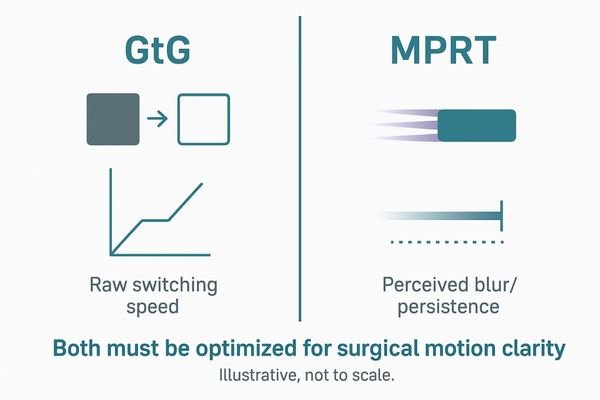
When evaluating a display’s specifications, you will likely encounter two different metrics for response time: GtG and MPRT.
- GtG (Gray-to-Gray)9: This is the more traditional metric and measures the average time it takes for a pixel to transition from one shade of gray to another. It is a good indicator of the panel’s raw switching capability. Most of the ultra-low "1 ms" claims on consumer monitors refer to a best-case GtG measurement.
- MPRT (Motion Picture Response Time)10: This metric measures how long a pixel remains continuously visible to the eye as it moves across the screen. As such, it is a much better indicator of perceived motion blur. A low MPRT means moving objects appear sharper with less ghosting.
For surgical applications, both are important, but MPRT often gives a more realistic sense of how the display will perform during rapid camera movements. A monitor with a low GtG but a high MPRT can still exhibit significant blur. Therefore,manufacturers of high-quality surgical displays like the MS192SA focus on engineering a balanced solution, optimizing the panel’s pixel overdrive and backlight behavior to minimize both GtG and MPRT, resulting in an image that is clear and sharp even during the most dynamic moments of a procedure.
Panel Technologies (IPS, OLED, etc.)
The underlying display panel technology directly influences a monitor’s performance characteristics. Each technology offers a different balance of color accuracy, viewing angle, and response time.
IPS panels offer superior color accuracy and viewing angles but have a slower native response time. OLED provides near-instant response but faces risks of higher cost and burn-in.
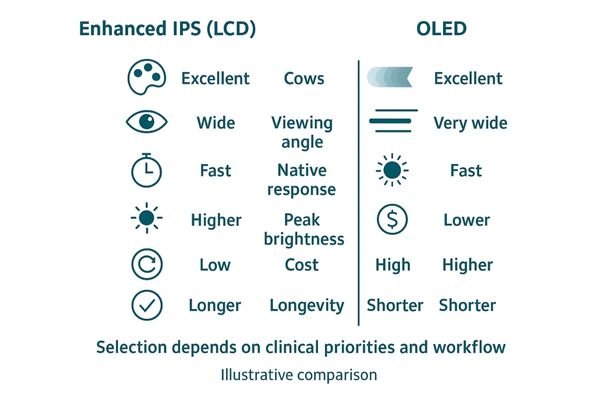
The choice of display panel technology involves inherent trade-offs between different performance attributes. In the medical field, two technologies are most prominent:
- IPS (In-Plane Switching)11: This is the most common technology used in high-quality surgical displays. Its primary strengths are exceptional color accuracy and wide, consistent viewing angles, which are critical for an operating room where the screen is viewed by multiple people from different positions. Its main weakness is a slower native pixel response time (typically ~4–5 ms GtG in its raw state). Manufacturers overcome this by implementing "overdrive" technologies that accelerate pixel transitions. A display such as the MS430PC uses an enhanced IPS panel to strike an effective balance.
- OLED (Organic Light-Emitting Diode)12: OLED technology offers a significant advantage in response time, with near-instantaneous pixel switching (0.1–1 ms). It also delivers perfect blacks and an extremely high contrast ratio. However, it comes with considerable downsides for clinical use, including higher cost, lower peak brightness than LCD, and a significant risk of permanent image retention, or "burn-in," where static interface elements can become permanently etched onto the screen. For these reasons, enhanced IPS remains the dominant and more reliable choice for most surgical applications.
Challenges in Endoscopic Imaging
The fluid and often rapid movements of an endoscopic camera create a challenging visual environment. Artifacts like motion blur and ghosting can obscure critical details at the worst possible moments.
Motion blur and ghosting are key challenges in endoscopic imaging, as they can hide fine tissue details. Displays with a response time below 30 ms are essential to eliminate these artifacts.
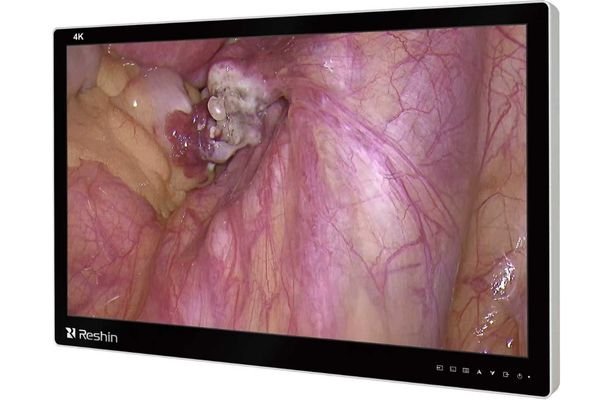
Endoscopic imaging presents a unique set of visual challenges that push a display’s performance to its limits. Unlike a static radiology image, the surgical video feed is constantly in motion. As the surgeon pans the camera across a field, navigates through a narrow passage, or quickly repositions to control bleeding, the monitor must render dozens of new frames every second without flaw. When a display has a slow response time, this rapid motion results in prominent ghosting and blurring artifacts. These are not minor annoyances; they can have serious clinical consequences. Motion blur can obscure the fine texture of a mucosal surface, making it difficult to differentiate healthy from pathological tissue. Ghosting can mask the precise location of a small vessel or nerve fiber, increasing the risk of inadvertent injury. This is why a response time below the 30 ms threshold13 is so critical. A high-performance 32-inch 4K monitor14 like the MS321PB is designed specifically to overcome these challenges, ensuring that even during the most rapid surgical movements, the image remains crisp, detailed, and artifact-free, thereby maximizing surgical precision.
Regulatory, Clinical, and Ergonomic Implications
While no specific regulation dictates a maximum response time, the overall performance of a display has clear implications for safety and ergonomics. Excessive lag can compromise both patient outcomes and surgeon well-being.
Although no regulation sets a numeric limit, display lag impacts essential performance under IEC 60601. Excessive delay increases clinical risk and surgeon eye strain, violating safety and ergonomic principles.
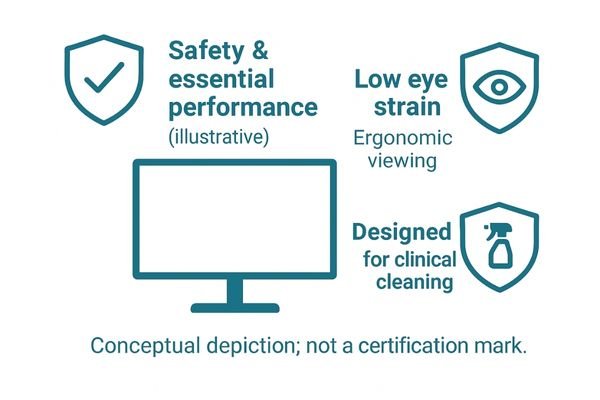
The regulatory landscape for medical devices is complex, but the guiding principle is safety and essential performance. While standards like IEC 60601-1 do not specify a hard numerical limit for response time15 in milliseconds, they do mandate that a medical device must perform its intended function safely without introducing unacceptable risk. A display with excessive lag that causes visual artifacts and compromises a surgeon’s ability to operate precisely would fail to meet this essential performance requirement. From a clinical perspective, the risk is clear: a delayed or blurry image can directly lead to surgical errors. From an ergonomic standpoint, high latency and motion blur force the surgeon’s brain to work harder to interpret the visual information and compensate for the lag. This increases cognitive load, accelerates eye strain, and can contribute to fatigue during long procedures. Therefore, minimizing response time is not just a technical goal; it is a fundamental requirement for building a safe, effective, and ergonomic surgical visualization system16. Products like the MS550P are designed with this holistic view, ensuring they meet not just technical benchmarks but also the practical demands of clinical use.
Industry Benchmarks and Technical Data
Published technical data and industry benchmarks provide a clear picture of what constitutes high performance in a surgical display. These figures allow for objective comparisons between different models and technologies.
Premium surgical displays typically achieve a GtG response time of around 6.5 ms, while reliable models list between 14–16 ms—all well within the <30 ms target for smooth endoscopic video.

Examining the technical specifications of leading surgical monitors provides valuable context for what is considered high performance in the industry. The data generally shows a consistent commitment to keeping response times low to prevent motion artifacts.
| Display Tier | Typical GtG Response Time | Refresh Rate | Clinical Suitability |
|---|---|---|---|
| Premium/Flagship | ~4.0 – 8.0 ms | 60 Hz – 120 Hz | Excellent for all surgical applications, including high-speed and 3D imaging. |
| High-Performance | ~8.0 – 16.0 ms | 60 Hz | Very good performance, suitable for the vast majority of 2D endoscopic and laparoscopic procedures. |
| Entry-Level Medical | ~16.0 – 25.0 ms | 60 Hz | Acceptable for less dynamic imaging, but may show some blur in rapid-motion scenarios. |
Looking at our own product line, models like the MS321PC list a response time of 14 ms, placing them firmly in the high-performance category. This speed, combined with a standard 60 Hz refresh rate (or 120 Hz on some advanced models), is more than sufficient to ensure a fluid, clear, and artifact-free image during demanding endoscopic procedures. These benchmarks confirm that keeping the total response well under the 30 ms threshold is a core design principle for any serious surgical display.
Conclusion
A display’s response time is a critical, non-negotiable specification for endoscopic surgery, directly influencing image clarity, surgeon confidence, and patient safety by eliminating dangerous motion artifacts.
👉 To learn more about selecting the right medical display with optimal response time, reach out to Martin at martin@reshinmonitors.com.
-
Understanding response time is crucial for ensuring safety and efficiency in medical procedures, making it a key factor in display selection. ↩
-
Exploring the differences helps ensure that medical professionals choose the right equipment for critical tasks, enhancing patient safety. ↩
-
Understanding response time is crucial for evaluating display performance, especially in critical environments like surgery. ↩
-
Exploring the best surgical displays can help ensure optimal performance and safety in medical procedures. ↩
-
Explore this link to understand how medical-grade displays enhance surgical precision and safety, ensuring optimal performance in critical environments. ↩
-
Discover the essential features of surgical monitors that ensure reliability and accuracy during operations, crucial for patient safety. ↩
-
Understanding input lag is essential for optimizing display performance, especially in critical applications like surgery. ↩
-
Minimizing total latency is crucial for surgical precision; explore strategies to enhance performance in medical displays. ↩
-
Learning about GtG can guide you in selecting monitors with optimal switching capabilities for your needs. ↩
-
Understanding MPRT helps you choose displays with better motion clarity, crucial for fast-paced applications. ↩
-
Explore the benefits of IPS technology, especially its color accuracy and viewing angles, crucial for surgical environments. ↩
-
Learn about the drawbacks of OLED technology, including burn-in risks and cost, to make informed decisions for medical applications. ↩
-
Understanding the critical response time can enhance surgical outcomes and patient safety, making it essential for medical professionals. ↩
-
Exploring the advantages of advanced monitors can significantly improve surgical precision and overall effectiveness in medical procedures. ↩
-
Understanding response time is crucial for ensuring safety and performance in medical devices, impacting surgical outcomes. ↩
-
Exploring surgical visualization systems reveals their role in enhancing precision and reducing errors during surgeries. ↩