Medical equipment buyers at MEDICA 2025 in Düsseldorf, Germany were once again confronted with hundreds of display vendors showcasing similar claims about resolution, brightness, and 4K clarity. Yet in practical clinical environments, high-level specifications rarely guarantee true medical-grade performance. Engineers and healthcare decision-makers increasingly want to know: which manufacturer can consistently maintain image quality, calibration stability, and workflow reliability across different departments and lighting environments?
From my perspective as an engineer working with medical-grade display systems, MEDICA 2025 made one thing absolutely clear: hospitals are no longer evaluating displays by “how sharp” they look, but rather by “how consistent and clinically reliable” they remain across surgical, endoscopy, and diagnostic workflows throughout their entire lifecycle.
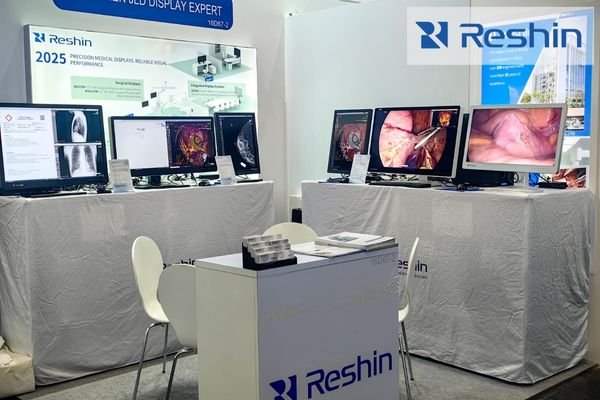
Trade shows like MEDICA allow clinical engineers to compare technologies side by side — not just in terms of specifications, but in how well displays withstand practical stress tests such as glare, long-hour operation, cross-department calibration, and signal stability. Having just returned from Düsseldorf, I’d like to share my engineering assessment of the display technologies shaping surgical visualization1, endoscopy workflows, and diagnostic imaging in 2025, along with how global manufacturers are adapting for different healthcare regions.
What MEDICA 2025 Reveals About the Next Stage of Surgical & Diagnostic Display Needs
One major observation at MEDICA 2025 was a shift in how healthcare professionals evaluate surgical monitors, diagnostic displays, and endoscopy monitors. Instead of asking whether a display is “clear,” clinical visitors increasingly asked how well the image maintains consistency when used in different lighting conditions, during long procedures, or across multiple screens.
The shift is unmistakable: buyers now prioritize glare resistance, long-term brightness stability2, cross-department color consistency, and unified compatibility across surgical, endoscopic, and diagnostic environments.
Evolution of Buyer Priorities
At MEDICA, I repeatedly saw the same upgrades in buyer expectations:
- From Resolution to Image Consistency – 4K surgical monitors are now standard; what matters is color and brightness consistency.
- From Brightness to Brightness Stability – engineering discussions focused on long-term performance rather than peak nits.
- From Single Device to Hospital-Wide Integration – hospitals want shared color profiles across OR, ICU, endoscopy, and radiology.
- From Feature Lists to Workflow Optimization – buyers emphasized clinical usability, not theoretical specs.
Cross-Departmental Compatibility
This hospital-wide perspective was particularly evident:
| Department | Previous Focus | Emerging Priority | Clinical Impact |
|---|---|---|---|
| Surgery | Peak brightness | Glare resistance + stable luminance | Reduced eye strain during long OR procedures |
| Endoscopy | Vivid colors | Consistent color across rooms | More reliable tissue identification |
| Diagnostic Imaging | Resolution | DICOM stability over time | More confident diagnoses |
| Interventional | Response time | Multi-input stability | Smoother workflow during complex procedures |
Manufacturer Response
Across the Düsseldorf show floor, manufacturers responded with:
- Automated calibration systems
- Ambient-adaptive brightness engines
- Centralized management platforms
- Extended lifecycle service guarantees
These responses indicate a maturing market where clinical reliability matters more than raw specifications.
A Practical Engineering Checklist for Choosing Medical Displays
Marketing brochures often highlight impressive numbers — peak nits, color gamuts, refresh rates — yet many of these parameters reveal little about real clinical performance. From an engineering standpoint, display selection must consider environmental stress, interoperability, and long-term maintenance.
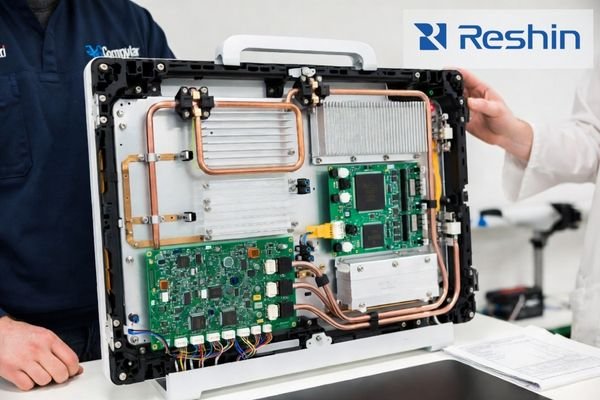
From real-world integration work, the most meaningful engineering criteria include signal redundancy, brightness stability, latency performance, EMI resilience, and cleaning/maintenance cost — all far more impactful than resolution alone.
Beyond Marketing Specifications
Critical engineering considerations include:
- Signal redundancy to maintain operation during unexpected disconnections
- Low latency crucial for surgical hand–eye coordination
- EMC/EMI resistance in equipment-heavy OR environments
- Thermal management design3 affecting performance and user comfort
- Power quality tolerance for regions with utility fluctuations
- Maintenance accessibility for frequent disinfection cycles
Practical Engineering Evaluation Matrix
A test-driven evaluation approach provides more clarity than comparing spec sheets:
| Evaluation Category | Test Method | Acceptance Criteria |
|---|---|---|
| Signal Reliability4 | Hot-plug during operation | No flicker or re-sync delay |
| Brightness Stability | 8-hour continuous test | <5% drift |
| Latency | Parallel reference comparison | <40ms for surgical use |
| Cleaning Resilience | 100 wipe cycles | No damage or ingress |
| Calibration Retention | 30-day drift test | Full DICOM compliance |
| Interface Flexibility | Source switching | No artifacts or delays |
Implementation Considerations
During hospital deployments, the following factors often determine long-term cost:
- Installation complexity
- User training requirements
- Compatibility with existing imaging infrastructure
- Service support model
- Firmware and upgrade pathways
Beyond Specifications — How to Identify a Reliable Display Manufacturer at Exhibitions
At exhibitions like MEDICA, nearly every booth displays beautiful images. But high-quality engineering is rarely visible on the surface. The question is: how can buyers distinguish between marketing performance and true medical-grade engineering?
The most reliable assessments involve testing multi-input behavior, verifying per-unit calibration, evaluating OEM flexibility, and examining whether the UI is engineered for clinical workflows.
Practical On-Site Evaluation Methods
During Düsseldorf discussions, these techniques proved most valuable:
- Compare multiple units of the same model for consistency
- Inspect individual calibration reports, not generic documents
- Stress-test interfaces with rapid switching and signal recovery
- Simulate real clinical workflows rather than watching demo loops
- Engage engineering staff, not only sales teams
Indicators of Real Manufacturing Capability
At the booth, I look for:
- Consistency between demo units
- Technical documentation quality
- Ability to discuss custom configurations
- Familiarity with IEC, EMC, and regional regulations
- Evidence of after-sales engineering support
Revealing Questions to Ask Manufacturers
These five questions consistently distinguish capable manufacturers:
- “How do you track calibration across individual units?”
- “What procedures do you use to validate firmware updates?”
- “How do you address regional medical compliance differences?”
- “What is the documented MTBF for this model?”
- “Can you demonstrate remote diagnostics?”
2025 Technology Shifts in Surgical & Endoscopy Displays
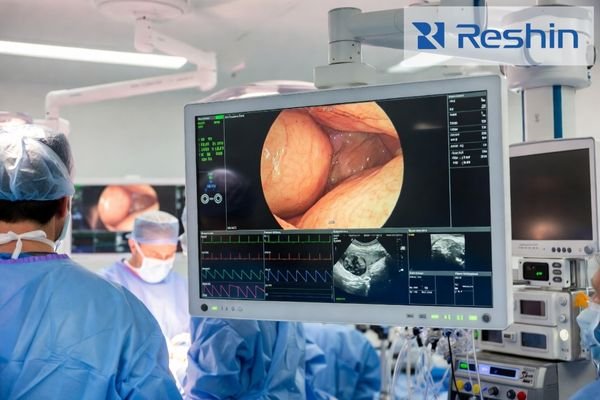
The MEDICA 2025 exhibition floor showcased several new technologies shaping the next generation of 4K surgical monitors, endoscopy displays, and multi-source OR visualization systems.
In 2025, surgical and endoscopy displays are shifting toward long-term brightness stability, multi-source fusion, and wider color gamuts such as BT.2020 — trends consistently visible across OR system manufacturers.
Key Technology Trends
Observed across multiple booths in Hall 10 and Hall 11:
- Next-generation optical bonding to eliminate internal reflections
- BT.2020 adoption for fluorescence-guided procedures
- Multi-parameter overlays combining patient data and imaging
- Adaptive processing engines tuned for procedure type
- Low-blue-light imaging to reduce fatigue in long cases
Integration Trends
| Integration Trend | Technical Implementation | Clinical Benefit |
|---|---|---|
| Wireless Transmission | <10ms latency | Less cable clutter |
| AI Visualization | Real-time structure enhancement | Better anatomy recognition |
| Multi-Display Sync | Frame-locked calibration | Consistent viewing angles |
| Voice/Gesture Control | Workflow-integrated UI | Reduced interaction with non-sterile surfaces |
| Remote Collaboration | Telestration & annotation | Better education & consultation |
Form Factor Evolution
- Bezel-free medical displays
- Flexible OR mounting architectures
- Integrated cable management
- Lightweight structures for arms
- Modular upgrade accessories
See You at Zdravoohraneniye 2025— Preparing Solutions for Eastern Europe & CIS Markets
As we prepare for Zdravoohraneniye 2025 in Moscow, Russia, I reviewed the clinical and operational priorities unique to Eastern European and CIS healthcare systems.
Regional feedback highlights growing demand for durable 4K surgical monitors, stricter DICOM verification workflows5, and display systems engineered for variable infrastructure conditions.
Regional Market Characteristics
- Emphasis on long operational lifetimes
- Importance of regional service networks
- Local-language technical documentation
- Support for regional certification processes
- Value-driven configurations prioritizing essentials
Technology Adaptation for Local Requirements
- Enhanced power conditioning
- Wider operating temperature ranges
- Simplified localized user interfaces
- Reinforced physical durability
- Long-term spare parts availability
Zdravoohraneniye 2025 Preview
| Display Solution | Regional Adaptation | Target Application |
|---|---|---|
| MS321PB | Extended brightness stability | General surgery setups |
| MD52G | Local-language DICOM workflow | Diagnostic imaging centers |
| MS275PA | Ruggedized mounts | Mobile surgical units |
| MD85CA | Region-specific calibration profiles | High-throughput diagnostic hubs |
If you are planning to attend Zdravoohraneniye 2025, I would be glad to discuss how our engineering approach can support your local clinical workflow demands.
Conclusion
MEDICA 2025 in Düsseldorf clearly demonstrated that the future of medical imaging displays is not dictated by higher pixel counts but by clinical consistency, workflow reliability, and sustained calibration performance across all medical environments.
The evolution of surgical, diagnostic, and endoscopic visualization shows that healthcare professionals increasingly value engineering depth over marketing claims. This year’s discussions reaffirmed the importance of long-term image stability, cross-departmental uniformity, and robust integration with modern OR ecosystems.
If you would like to explore solutions for your clinical visualization challenges, feel free to reach out.
📧 Email: info@reshinmonitors.com
🌐 Website: https://reshinmonitors.com/
-
Explore this link to discover cutting-edge innovations in surgical visualization that can enhance patient outcomes and surgical precision. ↩
-
Exploring brightness stability helps buyers make informed decisions for long-term reliability in surgical environments. ↩
-
Exploring thermal management design can reveal its critical role in maintaining equipment performance and user comfort in medical settings. ↩
-
Understanding Signal Reliability is crucial for ensuring optimal performance in medical imaging systems ↩
-
Learn about the critical role of DICOM verification workflows in ensuring accurate and efficient medical imaging. ↩