Surgical teams worldwide depend on clear, stable visualization to make fast and accurate decisions in the operating room. When image detail is inconsistent, reflections interfere with visibility, or signal handling is unreliable, the result is not just inconvenience—it can slow communication, reduce procedural efficiency, and increase avoidable risk in modern OR environments.
When selecting a 4K surgical monitor for a modern operating room, prioritize color accuracy, anti-reflection performance, optical bonding, multi-view processing, low latency, and interface compatibility across medical-grade surgical monitors.
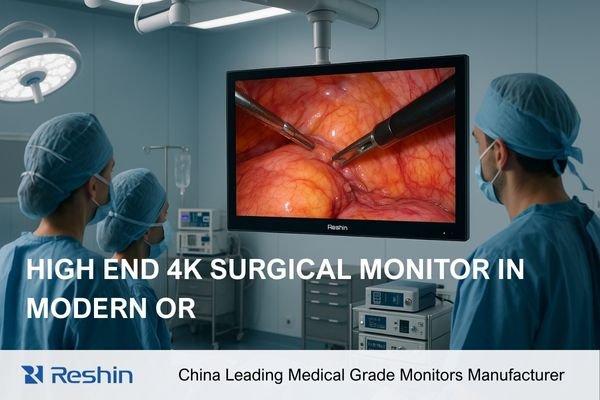
As an engineer specialized in medical display integration, I’ve implemented hundreds of OR visualization systems across diverse surgical environments. This experience has revealed a clear pattern: the difference between adequate and exceptional surgical visualization extends far beyond marketing specifications. This guide explores the essential elements that transform a standard 4K monitor into a true surgical-grade display1 capable of supporting critical clinical decision-making in demanding operating environments. At Reshin, my team and I approach OR visualization as a reliability system, not a screen purchase, so throughout this guide I connect engineering details to the procurement risks and integration outcomes that matter to OR planners, hospital buyers, distributors, and device partners.
4K Visualization as a Foundational Element of Modern Surgical Decision-Making
Surgeons increasingly report frustration with visualization limitations that extend procedure times and complicate team communication. Is your current display technology forcing unnecessary compromises in surgical technique?
In my OR integration projects, 4K has become a core component of the surgical decision-making chain rather than a cosmetic resolution upgrade. For endoscopic and minimally invasive procedures, higher detail clarity supports faster tissue boundary recognition, reduces communication ambiguity, and helps teams maintain smoother, more confident surgical pacing.
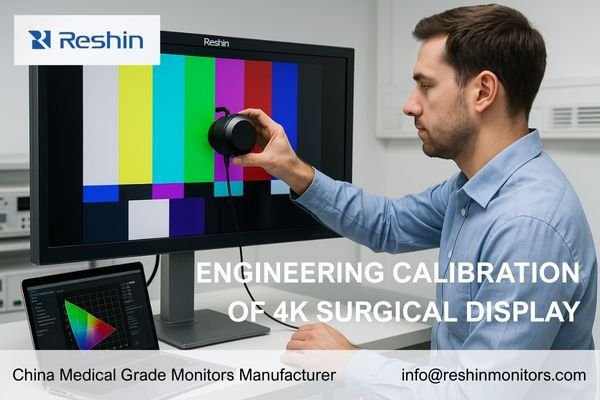
The transition to 4K in operating rooms represents much more than a simple resolution upgrade. In my field deployments, the most consistent clinical gains come from three linked effects: first, higher pixel density makes vascular networks, tissue planes, and pathological margins easier to distinguish in real time; second, surgeons spend less time re-confirming landmarks or repositioning cameras because the visual evidence is clearer on the first pass; and third, even without 3D, sharper texture cues and focus gradients can strengthen depth perception when tactile feedback is limited. These advantages are especially visible in minimally invasive and endoscopic workflows, where teams rely on shared visual certainty to keep the operation smooth and safe.
Enhanced Anatomical Recognition2
The increased pixel density of 4K displays provides significantly improved visualization of critical anatomical structures:
- Vascular Networks: Smaller vessels and branch patterns become visibly clearer, reducing the risk of accidental injury.
- Tissue Planes: Natural dissection lines appear more defined, supporting more controlled instrument movement.
- Pathological Boundaries: Margins between healthy and compromised tissue become more distinguishable.
In neurosurgical and other precision-dependent applications, these improvements can help surgeons differentiate delicate structures with greater confidence and consistency.
Engineering Criteria That Define a Reliable 4K Surgical Display Platform
With dozens of manufacturers claiming “surgical-grade” capabilities, how can OR planners separate engineering-driven performance from marketing language?
From an engineering perspective, I evaluate whether a 4K display meets OR requirements through factors such as color stability, anti-reflection performance, signal latency, hygiene compliance, multi-source processing, and long-term interface readiness. These criteria determine whether the monitor can deliver consistent imaging under demanding surgical conditions, not just whether it looks good in a specification sheet.
When I qualify a 4K surgical display for OR deployment, I treat the monitor as part of a time-critical imaging chain. That means verifying low end-to-end latency, stable motion handling, and hardware-level processing that will not degrade under multi-source loads. I also check thermal design and component reliability for 24/7 duty cycles—fanless cooling and conservative power management are priorities in enclosed boom and cart installs. On the integration side, broad interface coverage, including 12G-SDI, DP, HDMI, and future fiber pathways, reduces upgrade risk and avoids costly rewiring. Finally, OR durability is non-negotiable: sealed surfaces, disinfectant resistance, and EMI/RFI stability help keep the display safe and predictable around electrosurgical equipment. At Reshin, these checkpoints are built into our validation flow so procurement teams can predict lifecycle performance rather than react to field failures.
- Target sub-50ms3 end-to-end latency
- Hardware-level image processing preferred over software-only pipelines
- Reliable performance at 50/60Hz and variable frame rates
- Motion-optimized processing for fast endoscopic movements
For buyers, this section matters because the “best” 4K surgical monitor is not simply the one with the highest resolution. It is the one that delivers repeatable, workflow-safe performance under actual OR conditions.
Wide-Gamut Color Reproduction for Accurate Tissue Interpretation
When evaluating subtle tissue characteristics during critical procedures, can standard color reproduction adequately represent the nuanced visual information captured by modern surgical imaging systems?
In my experience calibrating endoscopic systems, wide-gamut reproduction is important for accurate tissue interpretation. Insufficient color coverage can diminish subtle differences within vascular and mucosal structures, forcing surgeons to confirm details repeatedly. A wider color space paired with precise gamma behavior supports faster and more reliable recognition.
The Clinical Impact of Color Accuracy
Color accuracy directly influences surgical interpretation.
Tissue Perfusion Assessment
Accurate color reproduction supports:
- Early ischemia identification
- Clear perfusion boundary visualization
- Reliable confirmation during revascularization
Pathology Identification
Many conditions exhibit color-based signatures:
- Inflammation
- Malignancy indicators
- Infection patterns
Superior color performance helps surgeons distinguish subtle variations more rapidly and with greater confidence.
Technical Requirements for Surgical Color Accuracy
Key engineering criteria include:
-
Expanded Gamut4 (e.g., high DCI-P3 coverage)
Provides visibly improved mucosal edge separation in real OR lighting. -
Accurate Gamma Tracking
Ensures consistent tonal structure across brightness levels. -
Color Consistency Across the Panel
Uniformity helps ensure the entire surgical field appears predictable and accurate.
At Reshin, we factory-calibrate every surgical line unit with clinical color references and multi-point uniformity checks. The goal is simple: make color a dependable interpretive cue rather than a variable surgeons have to compensate for during critical moments.
For procurement teams, wide-gamut capability should be evaluated together with calibration stability, uniformity, and the intended surgical workflow. In other words, color performance is most valuable when it improves recognition speed and decision confidence in real procedures.
Optical Bonding and AR Coatings for Glare-Free, Hygiene-Ready OR Environments
Operating rooms combine intense lighting with frequent exposure to fluids and aggressive disinfection. Is your display technology designed to maintain visibility and infection control under these demanding conditions?
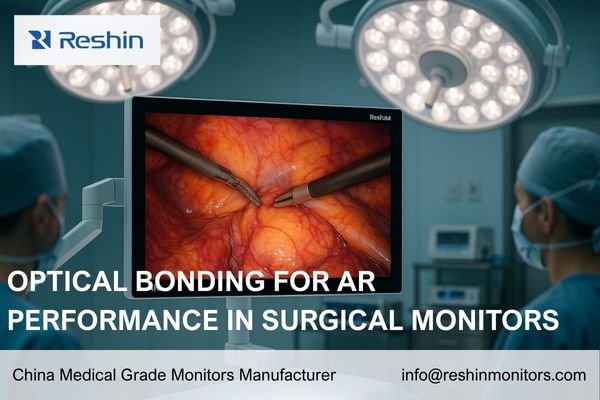
In real OR deployments, glare and liquid intrusion are two recurring risks. Non-bonded front glass creates reflections under surgical lighting and leaves gaps where moisture or disinfectant residue can accumulate. Optical bonding with a flat AR-coated surface helps reduce these issues while supporting the intensive cleaning cycles required in medical environments.
The Engineering Challenges of OR Display Integration
Lighting Complexity
OR lighting systems produce:
- Intense directional beams
- Multiple incidence angles
- Frequent repositioning
- High contrast between illuminated and shaded areas
Generic displays often struggle to maintain visibility under these conditions.
Infection Control Requirements
Surgical teams rely on displays that support:
- Seamless surfaces
- Compatibility with strong disinfectants
- Frequent cleaning cycles
- Protection from liquid ingress
Technical Solutions for OR Environments
Optical Bonding Technology
Optical bonding provides:
- Elimination of internal reflections
- Stronger structural integrity
- Higher contrast and reduced parallax
- Improved visibility under bright illumination
Advanced Anti-Reflective Treatments
High-grade AR treatments help keep glare to a minimum under surgical lights.
Sealed Design Implementations
Comprehensive sealing supports:
- Liquid resistance
- Chemical durability
- Protected ports
- Ventless thermal management
In Reshin OR deployments, optical bonding and AR control are treated as risk-reduction features, not optional upgrades—because a monitor that cleans easily but reflects under lights still fails the clinical requirement.
Multi-Source and Multi-View Processing for High-Efficiency Surgical Workflows
How does your current visualization system handle the growing complexity of surgical information streams? Are your teams forced to divide their attention between multiple displays?
In hybrid or teaching OR environments, surgeons frequently rely on simultaneous views from endoscopic feeds, overhead cameras, and navigation systems. Displays without professional multi-source processing often introduce distortion, switching delays, or unnecessary workflow friction. A robust 4K monitor with PIP, PBP, and quad-split modes supports more continuous and efficient surgical visualization.
In practice, multi-view capability is what turns 4K resolution into workflow value. Modern ORs blend primary endoscopic feeds, navigation overlays, pre-op reference images, and vital sign displays, and teams often need these sources aligned within a single visual context. The most effective platforms handle independent scaling, preserve aspect ratios, maintain consistent color across windows, and keep latency low even when four sources are active. In my hybrid OR projects, consolidating streams onto a reliable quad-view surgical monitor reduces cognitive switching, improves team communication, and keeps surgeons focused on the operative field rather than on screen management. Reshin’s multi-source processing roadmap is designed around this OR reality, so integrators can standardize layouts across rooms without compromising stability.
The Evolution of Surgical Information Management
Modern surgeries integrate:
- Primary operative camera feeds
- Navigation overlays
- Pre-operative CT/MRI references
- Vital signs
- Overhead or microscope cameras
Advanced Multi-Source Processing Capabilities
Layouts include:
- Picture-in-Picture
- Picture-by-Picture
- Quad-view
- Custom multi-layout presets
Processing requirements:
- Independent scaling
- Consistent color performance
- Low latency
- Intelligent resolution handling
Workflow Benefits
Multi-view processing brings:
- Reduced Cognitive Load
- Improved Team Communication
- Enhanced Procedural Efficiency
Recent deployments often show measurable workflow benefits after multi-view displays are implemented in more complex OR environments.
Selecting Appropriate Display Sizes to Match OR Layout and Surgical Workflow
With surgical teams positioned at varying distances from visual information, how do you determine the optimal display size for each OR position to ensure both detail visibility and complete field coverage?
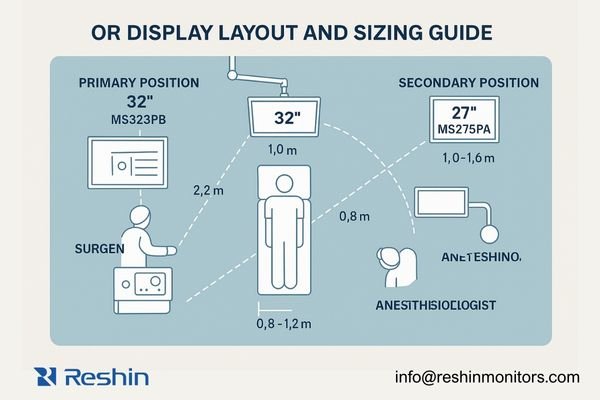
When selecting display sizes, I evaluate viewing distance, mounting location, and surgical workflow. Cart-mounted stations typically use 27-inch displays, primary surgical positions often benefit from 32–43-inch sizes, while teaching or long-distance viewing areas may require 55-inch or larger screens. Proper sizing influences comfort, clarity, communication, and procedural efficiency.
Before recommending specific sizes, I want to highlight why Reshin’s surgical lineup is structured the way it is. In our OR integrations, I’ve seen that the “right size” is less about preference and more about guaranteeing readable detail at the real viewing distance for each workflow position. That’s why our portfolio spans compact cart-mounted 27-inch platforms, main-view 32-inch workhorses, team-view 42.5-inch displays, and large 55-inch teaching or hybrid OR screens—so hospitals can standardize across rooms without forcing compromises in ergonomics or visibility.
Strategic Display Sizing Methodology
Viewing Distance Optimization
General ergonomic guidance:
- Minimum size: diagonal ≥ distance ÷ 3
- Optimal size: diagonal = distance ÷ 2
- 4K can shorten optimal viewing distance by ~30%
Display Size Recommendations by Application
| OR Application Scenario | Recommended Size | Recommended Models |
|---|---|---|
| Tower / Cart Mounted | 27" | MS275PA |
| Primary Surgical View | 32" | MS322PB |
| Shared / Large Field Surgical Viewing | 42–43" | MS430PC |
| Teaching OR / Hybrid OR Wall Display | 55" | MS550P |
Application-Specific Considerations
Tower / Cart-Mounted Systems
The 27-inch option minimizes footprint while delivering full 4K clarity for close-range viewing.
Primary Surgical Position
A 32-inch 4K surgical monitor provides a strong balance of field coverage and fine detail for the main surgical view.
42–43-inch options maintain visibility for multiple viewers at mid-range distances.
Teaching / Hybrid ORs
55-inch displays provide stronger visibility for teams, observers, and multi-view layouts.
Installation & Positioning Considerations
- Perpendicular viewing angle
- Eye-level height alignment
- Avoidance of glare sources
- Team-wide visibility
A common buying mistake is choosing screen size by preference rather than by actual viewing distance, room role, and team visibility needs. In modern OR planning, larger is not always better—the right size is the one that matches the viewing task.
Building a Future-Ready 4K Surgical Display Infrastructure
With rapid advances in surgical imaging technology, how do you ensure today’s visualization investments remain compatible with tomorrow’s innovations?
To support long-term scalability, I recommend displays equipped with 12G-SDI, DP1.2/1.4, advanced multi-source decoding, and sealed architectures. This helps preserve compatibility with next-generation endoscopic towers and AI-assisted imaging systems while reducing cabling adjustments and future integration risk.
Anticipating Technological Evolution
Resolution Progression
4K remains the current standard, while higher-resolution inputs and processing demands continue to emerge.
Advanced Visualization Modalities
Fluorescence, AR overlays, and AI-enhanced imaging require stronger color, processing, and signal-management capabilities.
Connectivity Evolution
12G-SDI, DP 2.0, HDMI 2.1, and fiber-optic pathways improve future compatibility planning.
System Architecture Considerations
Cabling Infrastructure
Oversized conduits, separated signal pathways, high-grade cables, and accessible routing help simplify future upgrades.
Signal Distribution Systems
Matrix routing, format conversion, redundancy, and unified control improve flexibility across the visualization chain.
Procurement Strategies for Long-Term Value
- Phased implementation
- Total cost of ownership consideration
- Vendor evaluation for long-term compatibility
Reshin supports OR planners not only with display hardware but also with integration guidance—helping teams validate signal paths, cable specifications, and upgrade planning so the 4K visualization ecosystem remains predictable across the full lifecycle.
FAQ
What features matter most in a 4K surgical monitor for modern ORs?
The most important factors are not resolution alone. Buyers should prioritize image clarity, low-latency performance, anti-reflection control, optical bonding, color consistency, interface compatibility, cleanability, and workflow fit.
Is a 27-inch or 32-inch surgical monitor better for an operating room?
It depends on viewing distance and workflow role. A 27-inch monitor is often suitable for tower or cart-mounted close viewing, while a 32-inch monitor is usually better for the primary surgical view in standard OR layouts.
When should hospitals choose a 42.5-inch or 55-inch OR display?
Larger displays are typically more suitable for shared viewing, teaching ORs, hybrid OR environments, and rooms where multiple team members need a clear view from a longer distance.
Why does 12G-SDI matter in surgical monitor selection?
12G-SDI is important when hospitals want reliable 4K signal handling, cleaner system integration, and a better path for future upgrades without unnecessary re-cabling.
What is the difference between a surgical monitor and a surgical display?
In practice, the terms are often used similarly, but the key issue is whether the platform is truly built for OR use. A suitable surgical display should support real surgical workflows, medical cleaning requirements, signal integration, and stable long-term performance.
What should hospital buyers confirm before purchasing a 4K surgical monitor platform?
They should confirm screen size, inputs and outputs, mounting options, glare control, cleanability, color performance, multi-view support, and compatibility with current and future OR infrastructure.
Conclusion
Selecting the right 4K surgical monitor requires more than comparing panel resolution. The real decision should be based on color accuracy, reflection control, multi-source performance, proper sizing, interface readiness, and long-term compatibility. These factors determine whether visualization supports surgical workflow—or becomes a constraint within it.
For modern OR decision-makers, the best approach is to evaluate the entire visualization chain: where the monitor will be mounted, how many people need to view it, what signal sources must be managed, and which features reduce long-term integration risk. In that context, a 27-inch cart-mounted display, a 32-inch primary-view monitor, a 42.5-inch shared-view screen, and a 55-inch teaching display each serve different but equally important roles.
Our engineering approach remains grounded in real-world OR requirements, helping ensure that each display—from compact 27-inch units to large-format 55-inch platforms—delivers reliable clarity, stable workflow support, and practical integration value. If your team is evaluating visualization upgrades or planning a future-ready OR infrastructure, we welcome you to reach out through the contact details below for technical guidance, model recommendations, or solution support.
📧 info@reshinmonitors.com
🌐 https://reshinmonitors.com/
-
Understanding the features of surgical-grade displays can enhance your knowledge of critical decision-making in surgery. ↩
-
Explore how Enhanced Anatomical Recognition can lead to better surgical outcomes and patient safety. ↩
-
Understanding sub-50ms latency is crucial for ensuring optimal performance in surgical displays, enhancing patient safety. ↩
-
Exploring expanded gamut technology can enhance your knowledge of color accuracy, vital for surgical precision. ↩