Digital illustration of Southeast Asia map with glowing hotspots and medical icons representing AI, digital healthcare, and market growth, alongside medical displays showing radiology and mammography images.

Medical Displays Expansion in Southeast Asia

The expansion of the medical display market in Southeast Asia is driven by increased healthcare spending and digitalization. Success requires tailored strategies to navigate diverse adoption rates, price sensitivity, and the critical need for local support.

Read More »
Medical monitor displaying endoscopic image with biopsy tool, showing HDMI, DisplayPort, DVI, USB-C, SDI, and VGA ports labeled for connectivity options, and a comparison between VGA and DisplayPort image clarity

Types of Common Interfaces in Medical Displays

Medical displays use specific interfaces to ensure image quality and system compatibility. Common types include:

DisplayPort (DP): The top choice for high-resolution surgical and diagnostic imaging due to its high bandwidth.
HDMI: A versatile and common interface for general multimedia and display connections.
SDI: Used for long-distance, uncompressed video transmission in professional settings like operating rooms.
DVI: A reliable older digital standard, often found on legacy medical equipment.
USB-C: A modern all-in-one solution for video, data, and power, ideal for portable devices.
Fiber Optic: Provides superior signal integrity over very long distances and in high-interference environments.
VGA: An older analog interface used for compatibility with legacy devices.**

Read More »
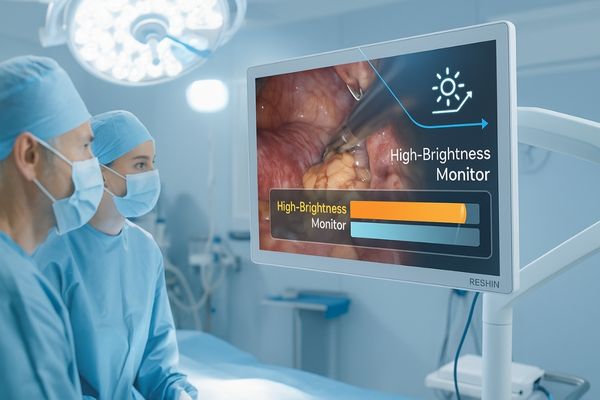
Two surgeons observing a surgical monitor comparing low-contrast and high-contrast anatomical images in a bright operating room environment

High contrast enhances detail recognition in surgical imaging

High-contrast monitors are essential for modern surgery because they enhance the recognition of fine details by revealing subtle tissue differences, improving the visualization of critical structures, and helping to minimize errors. This leads to more precise surgical decisions and better patient outcomes.

Read More »
Surgeon performing minimally invasive surgery while viewing a surgical monitor showing real-time, low-latency images in perfect sync with instrument movements

How Do Surgical Monitors Reduce Image Latency?

Surgical monitors reduce latency by using powerful, dedicated processing chips, optimized low-latency software, and high-speed signal pathways. These elements work together to minimize the time between video input and display output for real-time performance.

Read More »
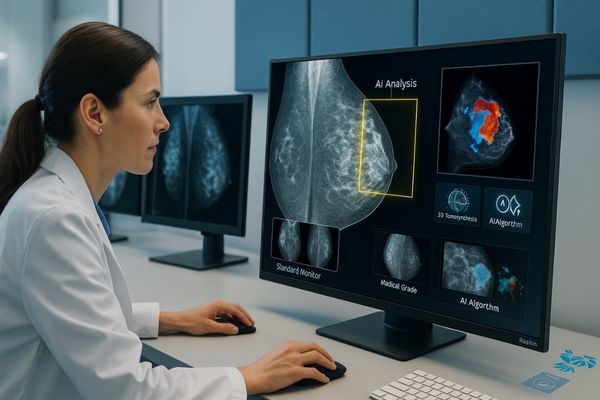
Radiologist analyzing high-resolution mammogram and color Doppler ultrasound on medical-grade monitor with AI-highlighted areas for breast cancer detection in a bright reading room

Application of Medical Displays in Breast Cancer Screening

Medical displays are foundational tools in breast cancer screening, enabling radiologists to accurately detect malignancies through high-resolution, DICOM-calibrated imaging. They improve diagnostic confidence, streamline workflows, and ensure consistent image interpretation across different modalities.

Read More »
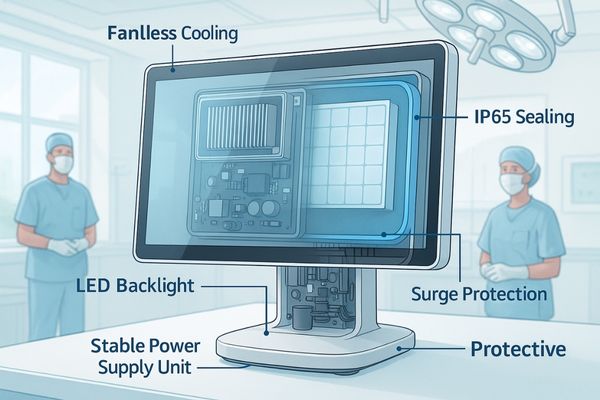
Cutaway digital illustration of a medical monitor showing internal components like LED backlight, heat sink for passive cooling, surge-protected power supply, and sealed casing for moisture resistance, set in a modern surgical room.

Top 8 Factors Influencing Display Lifespan

A medical display’s longevity is determined by a combination of critical factors. The most pivotal include:

Operating Temperature and Thermal Management
Backlight Technology and Longevity
Power Supply Stability and Protection
Usage Patterns and Operational Hours
Environmental Humidity and Moisture Risks
Chemical Resistance to Cleaning Agents
Prevention of Image Retention and Burn-In
The Manufacturer’s Core Engineering Philosophy

Read More »
Collage of medical monitors displaying CT scan, mammography, surgery image, grayscale calibration, and connectivity ports, highlighting key parameters like resolution, brightness, DICOM compliance, viewing angles, and system integration.

Key Parameters to Consider When Buying Medical Displays

When buying a medical display, key parameters include resolution for image clarity, brightness and luminance stability for consistent viewing, and DICOM compliance for accurate grayscale reproduction. Also consider viewing angles for collaboration and connectivity for system integration.

Read More »

Ask For A Quick Quote

We will contact you within 1 working day, please pay attention to the email with the suffix “@reshinmonitors.com”

Ask For A Quick Quote

We will contact you within 1 working day, please pay attention to the email with the suffix “@reshinmonitors.com”