Digital illustration of antibacterial coating degradation on medical display, showing new intact surface on one side and worn, damaged coating on the other, with technician performing surface swab test in a bright medical environment

Do antibacterial coatings lose effectiveness over time?

Yes, antibacterial coatings can lose effectiveness over time. This degradation is caused by physical abrasion, frequent cleaning with harsh chemical disinfectants, and prolonged exposure to environmental factors like UV light. Their longevity depends on the coating’s quality and the specific usage conditions.

Read More »
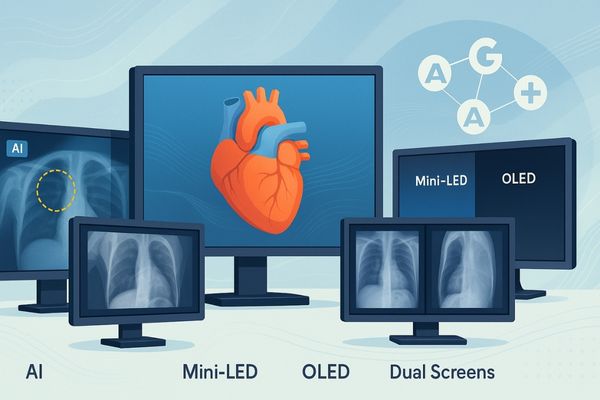
Illustration of advanced medical displays showing 3D organ rendering, AI-highlighted diagnostics, Mini-LED vs OLED comparison, and dual-screen imaging, representing innovation in medical display technology.

Sources of Innovation in the Medical Display Industry

Innovation in the medical display industry is driven by the convergence of several key forces. These include advancements in core display technologies, the integration of artificial intelligence, new materials, specific market demands, and cross-industry collaborations.

Read More »
Technician calibrating a medical display showing comparison of uncalibrated and calibrated mammogram images in a bright radiology room

Fundamentals of Color Management in Medical Displays

Effective color management in medical displays involves understanding color reproduction, adhering to key standards like DICOM, controlling environmental factors, and implementing regular calibration. This ensures consistent, accurate imaging for reliable diagnosis.

Read More »
Female dermatologist examining a high-resolution skin lesion image on a professional medical monitor in a bright, modern clinic.

What Kind of Monitor Does a Dermatology Clinic Need?

A dermatology clinic needs a monitor with high color accuracy, high resolution, and controlled brightness. These features are essential for visualizing fine skin textures and subtle color variations, which are critical for accurate diagnosis and patient documentation.

Read More »
Radiologist reviewing a CT lung scan with AI-highlighted nodule on a high-resolution medical display featuring a DICOM calibration graph

Value of Medical Displays in CT Imaging Diagnosis

The value of a medical display in CT diagnosis lies in its ability to render complex imaging data with exceptional clarity and accuracy. It ensures radiologists can confidently identify subtle pathologies, directly improving diagnostic precision and patient outcomes.

Read More »
Technician calibrating a medical diagnostic display using a handheld photometer to ensure brightness uniformity

Understanding Brightness Uniformity in Medical Displays

This article explains why brightness uniformity is essential for diagnostic accuracy. We will cover the standards that define it, the technologies that improve it, and why regular calibration is critical. You will understand how we engineer displays to meet these demanding requirements.

Read More »

Ask For A Quick Quote

We will contact you within 1 working day, please pay attention to the email with the suffix “@reshinmonitors.com”

Ask For A Quick Quote

We will contact you within 1 working day, please pay attention to the email with the suffix “@reshinmonitors.com”