Medical Display Market Should Focus More on Clinical Needs

Illustration of diverse clinicians collaborating with engineers around a medical display, symbolizing user-focused development and workflow integration in healthcare technology.

The market’s true advancement depends on prioritizing clinical feedback, creating specialized displays, ensuring seamless workflow integration, improving ergonomics, and committing to real-world validation over raw specifications.

Breakthroughs Needed in the Medical Display Industry

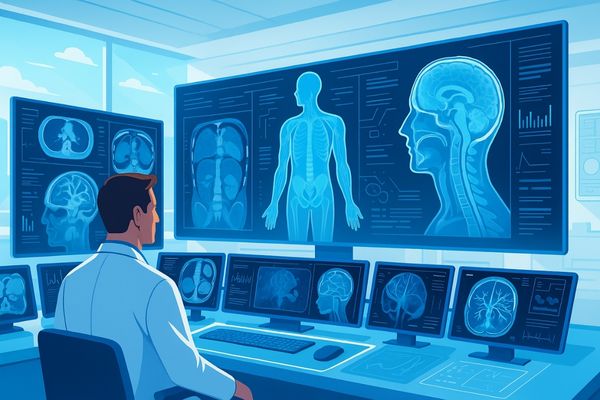
Futuristic medical display with AI integration, showcasing human anatomy wireframe, holographic charts, and key features like higher resolution, energy efficiency, and standardization.

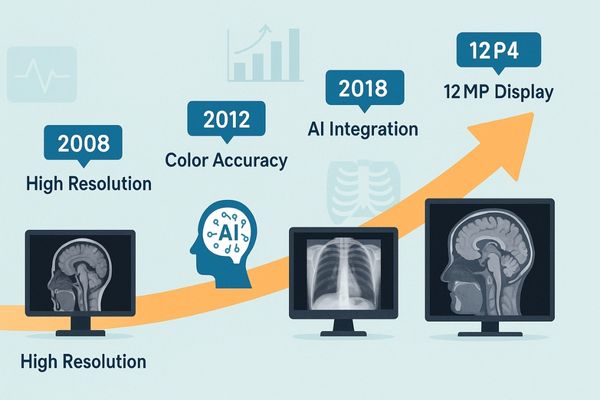
The medical display industry must innovate in five key areas: achieving higher resolution, integrating AI, improving energy efficiency, creating unified standards, and developing advanced features for surgical use.

HDR Technology in Medical Displays

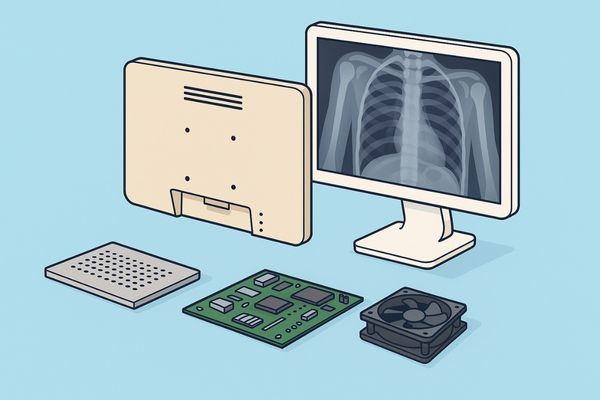
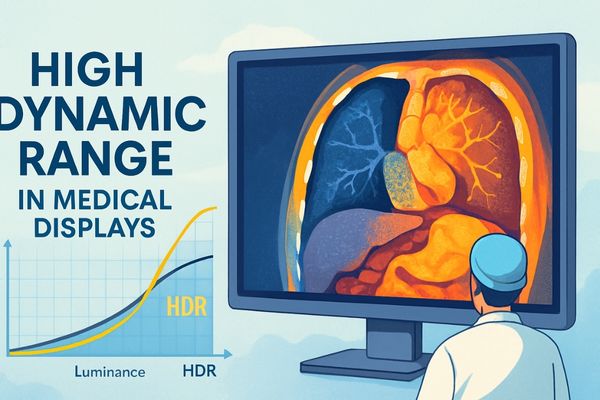
Comparison of HDR and SDR in medical imaging showing a chest X-ray, with HDR side displaying clearer details and improved contrast versus SDR side.

HDR enhances medical imaging with a wider dynamic range, improved lesion visibility through better contrast, and more accurate tissue differentiation via a wide color gamut, benefiting both diagnostics and surgery.

Price Trends in the Medical Display Market

Line graph showing fluctuating medical display prices, with an upward trend in the latter part, symbolizing market dynamics and technological advancement.

Medical display prices are shaped by a mix of factors. Technological advances and growing global demand tend to lower costs over time, while supply chain issues create short-term spikes. The market is stabilizing, but premium features will always command higher prices.

The Medical Display Industry’s Attitude Toward AI

Illustration of artificial intelligence in healthcare showing a doctor analyzing medical imaging on a display with a brain-circuit graphic and AI microchip symbol.

The medical display industry is moving from caution to active integration of AI. Leaders now recognize its potential to enhance image quality, automate quality assurance, and create smarter diagnostic and surgical workflows.

Optimal Configuration of Medical Displays in Operating Rooms

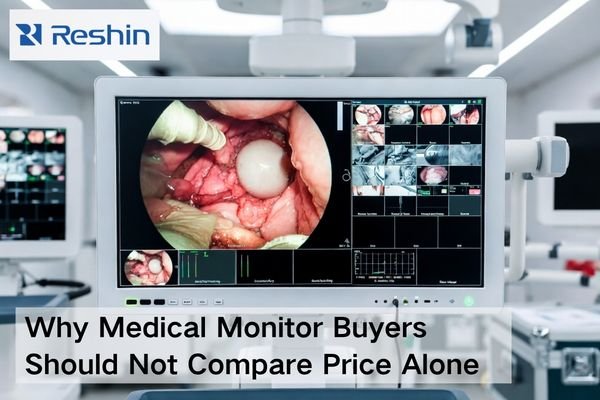
Modern operating room with multiple high-resolution surgical displays mounted on articulated arms for optimized viewing.

This article covers the optimal configuration of surgical displays. We will discuss display quantity, size, placement, input management, ergonomic mounting, and system compatibility to create a seamless and efficient operating room environment.

Significant Impact of Medical Displays on Precision Medicine

Doctor analyzing AI-enhanced medical imaging on a high-resolution display for precision medicine

Medical displays significantly impact precision medicine by enabling accurate interpretation of complex imaging data. They support multimodal visualization, ensure color-critical tissue differentiation, and facilitate collaboration. This high-fidelity view is essential for developing personalized, data-driven treatment strategies for each patient.