
An anonymized pre-sample project showing how Reshin supported a medical equipment manufacturer in identifying an existing medical display platform as the candidate baseline, separating mandatory integration changes from optional requests, and organizing private-label, documentation and continuity inputs before sample build.
Evidence scope: Customer identity, project location, commercial terms and selected configuration details remain confidential. This page documents the pre-sample candidate-configuration review together with relevant configuration-specific inspection, private-label and change-control evidence. Final sample approval, configuration freeze, pilot completion, volume orders and commercial deployment are not claimed.
The project was not treated as an unrestricted list of customization requests. A controlled stack was defined so that each adaptation remained connected to the candidate platform and later validation.
Each upper layer depended on a stable lower layer. Branding, documentation and continuity could not be finalized before the core platform and mandatory integration conditions were understood.
Customer-side validation, revision rules, pilot consistency, repeat-order feasibility and future replacement direction.
Customer model naming, labels, packaging, specifications and market-facing materials aligned with the actual configuration.
Interfaces, power, control, mounting, housing fit, cable access and other requirements necessary for equipment integration.
Existing display architecture, intended application, performance direction and core manufacturing baseline.
Medical equipment manufacturer · Malaysia, Southeast Asia
Private-label medical display integration into an equipment platform
Evaluate an existing platform first and adapt only where required
Pre-sample candidate-configuration review and program planning
Each requirement was placed into one of three paths: keep the proven standard configuration, adapt an item required for integration, or defer an optional request that did not justify additional scope.
Existing platform elements remained unchanged when they already supported the intended application, manufacturing process and expected validation path.
Mandatory adaptations were limited to requirements that directly affected system connection, mechanical installation, workflow or approved private-label execution.
Requests that added cost, lead time or revalidation effort without resolving a core integration need remained outside the first sample configuration.
Review principle: The objective was not to maximize customization. It was to identify the smallest controlled configuration that could support equipment integration, customer-side validation and repeatable later supply.
The review converted broad customization discussions into four decision gates, each with a defined output for the next program stage.
Existing medical display platforms were compared against the application, size, resolution, brightness and equipment-side conditions before any controlled variant was considered.
Candidate standard platform and required performance direction
Interface, power, control, mounting, enclosure and cable-access requirements were checked to identify the changes genuinely required by the host equipment.
Mandatory adaptation list and excluded optional requests
Model naming, product labels, carton labels, packaging and product information were reviewed only after the candidate configuration direction had become sufficiently stable.
Draft branding, label and documentation input package
Customer validation expectations, revision communication, pilot consistency, repeat-order feasibility and replacement planning were recorded for the stage after sample approval.
Post-validation freeze and continuity requirements
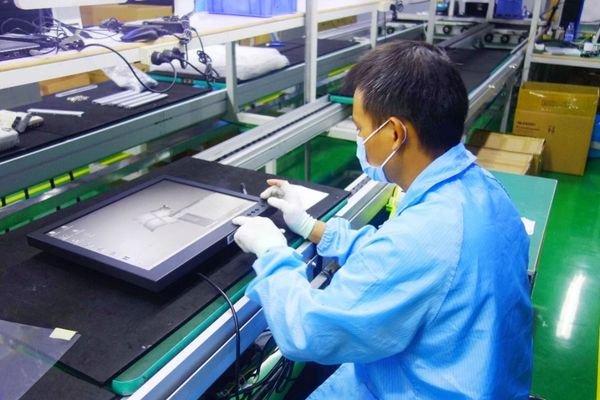
The candidate display could not be evaluated only as an engineering concept. The intended configuration also needed a practical path into controlled inspection, labeling, documentation and later production release.
This image shows a representative Reshin production-inspection environment and is not presented as the confidential customer’s exact project unit.
The evidence below demonstrates how customized medical display configurations can be translated into model-specific inspection, private-label, market-documentation and controlled-change records.
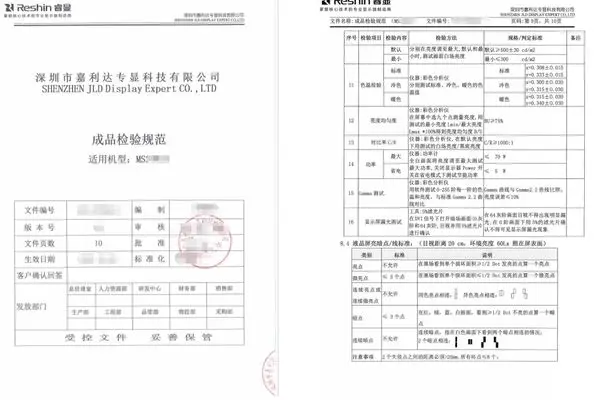
A redacted customized-model inspection specification demonstrates how an approved display configuration can be converted into controlled acceptance criteria covering appearance, structure, interfaces, display behavior, functions and release requirements.
A defined customized model and controlled document version
Interface, function, power and equipment-fit requirements
Appearance, image, structure and release acceptance items
Repeatable inspection reference for controlled manufacturing
This document is representative configuration-specific evidence. Customer identity, internal approvals and controlled technical details remain withheld. It is not presented as the exact anonymous project specification.
The project-context information describes the anonymized pre-sample configuration review. The inspection specification, label-layout record, regional-label evidence and engineering-change record demonstrate relevant Reshin configuration-control capability. They are not presented as proof of the customer's exact model, label, sample, pilot batch or completed commercial program.
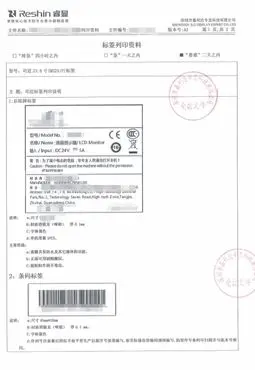
A redacted label-layout record demonstrates controlled review of model naming, rating data, nameplate content and barcode placement for a defined display configuration.
Representative private-label layout evidence, not the confidential customer’s exact artwork or approved production file.
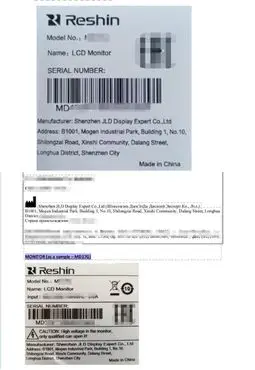
Redacted product and carton labels demonstrate alignment of model information, serial identification, regional markings and packaging data across customer-facing materials.
Representative regional-label and packaging evidence, not the confidential customer’s exact labels or registration files.
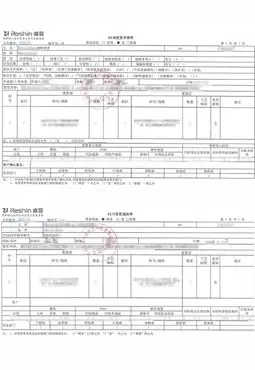
A redacted engineering-change record demonstrates how configuration revisions can be reviewed for affected items, approved and released under controlled change procedures.
Representative change-control evidence, not the confidential customer’s exact revision, approval record or production release.
The review separated the candidate platform, mandatory adaptation, private-label inputs and post-validation continuity requirements so each program area could enter customer-side evaluation with a clearer boundary.
| Program Area | Direction Retained | Review Rationale | Published Review Status |
|---|---|---|---|
| Candidate baseline platform | Closest existing medical display platform | Confirm whether the intended application, size, resolution and performance requirements could be met without unnecessary redesign. | Retained as the candidate baseline |
| Electrical and system fit | Required video, touch, control and power configuration | Define only the electrical changes required to connect the display with the host equipment before sample evaluation. | Requires pre-sample confirmation |
| Mechanical integration | Mounting, housing dimensions, installation space and cable access | Reduce later enclosure, bracket, connector-clearance and equipment-installation changes. | Requires mechanical-fit confirmation |
| Private-label and documentation | Model naming, labels, packaging and product information aligned with the candidate configuration | Keep customer-facing materials and traceability information consistent with the actual approved display direction. | Requires documentation alignment |
| Post-validation freeze and continuity | Validated configuration, revision communication and replacement direction | Protect consistency from customer-side validation through pilot, repeat production and later replacement planning. | Recorded as a later planning input |
The review changed the program from an open customization discussion into a controlled candidate-configuration framework that could support sample preparation, customer-side validation and later pilot planning.
Standard-model capabilities, integration-critical adaptations, optional requests, branding and documentation inputs had not yet been separated into a controlled program boundary.
An existing platform was retained as the candidate baseline, while mandatory changes, optional requests and private-label inputs were organized around the intended sample direction.
A possible sample evaluation could follow the candidate configuration, with final freeze, pilot consistency and revision control addressed only after customer-side validation.
This case documents the pre-sample candidate-configuration review. Final sample approval, configuration freeze, pilot completion, volume orders and commercial deployment are not claimed.
This case is published to demonstrate configuration-review and supplier-support capability without exposing confidential customer, commercial or controlled engineering information.
Similar equipment projects may require different levels of adaptation. The objective remains a repeatable configuration rather than unlimited modification.
Review an existing medical display first to determine whether its application, screen size, resolution, brightness and performance direction can support the host equipment without unnecessary redesign.
Typical output: Candidate baseline and gap list
Review video inputs, touch, control, power, connector position, default behavior and other equipment-side requirements according to integration necessity and manufacturing impact.
Typical output: Controlled interface and power definition
Coordinate mounting, enclosure fit, cable access, model naming, product labels, packaging and customer-facing documentation around the approved candidate configuration.
Typical output: Mechanical and private-label input package
After validation, control key parameters, approved documents, revision handling, pilot consistency, repeat-order feasibility and future replacement communication.
Typical output: Frozen configuration and revision-control baseline
This experience is relevant to equipment and product teams that need to define a controlled medical display configuration before sample build, private-label preparation or longer-term supply.
Review standard-platform adaptation, interface and mechanical customization, private-label execution and pilot-to-volume planning.
Explore Reshin's broader OEM cooperation framework for engineering coordination, controlled configuration and multi-stage equipment programs.
Review model continuity, stable configuration, controlled revisions and replacement planning for medical equipment projects with extended lifecycles.
Review Reshin's interface, mechanical, manufacturing, documentation and change-control capabilities for repeatable OEM display programs.
Share your intended application, candidate baseline model if available, screen size, resolution and brightness requirements, video, touch and control interfaces, power conditions, mounting and enclosure constraints, private-label inputs, target market, documentation needs and current sample stage. Reshin can help identify which requirements can remain standard, which changes are integration-critical and which optional requests should stay outside the initial sample scope.
OEM medical display programs may be subject to confidentiality, private-label, product-development or registration restrictions. Reshin therefore publishes the application context, review process, support scope and disclosed project stage without revealing the customer or complete configuration.
The case documents pre-sample candidate-configuration review. It covers baseline-platform evaluation, mandatory and optional change separation, integration and private-label inputs, and planning for later validation, configuration freeze and supply continuity.
No. The published project focuses on reviewing an existing medical display platform as the candidate baseline and applying controlled adaptations only where required. It does not claim a clean-sheet display, enclosure or electronics development program.
No. The project-context information describes the anonymized review. Configuration-specific inspection, label-layout, market-documentation and change-control records demonstrate relevant Reshin capability and are not presented as the customer's exact model, artwork, pilot or production record.
Helpful inputs include the intended application, required screen size, resolution and brightness, video, touch and control interfaces, power conditions, mounting method, enclosure space, cable access, private-label requirements, target market, documentation scope and sample plan.
A candidate configuration should be defined before sample build. Final freeze should normally follow customer-side validation and should be completed before pilot or repeat production, with interfaces, mechanical parameters, branding, documentation and revision-control requirements clearly recorded.
We use cookies to improve website functionality, analyze site performance, and protect inquiry forms from spam. You can accept all cookies, reject non-essential cookies, or manage your preferences at any time.
Tell us the application, model or required specification, quantity and destination country. We will review your request and reply by email.