Medical display color evaluation should connect the source signal, the selected color mode and measured output. BT.709 or BT.2020 support is one part of that review; it does not establish color accuracy, clinical suitability or an improvement in patient outcomes by itself.
This guide explains the questions to include in a display evaluation and the records to request from the supplier. It does not present an unnamed engineer’s deployments or an unreported comparative trial as evidence.
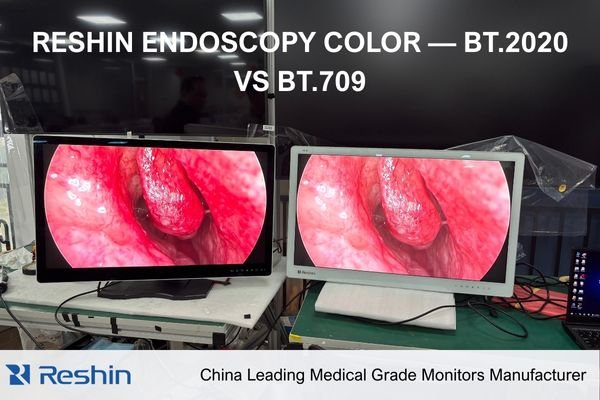
What Does Color Accuracy Mean in Medical Displays?
Color accuracy describes the agreement between a defined reference and the measured display output under stated conditions. Specify the source encoding, display preset, white point, transfer function, brightness setting and measurement method before comparing results.
Color Fidelity and Image Enhancement
More saturated colors are not necessarily more faithful to the source. Sharpening, contrast enhancement and gamut mapping can change the presentation. Agree which processing modes are permitted in the evaluated system and keep the settings consistent during comparison.
Measurable Components
| Measurement | What the report should identify |
|---|---|
| White point | Target chromaticity, measured chromaticity and brightness setting |
| Color difference (Delta-E) | Formula, reference space, patch set, instrument and mean / maximum result |
| Gamut | Target gamut, coverage calculation and measured primaries; distinguish signal acceptance from panel coverage |
| Uniformity | Measurement positions, viewing geometry and variation across the panel |
| Transfer response | Input encoding, output response and selected preset |
| Stability | Warm-up duration, operating conditions and repeated measurements |
There is no universal Delta-E pass value established by this article. Agree the acceptance criteria for the equipment and intended use before testing; results calculated with different formulas or patch sets are not directly interchangeable.
How Do BT.709 and BT.2020 Apply?
ITU-R BT.709 specifies parameters for HDTV systems, while ITU-R BT.2020 specifies parameters for UHD television systems. BT.2020 defines different color primaries and a wider target gamut. These are television signal-system recommendations, not medical-device approvals.
A display may accept a BT.2020 signal without reproducing the entire BT.2020 gamut. Ask for separate statements covering supported input formats, processing behavior, measured panel gamut and the preset used for verification.
Check the Complete Imaging Chain
Record the camera or processor model, firmware, output format, router or converter, cable path, display input and picture mode. A mismatch in encoding, range or processing may change the image even when every component advertises the same connector or resolution.
Compare the same representative source with enhancement settings controlled. Record any visible difference and its measured counterpart. A wider gamut alone should not be described as better detection of vessels, tissue changes or disease without application-specific clinical evidence.
What Influences Color Performance Over Time?
Temperature, operating time, backlight behavior and calibration settings can affect measured output. Ask which stabilization or calibration features are available on the exact model and how they are verified. Do not infer a sensor, correction function or multi-year tolerance from the label medical-grade.
A stability record should state the sample identity, operating condition, measurement intervals, instrument and measured change. No percentage advantage over consumer displays is claimed here without a comparable test record.
How Should Buyers Evaluate a Display?
- Define the intended source and viewing role.
- Obtain the current model specification and supported signal modes.
- Agree reference settings and acceptance criteria.
- Measure color, grayscale where applicable, uniformity and stability under recorded conditions.
- Verify switching, reconnection and repeatability with the actual signal path.
- Retain results, firmware and configuration revisions with the approval record.
Reshin Models to Review
The following links identify product directions for a model discussion. Request the current specification and measurement report for the proposed configuration; inclusion is not a claim that all models share the same color features or clinical approval.
| Model | Next verification step |
|---|---|
| MS275PA | Confirm intended use, supported source modes, calibration settings and available measurement records. |
| MS322PB | Confirm intended use, supported source modes, calibration settings and available measurement records. |
| MS430PC | Confirm intended use, supported source modes, calibration settings and available measurement records. |
| MD32C | Confirm intended use, supported source modes, calibration settings and available measurement records. |
| MD85CA | Confirm intended use, supported source modes, calibration settings and available measurement records. |
Frequently Asked Questions
Does every project need BT.2020?
No. Start with the actual source format and application requirements. Enabling a wider-gamut preset does not add information absent from the source.
Why can colors appear too saturated?
Check source encoding, display mode, range settings, enhancement and gamut mapping. Compare the complete configuration with the agreed reference instead of choosing a preset by appearance alone.
Is a consumer 4K TV equivalent because it accepts BT.2020?
No equivalence follows from that feature alone. Review intended use, documentation, integration behavior, cleaning and installation requirements, and the applicable equipment approval scope.
What should a tender request?
Request the model and revision, supported formats, calibration workflow, measurement conditions and results, service requirements and a project-specific acceptance plan. State whether a requirement concerns input compatibility or measured reproduction.
Conclusion
Choose a color configuration that matches the source and can be verified under repeatable conditions. Use published standards to identify signal parameters, and model-specific records to assess the proposed display. Clinical performance claims require separate evidence.
Request a surgical display model and sample evaluation with your processor, signal path and test requirements.