
An anonymized engineering-change case showing how Reshin documented and reviewed different change types within a customer-specific medical display program. The available ECR and ECN records cover product identification, mechanical reliability and power-configuration changes across related OEM display models.
Evidence scope: This page is based on real ECR/ECN records from the supplied customer-specific project files. The records do not prove that one physical unit underwent every change shown here. Related label, inspection and compliance documents are identified separately as supporting program or model-level evidence rather than the exact changed unit or commercial batch.
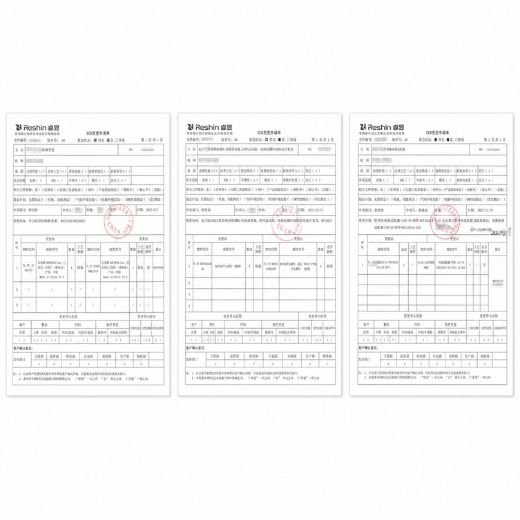
The records show that OEM change control is not limited to major redesign. Customer-facing identification, a small mechanical fastener and a power component can each affect documentation, product consistency or downstream validation and therefore require controlled review.
Medical equipment OEM · Germany, DACH region
A rear nameplate revision was initiated for related MS21KLD and MS24KLF configurations. The change record connects a seemingly simple label revision with controlled product and documentation management.
An MS24KLF locking-screen screw showed a loosening or detachment issue. The record states that sample testing was performed before the screw specification was changed.
A 24V/5A power-adapter configuration for related MS21KLF and MS24KLF models was changed after the original adapter failed the customer's leakage-current test.
The three records are not identical, but together they show a repeatable control logic: capture the trigger, determine affected items, define validation, review cross-functional impact and release the change into controlled execution.
Record the customer, product, quality or engineering reason that makes a change necessary.
Identify affected model, material, BOM, drawing, label, specification, SOP or other controlled item.
Determine whether sample testing, functional review, compliance confirmation or another validation activity is required.
Assess inventory, purchasing, quality, production, engineering and customer-communication implications.
Define implementation timing and update the relevant controlled records before the revised configuration is released.
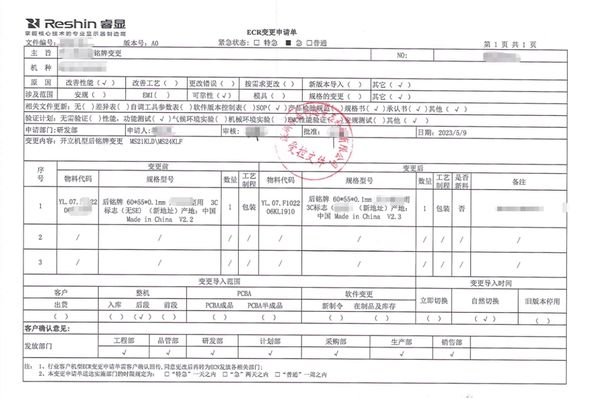
The ECR documents a rear nameplate revision affecting related MS21KLD and MS24KLF configurations. The form identifies the affected model scope and the before/after label direction rather than treating the change as an informal artwork request.
Nameplates can carry product identity, model information, rating data, country-of-origin information, serial or barcode rules and customer-facing branding. A revision therefore needs alignment with the configuration that is actually produced.
The related review form includes fields for BOM, technical documents, inventory, quality, production and other departments, showing that even identification changes can require broader execution control.
The mechanical record is especially useful because it documents an observed product issue, a sample-based verification step and a defined component-specification change.
The ECN states that the locking-screen screw on an MS24KLF configuration showed a loosening or detachment phenomenon. This created a concrete mechanical-reliability reason for change rather than a cosmetic preference.
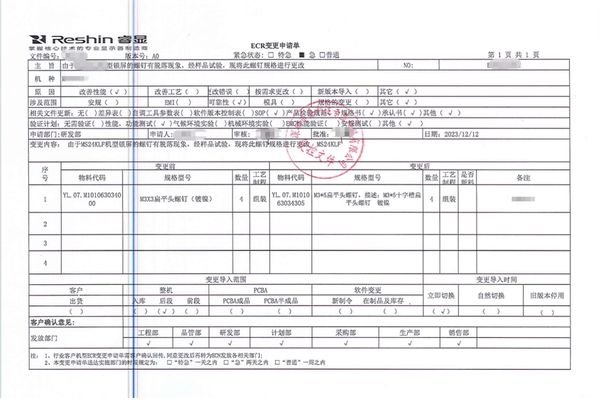
The screw specification was changed after the sample trial. The associated review sheet then provided a structured place to consider engineering documentation, material impact, inventory, quality and production implementation.
The electrical-change record states that the original 24V/5A power adapter used with related MS21KLF and MS24KLF configurations could not pass the customer’s leakage-current test. A replacement adapter configuration was therefore introduced through the engineering-change process.
The trigger came from a customer-side leakage-current test rather than an internal styling preference.
The power-adapter specification and related controlled product information required review.
The review form includes inventory, purchasing and production considerations before implementation.
Validation and risk-review fields are built into the change-review process before the revised configuration is released.
Boundary: This record supports a real customer-test-driven adapter change. It does not by itself prove final customer approval, shipment quantity or long-term commercial outcome.
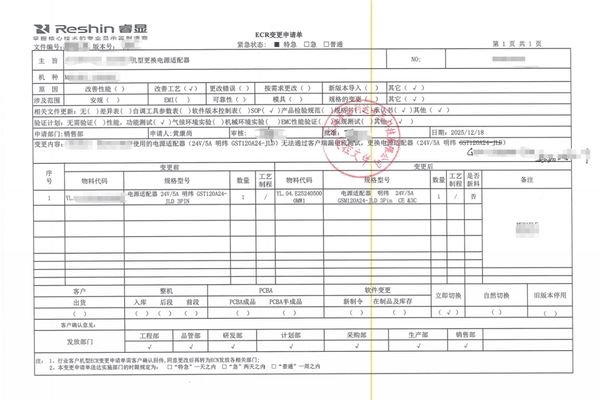
The review sheet attached to the power-configuration change shows a cross-functional structure for evaluating technical documents, inventory, purchasing, quality, production resources and customer communication.
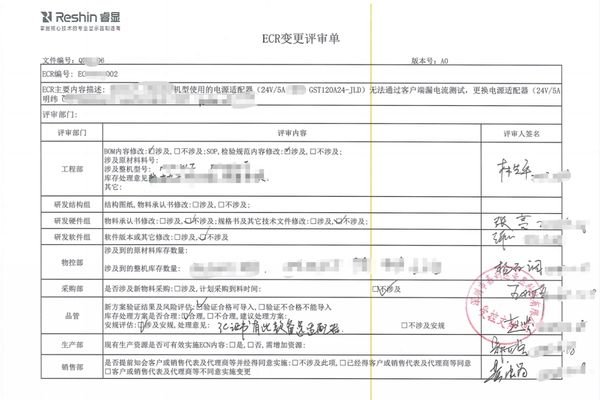
BOM, SOP and inspection-document impact.
Mechanical drawings and material-approval impact.
Hardware and technical-document impact.
Raw-material and finished-goods inventory impact.
New-material purchasing and supply preparation
Validation result, risk and release assessment.
Production-resource and implementation feasibility.
Customer or representative communication where required.
Implementation timing and old/new configuration transition.
The engineering-change records are the primary case evidence. The documents below add a separate layer of confidence by showing controlled label execution, finished-product inspection documentation and compliance evidence within the related customer-specific evidence set.
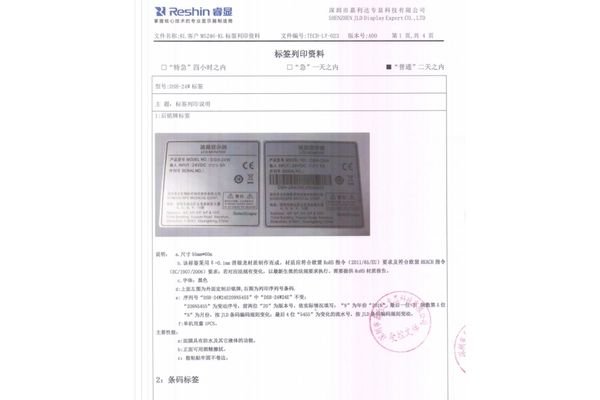
A separate customer-specific label-printing document shows that nameplate content, dimensions, serial or barcode rules and label execution are managed through a defined document rather than informal artwork alone.
Evidence level: Related program documentation. It is not presented as the exact final label revision released by the ECR above.
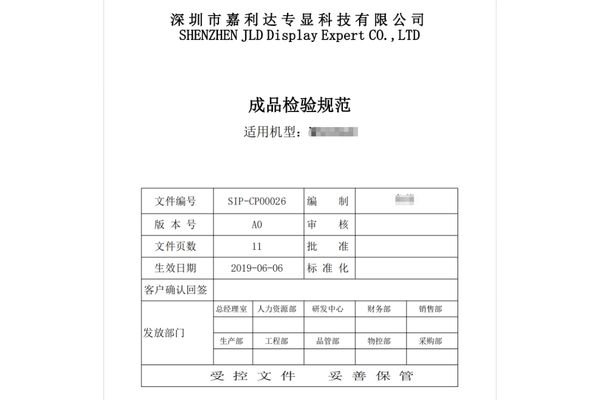
The MS21KLD finished-product inspection specification provides model-level evidence that a related OEM display configuration is supported by controlled inspection documentation and defined release criteria.
Evidence level: Model-level quality-control evidence supporting repeatability after configuration changes.
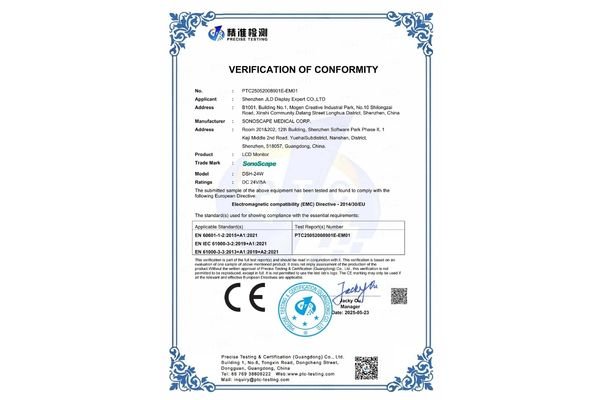
A separate conformity record for a related customer-specific display configuration provides supporting evidence of EN 60601-1-2 testing within the broader OEM documentation set.
Evidence boundary: Supporting compliance evidence only. It is not presented as validation of every engineering change shown on this page.
The strongest supplier signal is not that changes never occur. It is that changes can be identified, reviewed, verified, documented and released without losing configuration control.
Real ECR/ECN records exist for product-identification, mechanical and electrical configuration changes, including sample-test and customer-test-driven change triggers.
The page does not claim that one physical unit underwent all three changes, that the documents prove final customer approval, or that a particular shipment volume or repeat order resulted.
Reshin can document a change trigger, identify affected configuration items, review validation and operational impact, and connect the revised configuration with controlled downstream records.
This page is intentionally separated from Reshin’s existing OEM/ODM configuration-control case. The two pages address different risks in the supplier lifecycle.
The existing OEM/ODM case focuses on the pre-sample stage: selecting a proven baseline, separating mandatory integration requirements from optional requests, aligning private-label documentation and preparing a controlled sample configuration.
This case begins after an OEM configuration already exists and a change is required. The focus is the trigger, affected scope, validation, cross-functional impact, controlled release and continuity of the revised configuration.
Review Reshin support for medical equipment manufacturers, OEM brands and system-integration programs.
Review engineering, interface, mechanical, manufacturing and controlled-change capabilities for medical display programs.
Review public certifications, quality controls, project evidence and supplier-evaluation resources.
Share your application, current model, required change, validation concern and target project stage with the Reshin team.
Share the current model, reason for change, affected component or document, validation requirement, existing inventory, target market and expected implementation stage. Reshin can help structure the technical review and change-control scope before the revised configuration is released.
Changes to product identification, components, mechanical parts, interfaces, power configuration, firmware, labels, inspection criteria or other items that can affect the approved configuration should be reviewed according to their actual impact.
The test result should be linked to the affected configuration, the proposed change, required validation, inventory and production impact, and the controlled documents that must be updated before release.
No. An ECN or ECR proves that a change was documented and reviewed to the level shown in the record. Final customer approval, pilot completion, commercial shipment or repeat-order status should only be claimed when separate evidence supports those outcomes.
A small component can affect reliability, assembly, material control, drawings, inventory and production consistency. The MS24KLF record on this page is a practical example: a locking-screw issue led to sample testing and a controlled specification change.
Pre-sample configuration review defines what the initial sample should be. Engineering change control manages what happens later when an approved or established configuration needs to change.
Reshin can support requirement review, affected-item identification, available validation documentation, controlled configuration discussion and change communication according to the actual model, project scope and customer requirements.
We use cookies to improve website functionality, analyze site performance, and protect inquiry forms from spam. You can accept all cookies, reject non-essential cookies, or manage your preferences at any time.
Tell us the application, model or required specification, quantity and destination country. We will review your request and reply by email.