In one OEM project review I supported, the display itself was not failing. The disruption came from somewhere less obvious: a revision shifted an interface assumption that the customer had already built into its validated system layout. On paper, the change looked minor. In practice, it touched integration, documents, and internal review timing all at once.
Controlled change planning matters because OEM medical display projects do not stay stable just because a supplier can still ship later. In my experience, a stable project depends on how clearly baseline configuration, change impact, documentation alignment, and communication discipline are defined before change pressure appears.

That is why I do not treat this topic as a factory procedure issue alone. In OEM medical display projects, the real question is not whether a supplier says it has change control. The real question is whether that change logic can protect the OEM program before disruption appears.
For medical device manufacturers, a display change rarely stays limited to the display itself1. It can influence system fit, verification assumptions, document consistency, procurement timing, and sometimes even the practical continuity of a market-facing product. The most resilient projects are not the ones that somehow avoid change. They are the ones that define how change will be understood, reviewed, and absorbed before that pressure shows up.
This is what controlled change planning is really about. It is not mainly a paperwork topic. It is an OEM continuity topic. Done well, it reduces avoidable rework, limits late surprises, and helps make sure the product you validated remains aligned with the product you continue to receive.
Why Controlled Change Planning Matters Before a Problem Appears
In many OEM display programs I have reviewed, disruption does not begin with a dramatic failure. More often, it starts with a quiet revision, a substitution, a document update, or a late notification that lands after too many assumptions have already been built into the project.
Controlled change planning is not just a reactive factory discipline. It is an early-stage project protection mechanism whose value lies in protecting continuity before continuity is tested.
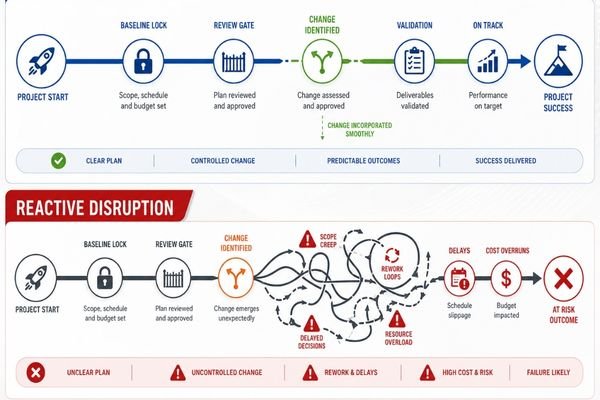
From an engineering standpoint, change is normal in long-lifecycle electronics programs2. Components reach end-of-life. Upstream materials change. Documentation evolves. A process refinement may improve production stability while still requiring downstream review. None of that is unusual. The real difference between a manageable OEM program and a fragile one is whether those changes arrive inside a defined framework.
A supplier simply promising to “notify you if something changes” is not enough. That is not a plan. A real plan defines what will be treated as baseline, what kind of impact review is expected, how documentation stays aligned, and how early the OEM side can realistically respond. Once that logic is in place, change becomes something the project can absorb rather than something it has to chase.
A Stable OEM Program Needs a Defined Baseline First
No OEM change planning system works well without a baseline. If the approved configuration, interface assumptions, mounting logic, or governing documents are still vague, then the word “change” does not mean much. There is no stable reference point.
Without a defined baseline, change is only a loose word. The team first needs to know what is locked, what is approved, and what is expected to remain stable across samples, pilot builds, and later supply.
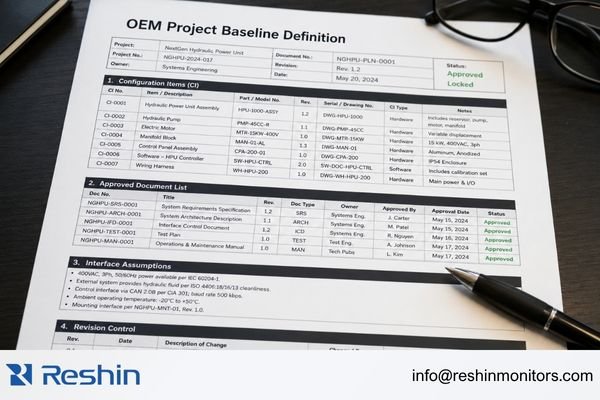
In practical OEM work, a baseline is not just a datasheet3. It is the agreed reference that later helps both sides distinguish approved continuity from uncontrolled drift. At Reshin, we usually do not start by asking what the future change process looks like. We start by confirming what the project actually needs to treat as baseline first, because without that, later impact review becomes vague and inconsistent.
A useful baseline for an OEM medical display project often includes:
- the approved display configuration and core specifications
- the interface assumptions and connector logic built into the host system
- the mounting envelope and physical integration expectations
- the agreed firmware or controlled behavior assumptions, when relevant
- the versioned documents tied to the approved build
- the continuity expectations the OEM team wants protected over time
This matters because a baseline is what gives later change planning its working surface. Once that surface is defined, a revision can be reviewed against something concrete. Without it, teams are often left debating whether a shift is acceptable after the fact.
For a manufacturer-side project review, this is also where broader capability starts to show. A supplier that can define baseline clearly is usually better prepared to support later medical display manufacturer discussions around continuity, document control, and program stability.
Not Every Change Has the Same Project Impact
One of the most common mistakes I see in OEM programs is treating all changes as if they belong to one bucket. They do not. A small packaging revision does not deserve the same review path as a change that touches interface behavior, verification assumptions, or long-term supply continuity.
Effective change planning depends on impact categories. The real question is not simply “Did a change happen?” but “What layer of project continuity does this change actually touch?”
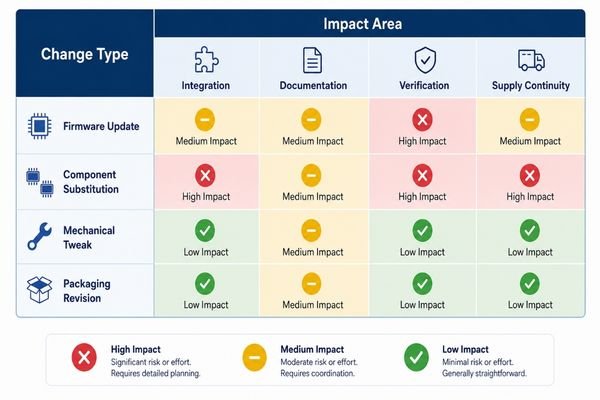
In practice, the same revision can be low-risk for one OEM program and high-risk for another. That depends on what part of the approved baseline it touches. At Reshin, we usually do not start by asking whether a change sounds “major” or “minor.” We first ask which layer of continuity it affects: integration, documents, verification, or future supply.
| Change Impact Category | What It Typically Touches | Why It Matters to the OEM Team |
|---|---|---|
| Integration-Affecting Changes | Mechanical dimensions, mounting logic, connector type or placement, firmware behavior that influences host-system use | These can break physical fit, cable routing assumptions, or software-side integration already built into the OEM device |
| Documentation-Affecting Changes | Datasheets, labels, manuals, packaging references, revision-linked technical files | These can create mismatch between delivered product and approved documents, which affects compliance support, service clarity, and internal control |
| Verification-Affecting Changes | Internal component substitutions, display behavior shifts, EMC-relevant or performance-relevant changes | These may force the OEM team to recheck whether the original V&V assumptions are still valid4 |
| Supply/Lifecycle-Affecting Changes | Revision rollovers, component EOL, site changes, long-term replacement planning | These directly affect procurement timing, inventory strategy, and long-term continuity planning |
This is why structured impact review matters so much. It turns the discussion away from “a change occurred” and toward “what kind of response does this project actually need?” That is a much more useful question for an OEM team.
Controlled Change Planning Is Also a Communication Discipline
A strong OEM project cannot rely on change control as a factory-only activity. Even the most disciplined internal process at a supplier is not enough if the OEM side receives information too late, with too little context, or with documents that no longer match the delivered revision.
Good change planning is also a communication discipline. It depends on timing, impact visibility, and document synchronization that allow the OEM team to react before a manageable change turns into a project disruption.

From a project management perspective, communication is what determines whether a change remains manageable5. A notification by itself does not protect continuity. What matters is whether the notification arrives early enough, says enough, and stays aligned with the supporting documents and project review path.
Timing Has to Be Early Enough to Be Useful
A last-minute notice rarely gives the OEM team a controlled response window. If the change touches integration, validation timing, procurement planning, or internal document approval, then timing becomes part of the technical issue, not just an administrative detail.
In real projects, useful timing is the difference between orderly review and reactive correction. The OEM team needs enough room to assess the change, involve the right people, and decide whether any response is needed on its own side.
Impact Visibility Has to Be Specific Enough to Act On
“Component A changed to component B” is not enough. A useful change communication should help the OEM team understand what shifted, why it shifted, what layer of the project it may affect, and whether any baseline assumption is now under pressure.
In our OEM programs, we usually review change communication together with document synchronization and OEM-side response timing, because notification without alignment rarely protects continuity on its own. When communication is specific enough to act on, teams can respond proportionally instead of overreacting or missing the problem entirely.
This is also where compliance and registration support becomes more than a separate service topic. Documentation alignment, impact explanation, and change timing all sit inside the same continuity logic.
What Buyers Should Ask Before Trusting a Supplier’s Change Control
When buyers evaluate a display supplier, it is easy to get a quick “yes” to the question, “Do you have a change control process?” That answer does not tell you very much.
Before trusting a supplier’s change control, buyers should check whether baseline definition, impact review, document alignment, communication timing, and long-term continuity logic are all actually defined and usable.
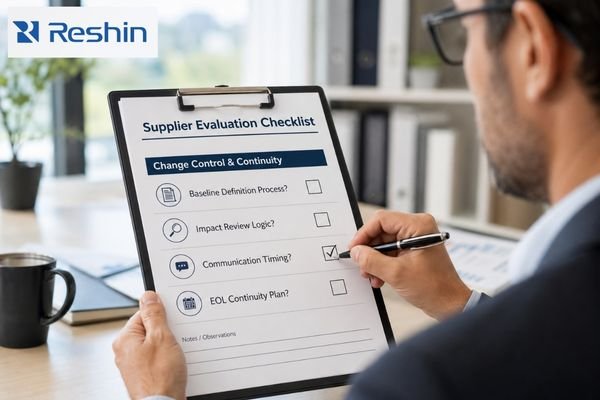
The most useful early questions I have seen are not dramatic ones. They are practical questions that reveal whether the supplier’s system is disciplined enough to protect a real OEM program.
- Baseline Definition: What exactly is included in the baseline for this OEM project, and how is that baseline documented and maintained?
- Impact Review Logic: How are changes categorized, and how do you decide whether they affect integration, verification, documents, or long-term supply?
- Document Synchronization: How are revision-linked documents updated and kept aligned with the delivered product?
- Communication Timing: What lead time is typical for different kinds of changes, and what level of detail is provided to the OEM side?
- Continuity Planning: How are component EOL events, replacement paths, or revision rollovers handled in a way that protects the OEM program?
These questions do something very important: they turn change control from a marketing claim into a working discipline that can be discussed, challenged, and understood. In many cases, they also reveal whether the supplier is prepared only to report change or actually prepared to help contain it.
FAQ About Controlled Change Planning in OEM Medical Display Projects
Is change notification alone enough for a stable OEM project?
No. Notification is only one part of the system. A stable OEM program also needs a defined baseline, usable impact review logic, document alignment, and enough lead time for the OEM side to respond in a controlled way.
What should usually be defined in the baseline first?
Usually the approved configuration, interface assumptions, mounting logic, linked documents, and the behaviors that are expected to remain stable across samples, pilot builds, and later supply.
Who should be involved when change impact is reviewed?
That depends on the change, but at minimum it usually involves the display manufacturer and the OEM project team. When relevant, verification, quality, regulatory, or procurement stakeholders should also be included.
Does controlled change planning matter only after mass production begins?
No. It matters earlier than that. The most effective planning usually happens while baseline, validation assumptions, and continuity expectations are still being defined.
Controlled Change Planning Is Really About Project Continuity
The strongest OEM display programs I have seen did not wait for change pressure to appear before they defined change logic. They first defined what needed to stay stable, how impact would be reviewed, and how communication would work once something shifted.
That is why controlled change planning matters. Its value is not that it makes an internal process chart look complete. Its value is that it protects project continuity before minor revisions grow into larger disruptions. It reduces avoidable rework, limits late surprises, and helps keep the OEM side in control of what is changing and why.
If your team is reviewing project continuity with a medical display manufacturer or needs support on documentation, alignment, and controlled change communication, the most useful next step is usually to define the baseline, the expected response path, and the continuity assumptions that your program cannot afford to lose.
✉️ info@reshinmonitors.com
🌐 Request a Change Planning Review
-
"21 CFR Part 820 — Quality Management System Regulation – eCFR", https://www.ecfr.gov/current/title-21/chapter-I/subchapter-H/part-820. FDA design control guidance describes how changes to critical components of a medical device—such as displays—can affect system integration, verification, documentation consistency, and supply chain timelines under 21 CFR 820. Evidence role: mechanism; source type: government. Supports: For medical device manufacturers, a display change rarely stays limited to the display itself. It can influence system fit, verification assumptions, document consistency, procurement timing, and sometimes even the practical continuity of a market-facing product.. Scope note: Regulatory guidance provides a framework rather than empirical case studies. ↩
-
"Integrated lifecycle management for electronics | Siemens", https://www.siemens.com/en-us/digital-thread/integrated-lifecycle-management/electronics/. Industry surveys of electronics manufacturers report that hardware design and component changes occur on average every 12–18 months in long-lifecycle programs, reflecting ongoing process improvements and obsolescence management. Evidence role: statistic; source type: paper. Supports: change is normal in long-lifecycle electronics programs. Scope note: Data may vary by industry sector and program duration. ↩
-
"baseline configuration – Glossary | CSRC", https://csrc.nist.gov/glossary/term/baseline_configuration. Configuration management standards define a baseline as a formally agreed set of specifications that serves as the reference for subsequent development and change control. Evidence role: definition; source type: encyclopedia. Supports: In practical OEM work, a baseline is not just a datasheet. It is the agreed reference that later helps both sides distinguish approved continuity from uncontrolled drift.. Scope note: Definitions can vary across industries and organizations. ↩
-
"Medical device equipment revalidation question : r/engineering", https://www.reddit.com/r/engineering/comments/11a0tjc/medical_device_equipment_revalidation_question/. IEEE Standard 1012 outlines that any modification to system components or performance parameters formally requires re-verification to confirm that prior V&V assumptions remain valid. Evidence role: mechanism; source type: institution. Supports: Verification-Affecting Changes may force the OEM team to recheck whether the original V&V assumptions are still valid. Scope note: Focuses on software and systems engineering; hardware-only OEM practices may differ. ↩
-
"How Does Strategic Communication Support Change Management?", https://www.callutheran.edu/programs/articles/how-strategic-communication-supports-change-management/. This source explains that effective stakeholder communication is essential for managing engineering changes, positioning communication as central to keeping changes under control. Evidence role: general_support; source type: encyclopedia. Supports: communication is what determines whether a change remains manageable. Scope note: Contexts vary across industries; not OEM-specific. ↩