In my work supporting medical display implementations across diverse healthcare environments, I’m looking forward to WHX Dubai 2026 as a chance to discuss real integration pain points face-to-face and to show how Reshin, as a medical-grade display manufacturer, designs for predictable performance in surgery and diagnosis—not just for a “demo-perfect” moment, but for repeatable deployment behavior.
WHX Dubai 2026 (formerly Arab Health) is widely regarded as one of the Middle East’s leading healthcare technology exhibitions, running February 9–12, 2026 at Dubai World Trade Centre. During the show, Reshin will demonstrate surgical and diagnostic display solutions built for reliable system integration—stable signal handling, predictable switching behavior, and deployment-ready configuration thinking that supports demanding clinical workflows.
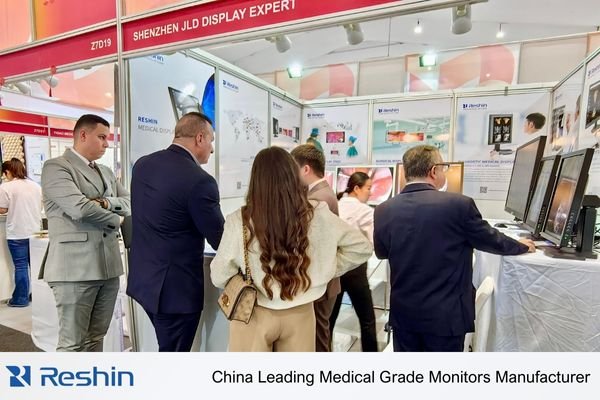
From my experience with regional healthcare implementations, exhibitions like WHX Dubai1 are especially useful because procurement teams and integrators can evaluate how a display behaves in realistic integration scenarios—switching, routing, and typical operational constraints—rather than relying only on specification comparisons or idealized lab conditions.
What Is WHX Dubai 2026 (Formerly Arab Health)?
Understanding the exhibition context helps frame the opportunities for healthcare technology evaluation.
WHX Dubai 2026 (formerly Arab Health) is positioned as a major Middle East healthcare exhibition where hospitals, distributors, and technology partners evaluate medical devices and clinical solutions. The 2026 edition runs February 9–12, 2026 at Dubai World Trade Centre, bringing together global suppliers across medical equipment, imaging, digital health, and surgical ecosystems.

When I review successful medical display deployments, I often find that the most effective selections happen when teams can evaluate integration behaviors—signal stability2, switching performance, and workflow compatibility—in realistic demonstration environments rather than relying solely on specification comparisons.
Regional Healthcare Focus
WHX Dubai serves as a concentrated platform for regional healthcare decision-makers to assess technologies relevant to Middle East and North Africa healthcare environments, including operational considerations related to infrastructure, installation realities, and long-term reliability expectations.
Technology Integration Platform
The exhibition provides opportunities to evaluate how medical displays integrate with common clinical systems, from endoscopy towers and imaging workstations to OR routing and switching infrastructure that increasingly defines modern healthcare facilities.
Why Does WHX Dubai Matter for Healthcare Decision-Makers in MENA?
Regional exhibitions provide unique evaluation opportunities for healthcare technology assessment.
WHX Dubai functions as a regional direction-setting event where procurement teams and integrators can evaluate deployment readiness across surgery, imaging, and clinical review applications. MENA environments often require displays that handle long cable runs, switching devices, multiple sources, and repeated state transitions reliably, making in-person evaluation valuable for assessing real-world performance.

Based on the projects I support with OR integration and routing partners, regional exhibitions3 accelerate alignment on practical deployment requirements—mounting constraints, cleaning protocols, serviceability expectations, and validation procedures—that enable teams to move from interest to workable implementation baselines.
End-to-End Reliability Assessment
MENA healthcare environments frequently require displays that maintain stable operation with complex signal chains, extensive routing infrastructure, and operational conditions that demand consistent performance across extended use.
Project Reality Alignment
Face-to-face evaluation enables rapid alignment on practical constraints including installation requirements, maintenance expectations, training needs, and lifecycle support that affect successful long-term deployments in regional healthcare facilities.
Partnership Development
Regional exhibitions facilitate relationship building between healthcare organizations and technology partners that support collaboration throughout evaluation, implementation planning, and operational phases of clinical display deployments.
What Surgical Display Requirements Will Reshin Focus on at the Show?
Surgical applications demand specific display characteristics that support demanding OR environments.
Surgical environments require predictable behavior under pressure: fast re-lock after switching, minimal interruptions, consistent presentation across sources, and practical usability under OR cleaning and mounting conditions. Real OR signal chains can experience "no signal" or mode inconsistencies due to negotiation and state transitions, making input strategy and switching behavior critical evaluation areas.
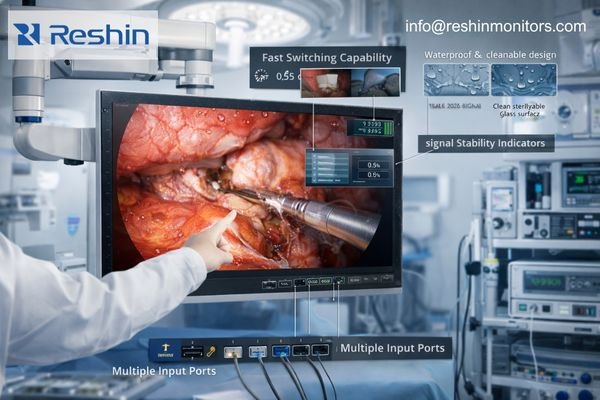
In my OR integration work at Reshin, I’ve learned that surgical display discussions4 work best when they stay scenario-based—endoscopy tower compatibility, multi-source routing stability, team viewing geometry, and maintaining workflow predictability through repeatable configuration and verification procedures.
Signal Chain Stability
Surgical applications require displays that maintain stable operation through the complex signal chains typical of modern ORs, including endoscopy towers, camera processors, routing matrices, and switching devices that can trigger negotiation challenges.
Switching Performance
OR workflows depend on fast, reliable switching between multiple sources without signal dropouts or extended re-lock times that could interrupt critical moments during surgical procedures.
Mounting and Cleaning Compatibility
Surgical displays must support flexible mounting solutions that accommodate OR layouts while providing surfaces and sealing compatible with standard OR cleaning protocols and infection control requirements.
Mode Consistency
Surgical teams require displays that maintain consistent presentation modes across power cycles, input switching, and routing changes to support predictable visual behavior throughout procedures. Contact us at info@reshinmonitors.com to schedule a demonstration of our surgical display solutions at WHX Dubai 2026.
What Diagnostic Display Priorities Can Visitors Evaluate with Reshin?
Diagnostic applications have specific requirements that differ from surgical display needs.
Diagnostic reading emphasizes grayscale consistency, calibration discipline, and pixel-accurate presentation within clinical workstation environments. Beyond panel performance, integration considerations include standardized workstation outputs, OS/GPU change management, and verification procedures that maintain consistent display behavior after updates or maintenance.
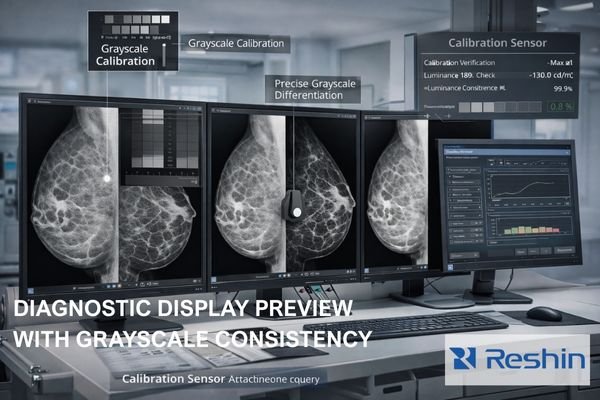
From an engineering standpoint, I usually find that diagnostic display evaluation must address deployment realities including room lighting management, viewing distance optimization, multi-monitor layouts, and lifecycle planning that treat displays as part of controlled diagnostic systems.
Grayscale Performance
Diagnostic applications require displays that maintain excellent grayscale accuracy and consistency across the luminance ranges used for medical imaging interpretation, with stable behavior over extended operational periods.
Calibration Integration
Diagnostic workflows depend on displays that support systematic calibration procedures5 and maintain performance stability between calibration cycles, enabling consistent interpretation practices across clinical teams.
Workstation Compatibility
Diagnostic displays must integrate reliably with clinical workstation hardware and software configurations, maintaining stable output modes and presentation characteristics across system updates and maintenance cycles.
Multi-Monitor Consistency
Diagnostic reading environments often require multiple displays that maintain matched performance characteristics, enabling consistent image presentation across extended viewing configurations used for comparative review.
Which Medical Display Solutions Will Reshin Demonstrate at WHX Dubai 2026?
Our exhibition focus emphasizes practical integration and deployment-ready solutions.
The most effective exhibition approach maps display solutions to specific clinical workflows while demonstrating repeatable real-world integration rather than idealized conditions.
| Clinical Role / Application | Workflow Requirements | Display Requirements | Recommended Model | Key Demonstration Focus |
|---|---|---|---|---|
| Diagnostic Reading | Grayscale accuracy, calibration stability | High-resolution, stable grayscale performance | MD52G | Calibration consistency, workstation integration |
| Clinical Review | Multi-modality viewing, reliable operation | Versatile input support, stable operation | MD32C | Multi-source compatibility, consistent presentation |
| Compact Diagnostic | Space-efficient installations | Reliable performance, efficient design | MD26C | Space optimization, consistent diagnostic quality |
| Entry Diagnostic | Cost-effective diagnostic capability | Reliable diagnostic performance | MD18G | Essential diagnostic features, reliable operation |
| Surgical Visualization | OR integration, switching stability | Fast switching, stable signal handling | MS321PB | OR workflow integration, switching performance |
| Endoscopy Applications | Tower compatibility, stable presentation | Reliable endoscopy integration | MS270P | Endoscopy tower compatibility, consistent imaging |
For surgical applications, demonstrations will emphasize stable signal locking, predictable switching behavior, mounting flexibility, cable management, and cleaning compatibility that support real OR operational requirements.
Diagnostic demonstrations will focus on consistent grayscale presentation, calibration approaches, workstation integration strategies, and verification procedures that help maintain performance across system updates and maintenance cycles.
Interface strategy and signal chain considerations will receive particular attention, including input selection approaches, routing path optimization, and baseline configuration documentation that enables teams to verify and restore known-good configurations when environments change.
FAQ
When and where is WHX Dubai 2026 held?
It runs from February 9–12, 2026 at Dubai World Trade Centre (DWTC) in Dubai, United Arab Emirates.
Is WHX Dubai the same event as Arab Health?
WHX Dubai 2026 is positioned as the continuation of the event formerly known as Arab Health, with the same regional focus on healthcare technology and solutions.
What should visitors prepare to evaluate surgical monitor fit?
Bring your typical source profile (endoscopy tower/camera processor output modes), switching/routing context, and your "must-have" behaviors such as fast re-lock and stable mode retention across switching.
What causes display behavior to change between setup and real use in the OR?
State transitions and chain complexity—boot/wake/switching events, intermediate devices, and port/path changes can trigger renegotiation and silent mode shifts.
How do you recommend validating a display system after updates or maintenance?
Re-verify the same baseline mode and the same signal path, focusing on repeatability across power cycling and switching, and document any changes so the system can be restored quickly.
Can a monitor "work" but still be in a suboptimal mode for surgery or diagnosis?
Yes—an image can appear in a fallback mode with unexpected scaling, different encoding, or slower switching behavior; confirming and standardizing modes is key to predictable workflows.
Conclusion
WHX Dubai 2026 at Dubai World Trade Centre (February 9–12, 2026) will be a valuable opportunity for MENA healthcare teams to evaluate clinical display technologies under realistic integration conditions that reflect actual deployment environments. Our exhibition approach emphasizes repeatable integration outcomes—stable modes, predictable state transition behavior, and configuration baselines that teams can verify and maintain throughout system lifecycles.
Reshin’s presence at WHX Dubai 2026 will focus on demonstrating surgical and diagnostic medical displays from a manufacturer’s perspective: engineering for reliable integration, controlled configuration, and maintainable deployment baselines rather than one-off success in ideal conditions. By showcasing approaches that address real-world constraints—including mounting requirements, cleaning protocols, and serviceability expectations—we aim to help healthcare organizations make informed decisions that translate into successful long-term implementations. We look forward to meeting with regional healthcare professionals to discuss how our medical display solutions can support their specific clinical workflow requirements and deployment objectives.
✉️ info@reshinmonitors.com
🌐 https://reshinmonitors.com/
-
This resource will help you understand the importance of WHX Dubai in showcasing innovative healthcare solutions and networking opportunities. ↩
-
Understanding signal stability is crucial for ensuring reliable performance in medical displays, making this resource invaluable for healthcare professionals. ↩
-
Explore how regional exhibitions foster collaboration and innovation in healthcare technology, enhancing deployment strategies. ↩
-
Explore this link to understand how scenario-based discussions enhance surgical display effectiveness in ORs. ↩
-
Exploring systematic calibration procedures can enhance display performance and ensure consistency in clinical interpretations. ↩