In medical equipment projects, I often see teams treat the choice between a standard product and a custom medical display as if it were mainly a preference question. In practice, it usually becomes much clearer once we look at five things first: mechanical fit, interface requirements, default behavior, project stage, and long-term supply goals. From an engineering standpoint, those factors usually tell us far more than a general discussion about whether customization sounds attractive.
In medical equipment projects, neither standard products nor custom displays are automatically better. In my project reviews, I usually start with mechanical fit, interface needs, default behavior, project stage, and long-term supply goals before deciding whether a standard platform is enough or whether a controlled customization path is justified. The real issue is not whether customization is possible, but whether the project truly needs it.
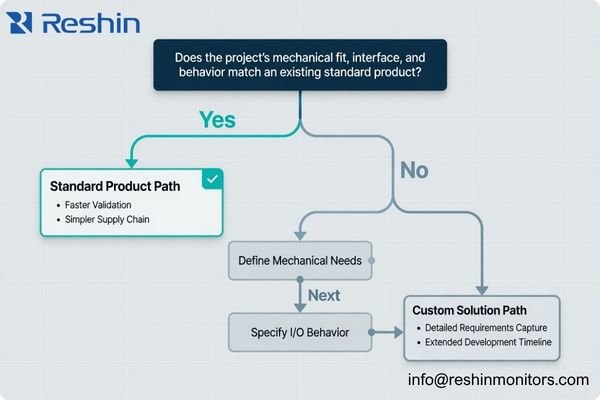
When I support equipment manufacturers, OEM teams, and system integration projects, I try to move the discussion away from a premature “standard versus custom” debate. I would rather define the project boundary first. What is the device type? How much installation space is really available? What signal path is already fixed? Does the display need a particular startup behavior? Is the project still in evaluation, or is it already moving toward pilot and mass production?
Many teams talk about customization before those conditions are clear. That usually creates noise rather than clarity. A better approach is to identify the non-negotiable project conditions first1 and then judge whether an existing platform already fits. In our own project reviews, this is usually the point where the answer starts to emerge on its own. Sometimes a standard platform already solves the real problem. Sometimes the remaining gap is specific enough that a controlled custom path becomes the more reasonable choice.
The Right Question Is Not “Standard or Custom?” but “What Does the Project Actually Need?”
In my equipment project reviews, I do not start by arguing for either a standard path or a custom path. The more useful starting point is to define the project boundary before anyone chooses a platform.
A useful decision usually comes from defining the project constraints first, such as equipment type, mounting method, interface path, default behavior, and project stage. Once those are clear, it becomes much easier to see whether a standard platform already fits or whether controlled customization is genuinely necessary.

The conversation about customization often happens too early. Before I can judge whether a display should stay standard or move toward custom, I need to understand the system it will live in. A display is not an isolated purchase in this kind of project. It is one component inside a larger medical device, and that device already comes with its own structure, interfaces, operating logic, and validation path.
Focusing on the System Requirements
I usually guide teams to look at the display as part of the complete system. The enclosure may limit the allowable depth. The mounting structure may leave very little room for flexibility. The processor may require a certain input arrangement or behavior at startup. Those are not soft preferences. They are practical conditions that the display has to match.
Defining Before Deciding
Only after those conditions are mapped out does the standard-versus-custom discussion become productive. At that point, we can review whether an existing platform from a medical display manufacturer already covers the project well enough. If it does, that is often the cleaner path. If there is a real gap in fit or behavior, then a custom discussion becomes meaningful instead of speculative.
A Standard Product Is Usually the Better Path When the Existing Platform Already Fits
From an engineering standpoint, if an existing platform already meets the project’s requirements for size, mounting, interfaces, and operating behavior, a standard product is often the more controllable path. In many projects, what matters most is not flexibility by itself, but reducing avoidable uncertainty.
When an existing platform already fits the project well, a standard product usually reduces development work, simplifies revision management, and supports a smoother transition into validation and mass production. It is often the better fit when the system can already work as intended without extra engineering changes.
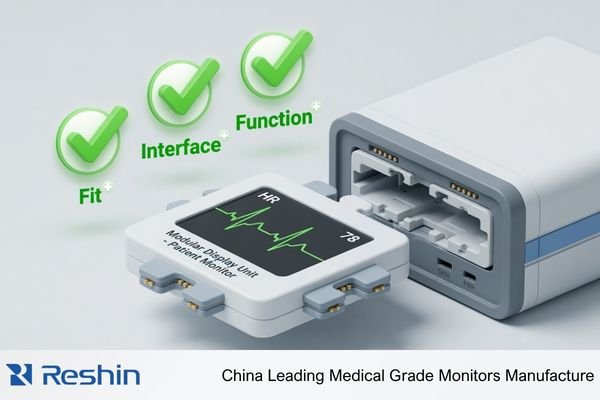
The biggest advantage of a standard product is predictability.2 The baseline is already known. The supply path is usually easier to understand. Documentation and production logic are often more stable from the start. That does not automatically make every standard platform the right answer, but when the fit is already there, it usually gives the project a simpler route forward.
Standard products also tend to reduce lifecycle management pressure later. If the platform already sits inside a broader, more established product line, future continuity is often easier to manage than in a project-specific configuration. In practice, I usually see standard products work best when the display already fits the system with minimal compromise. A custom path becomes worth the added effort only when the remaining gap is real enough to affect integration, validation, or long-term deployment.
Custom Display Projects Become Valuable When the Real Gap Is Integration Fit
I do not usually treat customization as a simple branding option. A custom medical display becomes valuable when the real problem is integration fit and the standard platform cannot close that gap without forcing an awkward compromise somewhere else in the system.
Customization becomes the better path when there is a clear integration problem, such as a mechanical mismatch, specific I/O placement requirements, required startup behavior, or controlled differentiation across multiple SKUs in the same equipment family.
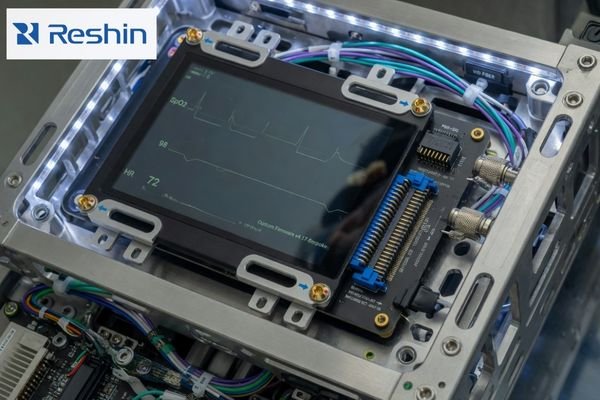
A standard platform can stop being the best option3 when it creates pressure somewhere else in the project. The mounting points may not line up with the enclosure. The connector layout may make cable routing awkward. The default input behavior may not fit the user flow of the final device. In those cases, the display is no longer just a purchase item. It becomes part of the integration problem.
It also helps to separate lighter customization from deeper engineering work. A logo change, label update, or packaging adjustment is one thing. That is not the same as changing mounting points, adjusting I/O mapping, defining startup logic, or controlling SKU-level variation across a product family. In our own project discussions, I usually try to make that distinction early, because many teams say “custom” when they are actually talking about two very different levels of change.
This is where OEM & ODM medical display solutions start to make practical sense. The value is not that the display becomes more unique. The value is that it becomes a better fit for the device it is meant to serve.
Custom Is Not Automatically Better, Because It Also Adds Coordination, Validation, and Change-Control Work
Customization can solve the right problem, but it also adds project work. I think it is important to say that plainly. A custom path is not just extra flexibility. It usually means extra coordination, clearer requirement control, and more disciplined change management over time.
The value of customization has to be weighed against the added management work it introduces, including tighter requirement definition, a longer coordination path from sample to production, and stricter revision and change-control discipline later on.
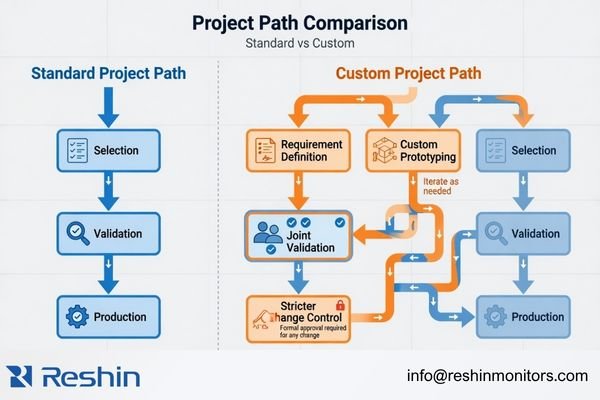
Once a project moves into a custom path, the working model changes. The conversation becomes more detailed, and the project usually becomes more collaborative.
Where Custom Projects Usually Add Coordination Work
A custom project often needs more detailed drawings, clearer functional descriptions, and more review cycles between the buyer and the manufacturer. The team usually has to work through sample confirmation, fit review, pilot planning, and production alignment in a more structured way. In our own workflow, this is usually where we start separating sample targets, pilot expectations, and mass-production conditions instead of treating them as one continuous discussion.
Why Change Control Becomes Much More Important After Customization
Once the custom baseline is defined, it needs to stay controlled. Later adjustments in firmware, I/O behavior, or component selection can matter much more when the display has been built around a specific equipment program. That is why revision discipline becomes a bigger issue after customization4. If the project boundary is still changing every few weeks, pushing into a custom path too early usually adds complexity before it adds value.
The Better Buyer Decision Usually Comes from Confirming Five Project Constraints First
When I support equipment projects, I usually bring the discussion back to a short list of practical constraints. Once those are clear, the better path often becomes much less debatable.
The table below works best as a decision framework, not just a question list.
| Project Constraint | What Makes a Standard Path Work | What Usually Pushes the Project Toward Custom |
|---|---|---|
| Mechanical Structure & Mounting | Existing dimensions, mounting pattern, and display depth already fit the equipment without redesign pressure. | The enclosure, bracket, bezel, or installation structure creates a real mechanical conflict. |
| Signal Interface & I/O Path | Standard inputs and connector locations already match the processor outputs and cable routing plan. | The project needs different connector placement, different I/O mapping, or a more controlled integration layout. |
| Default Behavior & Usage Logic | Standard startup behavior, input selection, and user controls already fit the intended workflow. | The device needs defined startup logic, hidden controls, locked settings, or another behavior that the standard platform does not cover well. |
| Current Project Stage | The team is still validating the broader system direction and can move faster with an existing platform. | The project has already defined stable requirements that clearly exceed what the standard platform can support. |
| Long-Term Supply & Continuity | A standard platform already offers acceptable continuity, version visibility, and future supply stability. | The project needs a more tightly controlled SKU, locked baseline, or project-specific continuity plan over a longer lifecycle. |
In practice, I usually see the answer become clearer once these five areas are discussed in plain terms. The project does not really choose the path by preference alone. The path is usually pushed into place by the actual constraints.
FAQ About Standard Product vs Custom Medical Display for Equipment Projects
Is a standard product usually better for the first sample stage?
Usually, yes, if an existing platform already fits the project reasonably well. When structure, interfaces, and display behavior are already close to the target, a standard product often helps the team validate the system direction faster and with less avoidable complexity.
Does customization always mean longer lead time and higher project complexity?
In many cases, it does add more coordination and management work. But the more useful question is whether the added work solves a problem that the standard platform cannot solve. If it does, the trade-off is often reasonable.
Does private label alone count as a custom medical display project?
It can count as a lighter customization layer, but it is not the same as engineering-level customization. Buyers should separate branding-level change from deeper changes involving structure, interfaces, behavior, or SKU control.
What should buyers confirm first before deciding between standard and custom?
I usually recommend confirming mechanical fit, interface path, default behavior, project stage, and long-term supply expectations first. Once those five areas are clear, the decision is usually much less ambiguous.
The Better Fit Is the One That Solves the Real Project Constraint with the Least Extra Complexity
The better fit is the one that solves the real project constraint with the least extra complexity. That is usually the clearest answer to this question.
If a standard platform already covers the project well enough, it is often the steadier path. If the real gap sits in mechanical fit, interface mapping, startup behavior, or controlled SKU differentiation, then a custom path usually makes more sense. The key is not to decide too early based on preference. It is to define the project conditions clearly and then choose the path that fits those conditions best.
If your team is still deciding between a standard platform and a controlled custom path, the next useful step is usually to review your mechanical, interface, behavior, and lifecycle requirements with a medical display manufacturer before locking the direction. And if the project clearly requires engineering-level adaptation rather than a standard platform, it makes sense to continue that discussion through OEM & ODM medical display solutions rather than treating customization as a vague add-on.
✉️ info@reshinmonitors.com
🌐 Medical Display Manufacturer
-
"Writing Assumptions and Constraints in SRS: Best Practices", https://qat.com/writing-assumptions-constraints-srs/. Requirements engineering standards recommend capturing and prioritizing constraints and non‐functional requirements at the start of a project to guide design decisions. Evidence role: mechanism; source type: government. Supports: identify the non-negotiable project conditions first. Scope note: Standards focus on software and systems requirements, so application to hardware integration may require adaptation. ↩
-
"Why Predictability In The Supply Chain Is A Game-Changer For …", https://frigate.ai/supplychain/why-predictability-in-the-supply-chain-is-a-game-changer-for-manufacturers/. Industry analyses identify predictability of performance and supply chains as a primary benefit of standard products in technology procurement. Evidence role: general_support; source type: paper. Supports: The biggest advantage of a standard product is predictability.. Scope note: Primarily reflects software procurement contexts and may not fully represent hardware scenarios. ↩
-
"From custom-made to commercial: how ESA is changing the way …", https://www.esa.int/Enabling_Support/Preparing_for_the_Future/Discovery_and_Preparation/From_custom-made_to_commercial_how_ESA_is_changing_the_way_that_spacecraft_are_built. Studies of commercial off-the-shelf (COTS) components document how a “standard” hardware choice can introduce integration pressures—such as mismatched mounting holes or connector misalignments—that outweigh procurement benefits. Evidence role: mechanism; source type: paper. Supports: A standard platform can stop being the best option when it creates pressure somewhere else in the project.. Scope note: Focuses on COTS components generally, not only display modules. ↩
-
"Understanding Revision Control in Product Development – Epec’s Blog", https://blog.epectec.com/understanding-revision-control-in-product-development. Configuration management frameworks, such as ISO 10007, emphasize that disciplined revision control becomes critical after product customization to prevent design inconsistencies and costly errors. Evidence role: mechanism; source type: institution. Supports: revision discipline becomes a bigger issue after customization. Scope note: Applies primarily to regulated or highly engineered manufacturing contexts. ↩