For a first order, after-sales support should be reviewed as carefully as price, specifications, and delivery time. In medical display projects, the real concern is not only whether a problem might happen, but how clearly and efficiently it will be handled if it does.
Before the first order, buyers should confirm response timing, troubleshooting steps, replacement conditions, communication ownership, and logistics responsibility—not just warranty length.
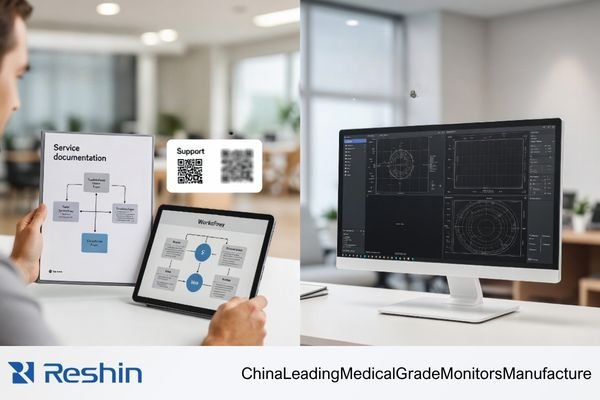
In first-time overseas projects, uncertainty around support often creates more hesitation than the product itself. Buyers want to know who will respond, what information will be needed, whether the issue can be checked remotely first, and what happens if the display cannot be restored quickly. Clear answers to those questions help reduce risk before the order is placed.
What should be checked about after-sales support before the first order?
Before the first order, buyers should check the parts of after-sales support that will matter when a real issue appears in the field, not just the wording in a quotation.
The most important checks usually include the first response contact, expected acknowledgment timing, the information needed for initial diagnosis, whether remote troubleshooting is available, how repair or replacement decisions are made, and how communication and logistics will be handled if more than one party is involved.
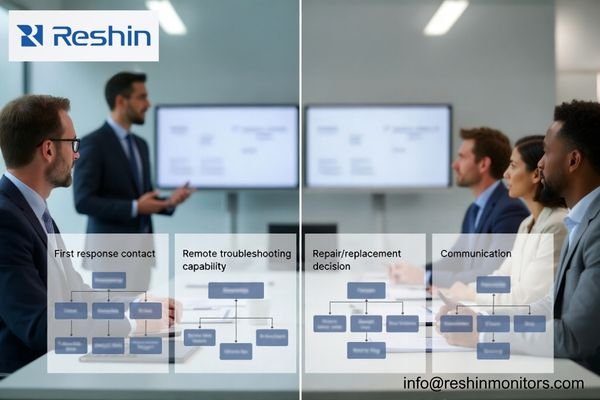
For buyers working with distributors, PACS partners, KVM providers, or system integrators, after-sales support1 should be treated as part of project risk control. A good support model should already be understandable before shipment, so the buyer knows what to expect if a problem appears later.
Service Response and Initial Diagnosis Procedures
A useful support model starts with clarity. Buyers should know who to contact first, how quickly the case is usually acknowledged, and what information should be prepared for initial diagnosis. In real projects, this often includes symptom description, usage conditions, signal chain details, installation environment, and any basic images or videos that can help confirm what is actually happening.
Escalation Logic and Resolution Pathways
Buyers should also understand how the case moves forward if the issue cannot be solved immediately. That includes knowing when the case stays in guided troubleshooting, when it is escalated for deeper review, and under what conditions repair, replacement, or return may be considered. If a distributor, integrator, or local partner is involved, the communication path should already be clear before the first order.
Warranty vs after-sales support: what is the real difference?
Warranty and after-sales support are related, but they are not the same thing.
Warranty usually answers how long coverage lasts, while after-sales support answers how a problem is actually handled.
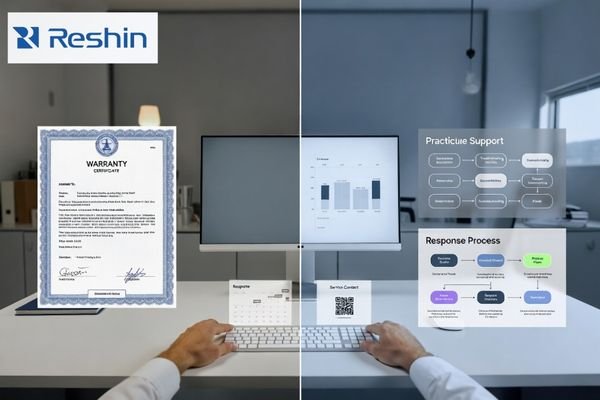
A warranty term2 may look acceptable on paper, but it does not automatically explain who responds first, how troubleshooting begins, whether the issue can be checked remotely, or what conditions may lead to replacement or return. That practical side belongs to after-sales support.
For first-time buyers, this difference matters because a long warranty does not remove uncertainty if the service path is still vague. In overseas projects, execution usually matters more than wording.
A buyer should therefore read warranty and after-sales support together. One defines coverage, while the other shows whether that coverage can be used efficiently in a real project.
If a medical display has problems after delivery, how should they be handled?
Problems after delivery should be handled through a clear confirmation path, not by assuming that every visible issue automatically requires replacement.
A practical first step is to confirm the symptoms, usage conditions, signal chain status, and installation environment before deciding whether the issue is configuration-related, environment-related, or likely to involve the display itself.
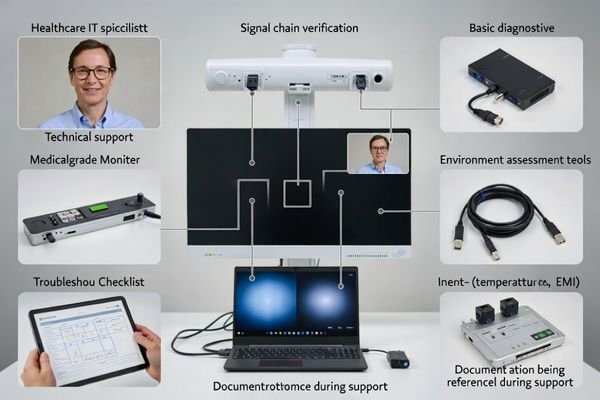
In real projects, many apparent display problems do not originate from the display panel or electronics alone. Signal sources, cables, interface compatibility, installation conditions, power quality, or environmental factors can all create symptoms that look like hardware failure. That is why structured confirmation is usually more useful than jumping directly to return or replacement.
| Problem Category | Initial Verification Steps | Remote Resolution Potential | Escalation Triggers | Typical First-Step Timing |
|---|---|---|---|---|
| Signal Chain Issues3 | Source check, cable check, interface compatibility review | High | Issue remains after guided checks | Initial remote review |
| Display Behavior | Power cycle, menu/settings check, status review | Medium | Abnormal behavior continues after basic checks | Initial remote review |
| Installation Problems | Mounting, ventilation, power input verification | High | Physical damage or continued instability | Guided assessment |
| Environmental Factors | Temperature, EMI, cleaning method, surrounding conditions | Medium | Issue persists after environment is adjusted | Case-by-case review |
| Possible Hardware Failure | Fault symptom isolation, documented evidence, basic diagnostic confirmation | Low | Confirmed hardware fault or critical unresolved issue | Case review and next-step confirmation |
What buyers need most is not a complicated technical procedure, but a predictable handling path. If the issue cannot be solved in the first stage, the next step should already be clear: whether the case moves toward deeper review, repair, replacement, or return.
That clarity is especially important in overseas projects, where unnecessary shipment decisions can create cost, delay, and confusion that might have been avoided with better first-step handling.
Which service details matter most in overseas medical display orders?
In overseas orders, service details that feel minor on paper often become major issues in practice.
The most important details usually include response timing, communication path, logistics responsibility, and how support works when distributors, system integrators, or end-user sites are involved.
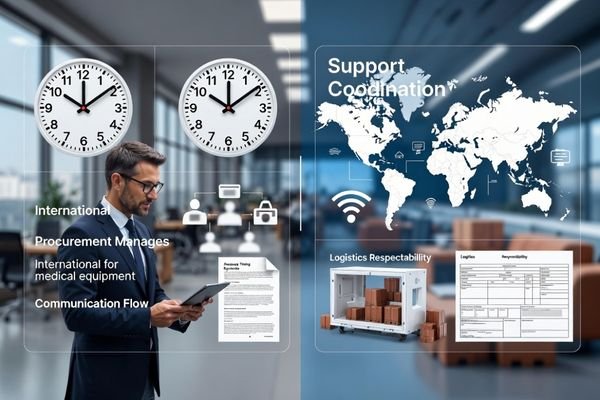
For international projects, every delay can be amplified by freight time, customs procedures4, time-zone differences, and multi-party communication. That is why buyers should check whether the service model still works under realistic project pressure, not only under ideal conditions.
Response Timing and Communication Management
In overseas projects, the first response path matters because it determines how quickly the situation becomes manageable. Buyers should know where communication starts, how updates are shared, and how escalation works if the first round of support is not enough.
Logistics Responsibility and Downtime Impact Assessment
Buyers should also understand who handles shipping coordination, customs-related follow-up, and any replacement-related communication. This becomes more important when downtime is highly sensitive, such as in hospital use, endoscopy rooms, or integrated OEM systems where display availability can affect a larger workflow.
What questions should buyers ask before placing the first order?
The best pre-order questions are the ones that make service practical, not just reassuring.
Before the first order, buyers should ask questions that clarify response ownership, diagnosis requirements, remote troubleshooting, replacement conditions, logistics handling, and support coordination in overseas cases.
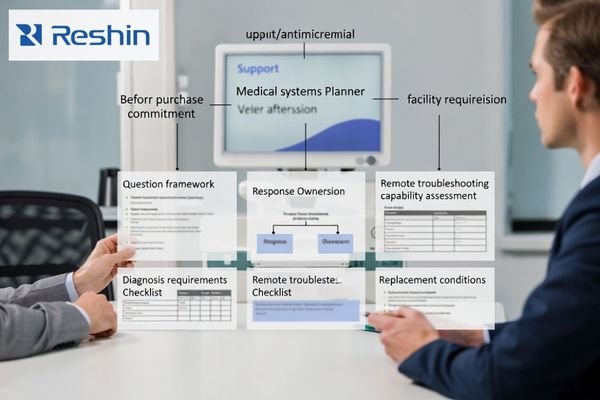
Useful questions include: Who will be the first response contact? What is the usual acknowledgment timing? What information is needed for initial diagnosis? Is remote troubleshooting5 part of the normal process? Under what conditions would repair, replacement, or return be considered? How are communication and logistics handled in overseas cases?
These questions are valuable because they show whether the supplier has already thought through how support works in practice. A supplier that can answer clearly before the first order is usually easier to work with later.
If a distributor, integrator, or local partner is part of the project, buyers should also ask how support is coordinated across those parties and who owns communication at each stage.
How does Reshin support first-time overseas orders?
For first-time overseas orders, Reshin focuses on making the support path clear before shipment, so the customer is not left guessing later.
Reshin starts by understanding the project context, then explains the practical support path, including communication entry point, basic diagnosis requirements, remote troubleshooting approach, and how the next step is determined if the issue cannot be resolved immediately.
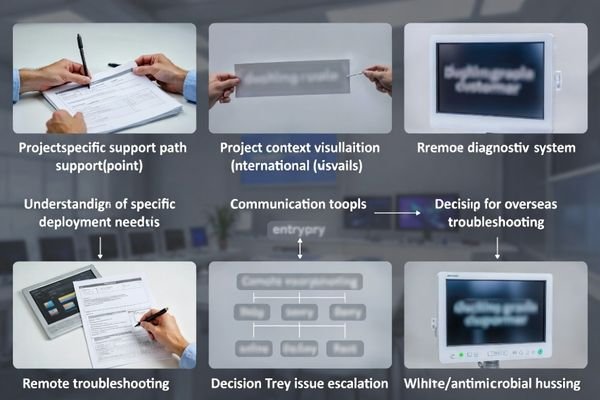
For example, support expectations can differ greatly depending on whether the order is for hospital use, distribution, OEM integration, or a broader system application. Because of that, Reshin first clarifies the operating context before discussing support details in order to align the service path with the actual project.
In first-time overseas cooperation, we also place strong emphasis on communication clarity. That includes identifying the primary contact path, explaining what information is usually needed for first-stage diagnosis, and making sure the customer understands how remote troubleshooting normally starts before more disruptive actions are considered.
When a distributor or multiple stakeholders are involved, Reshin pays extra attention to communication ownership and responsibility boundaries. The goal is not to make unrealistic promises, but to make the process understandable early enough that the first order feels manageable instead of uncertain.
FAQ
Is warranty enough to judge after-sales support for a first order?
No. Warranty is only one part of the picture. Buyers should also understand response timing, troubleshooting flow, replacement conditions, logistics responsibility, and who actually owns communication when a problem occurs.
Why should after-sales support be checked before the first order instead of after delivery?
Because many later disputes come from unclear expectations rather than the fault itself. If the support path is unclear before shipment, confusion and delay are much more likely after delivery.
What matters more in real use, warranty length or response speed?
In many projects, response speed affects the customer experience more directly because it determines how quickly the issue becomes manageable.
Does a good sample mean after-sales risk is already low?
Not necessarily. A good sample can reduce product uncertainty, but after-sales risk still depends on how clearly the handling process is defined and how well it works later.
Why does after-sales support feel more complicated when a distributor is involved?
Because communication and responsibility may be shared among several parties. If these boundaries are not clear early, the process becomes much harder to manage later.
What should be prioritized if downtime is highly sensitive in the project?
Buyers should focus on response timing, escalation logic, likely handling method, and whether the supplier’s support model is realistic for that level of urgency.
Conclusion
Before the first medical display order, after-sales support should be judged by clarity, practicality, and fit with the real project environment. Buyers do not just need to know that support exists. They need to know how it works, what happens next when a problem appears, and whether the supplier can reduce uncertainty instead of adding more of it.
At Reshin, the goal of first-order support planning is to make that path understandable before shipment. Clear responsibilities, realistic response logic, and practical handling expectations help turn after-sales support from a vague promise into something buyers can evaluate with confidence before they place the order.
✉️ info@reshinmonitors.com
🌐 https://reshinmonitors.com/
-
Understanding after-sales support is crucial for buyers to ensure they receive the necessary help and service post-purchase. ↩
-
Exploring warranty terms helps buyers make informed decisions and reduces uncertainty in service expectations. ↩
-
Understanding Signal Chain Issues can help you troubleshoot effectively and avoid costly mistakes. ↩
-
Exploring customs procedures helps buyers navigate potential delays and streamline their international shipping processes. ↩
-
Exploring remote troubleshooting can enhance efficiency and reduce downtime in support scenarios. ↩