Understanding HL7 messaging is essential for successful medical imaging integration and workflow synchronization across healthcare systems.
An HL7 message is a structured, machine-readable exchange that carries patient identity, encounter context, orders, results, and status updates. In imaging integration, HL7 keeps RIS, PACS, modalities, and reporting aligned so the right patient and procedure context appears consistently across the workflow.
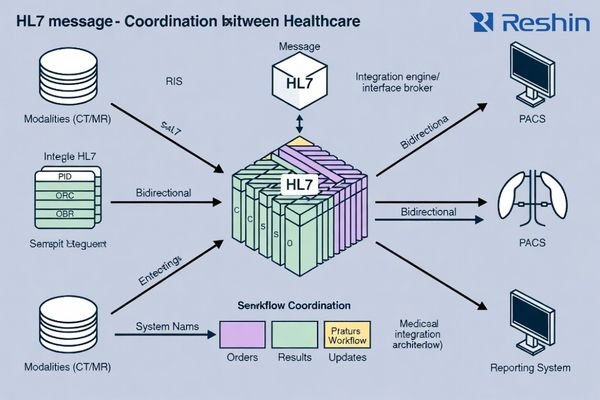
From my work with healthcare IT integration projects, HL7 messaging1 functions as the communication layer that lets different vendor systems share patient and order information reliably. When it is mapped and monitored well, it reduces manual data entry, lowers the risk of mismatches, and helps keep imaging workflows running smoothly in environments where multiple applications must stay synchronized.
What is an HL7 message in practical terms?
HL7 messages function as structured event notifications that keep healthcare systems synchronized across different applications and workflows.
An HL7 message is a structured, machine-readable event transaction that tells other systems what happened—such as an admission, order, procedure update, or finalized report—so they can update their own records consistently.
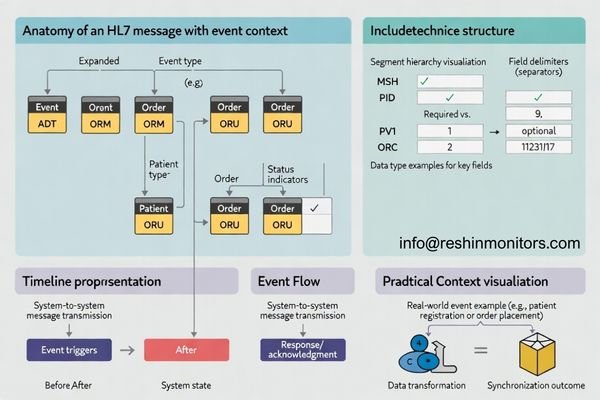
In my integration work at Reshin, I focus on HL7 messages as interoperability enablers that allow different vendors to interpret the same fields and segments predictably. This supports reliable data movement across applications without re-keying or manual reconciliation steps that can introduce errors, delays, and avoidable workflow friction.
Message Structure and Standardization Benefits
HL7 messages use standardized formats2 with defined segments, fields, and data types that support consistent interpretation across different healthcare applications. This standardization reduces integration complexity and helps make interfaces more predictable when connecting systems from multiple vendors in medical imaging environments.
Event-Driven Workflow Synchronization Mechanisms
Each HL7 message represents a specific clinical or administrative event that triggers downstream updates, helping systems stay aligned without constant manual intervention. In practice, this event-driven approach keeps identity, orders, and status changes synchronized as work moves from registration through scheduling, performance, interpretation, and distribution.
How do HL7 messages move through an imaging workflow?
HL7 messaging provides the administrative and clinical context that coordinates imaging operations across multiple interconnected systems.
In imaging integration, HL7 carries order and status events that connect patient identity and procedure intent across RIS, PACS, modalities, and reporting. As the exam progresses, messages reflect transitions such as ordered, scheduled, performed, and reported so each system stays aligned.
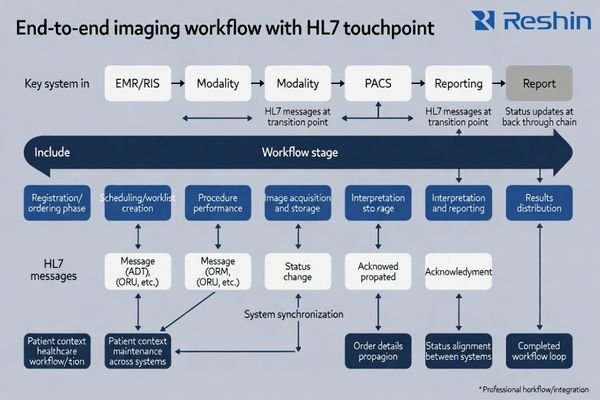
Based on the projects I support with PACS and KVM partners, well-integrated environments use HL7 to keep administrative and clinical systems synchronized while imaging-specific standards3 handle the imaging objects themselves. This is often the difference between a seamless worklist-to-report loop and workflows that rely on phone calls, manual edits, and after-the-fact corrections.
A practical way to think about HL7 flow is a small set of repeatable checkpoints that keep systems in sync:
- Registration/admission updates patient and encounter context upstream
- Order/scheduling events create or update imaging work items downstream
- Procedure status events keep RIS, modality workflow, and PACS aligned
- Result/finalization events trigger report availability and distribution
The integration feels reliable when the same identifiers and the same status meanings travel consistently across each checkpoint, without “silent” field changes or inconsistent mapping rules between systems.
What are the most common HL7 segments and fields that impact imaging integration?
Critical HL7 segments and fields determine identity matching, order intent, and lifecycle status that drive imaging workflows.
For imaging, the most consequential HL7 content is what controls identity matching, order intent, and lifecycle status—because these drive worklists, routing, and report association. Patient and visit data must be consistent, and order details must be specific enough to map correctly downstream.
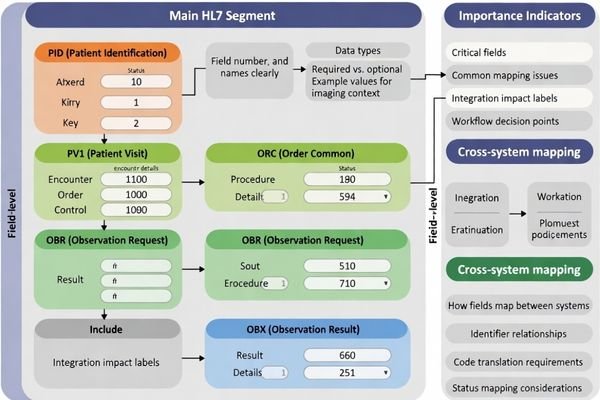
From an engineering standpoint, I usually emphasize that status indicators4 need clear semantics so that "scheduled," "in progress," "completed," and "final" mean the same thing across RIS, PACS, and reporting systems to prevent integration issues.
| HL7 Segment | What it controls in imaging | Why it matters |
|---|---|---|
| PID | Patient identifiers and demographics | Prevents duplicates and wrong-patient matching |
| PV1 | Encounter/visit context | Keeps studies tied to the correct visit and routing rules |
| ORC | Order control and order status | Drives workflow state coordination across systems |
| OBR | Procedure details (what, when, priority) | Enables worklist creation and protocol/procedure mapping |
| OBX | Results payloads and result status signals | Affects report delivery, status interpretation, and “final” recognition |
In practice, problems show up when one system treats a field as authoritative while another treats a different field as the primary key, or when procedure codes and status semantics do not match downstream expectations. Consistent identifier strategy5, procedure mapping, and a shared status model are the fastest way to reduce missing exams, orphaned reports, and confusing worklist behavior.
What goes wrong when HL7 messaging is inconsistent or poorly mapped?
HL7 inconsistencies create operational mysteries that appear as workflow problems rather than obvious technical failures.
When HL7 mapping is inconsistent, common symptoms include duplicate patients, missing worklist items, “completed” studies that cannot be found, or reports linked to the wrong encounter. These usually come from subtle mismatches in identifiers, demographics, procedure mapping, or status semantics.
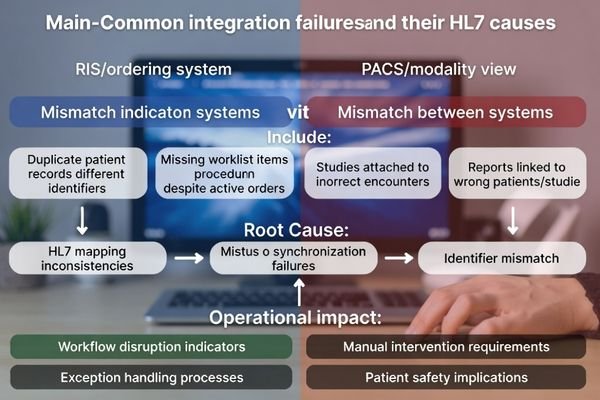
In my experience with imaging integration troubleshooting, these problems turn routine workflow into exception handling, increase manual cleanup requirements, and can erode trust in the overall integration even if image transfer continues to work technically.
Identity Management and Duplicate Prevention Challenges
Inconsistent identifier strategy is a frequent root cause: different systems may prioritize different ID types, tolerate demographic variation differently, or apply different matching thresholds. The result is usually duplicates, split encounters, or mismatches that require manual reconciliation and slow downstream work.
Order Mapping and Workflow State Synchronization Issues6
Procedure mapping gaps and unclear status transitions commonly cause divergence, such as orders that exist in RIS but never produce an actionable work item downstream, or workflow states that advance in one system while another stays behind. Clear mapping rules and a shared status definition prevent routine cases from turning into constant exceptions.
How do you choose integration-ready displays and workstations for HL7-driven imaging workflows?
Integration-ready displays should minimize human re-entry and make status-driven tasks predictable in HL7-driven environments.
When HL7 drives the workflow backbone, displays and workstations should support fast verification of patient context, order intent, and status without distracting from diagnostic viewing. Clear separation between diagnostic and administrative tasks helps reduce ambiguity and re-entry.
Think end-to-end about network stability and authentication behavior that should not interrupt active reading, peripherals and mounting that support consistent ergonomics, cleaning and maintenance processes that do not degrade connectors or uptime, and lifecycle planning considering validation updates across equipment fleets so behavior stays consistent after software or interface changes.
A practical workstation approach is to assign clear roles so users can confirm identity and order context quickly:
- Diagnostic zone for primary image interpretation and comparison
- Admin/reporting zone for worklist selection, patient verification, and reporting steps
- Consistent login/session behavior to avoid mid-read interruptions
- Fleet consistency so updates do not change user behavior unexpectedly
| Use case | Primary needs in HL7-driven workflow | Recommended Model |
|---|---|---|
| Radiology reading workstation | Consistent diagnostic viewing plus predictable multi-screen behavior for worklist/reporting separation | MD45C |
| Technologist/workflow station | Fast patient and order verification with durable deployment for busy front-line use | MS247SA |
| Modality control/OR station | Stable on-cart deployment and reliable daily operation with workflow context visibility | MS321PC |
| PACS admin/support desk | Comfortable multi-tasking for order management and distribution monitoring | MD33G |
| Mobile review/consult station | Practical deployment with consistent access to patient/order context | MS220SA |
In short, "integration-ready" is less about a single specification and more about reducing ambiguity at the workstation level, making the right patient, correct order, and appropriate status easy to verify every time users interact with the imaging workflow system.
FAQ
Is HL7 the same as DICOM in imaging integration?
No. HL7 primarily carries workflow and clinical context such as patient, order, and status events, while DICOM is used to encode and transport imaging studies and related imaging metadata; they complement each other in complete integrations.
What is the biggest HL7-related cause of wrong-patient or duplicate records in imaging?
Inconsistent identifier strategy such as different systems prioritizing different patient IDs or visit numbers, combined with incomplete demographics, which can create near-duplicates and mismatches during reconciliation processes.
Why can an exam be scheduled in RIS but missing from the modality worklist?
The scheduling or order message may not be reaching the downstream system, may be filtered by mapping rules, or may lack required fields for worklist creation, so the modality never receives a complete, actionable work item.
What should you standardize first to stabilize HL7-based imaging workflows?
Start with identity and order semantics: define authoritative identifiers, mapping rules, and clear status transitions so "ordered/scheduled/performed/final" have consistent meaning across all connected systems.
Do HL7 interfaces need ongoing monitoring after go-live?
Yes. Message flow, error queues, and mapping changes should be monitored continuously, because small upstream workflow or code changes can silently create downstream mismatches over time without obvious symptoms.
How can you reduce manual corrections for imaging orders and patient context?
Use consistent identifiers, enforce required fields, align procedure code mapping, and design workstation workflows that make patient and order verification quick and unavoidable before finalizing reporting steps.
Conclusion
HL7 messages matter in imaging integration because they carry the patient, order, and status events that keep RIS, PACS, modalities, and reporting synchronized. When HL7 is cleanly mapped and consistently monitored, workflows become more predictable and easier to standardize across vendors and sites.
Our experience at Reshin shows that strong HL7 outcomes require more than message mapping: consistent identity rules, clear status semantics, reliable infrastructure, and practical workstation workflows that reduce ambiguity during daily use.
✉️ info@reshinmonitors.com
🌐 https://reshinmonitors.com/
-
Understanding HL7 messaging is crucial for effective healthcare IT integration, ensuring reliable communication between systems. ↩
-
Exploring standardized formats reveals their importance in reducing errors and improving communication between diverse healthcare applications. ↩
-
This resource will help you grasp the significance of imaging-specific standards in maintaining the integrity of imaging data and workflows. ↩
-
Understanding best practices for status indicators can enhance clarity and integration across systems. ↩
-
Exploring identifier strategies can help prevent integration issues and improve data accuracy in healthcare systems. ↩
-
This resource offers insights into enhancing order mapping and synchronization, crucial for efficient operations. ↩