Cath lab display approval becomes risky when sample testing depends only on visual preference. I prefer to define acceptance criteria first, because angiography, fluoroscopy, DSA, routing, room layout, and procurement planning all affect display readiness.
Cath lab display acceptance criteria should connect imaging source behavior, signal compatibility, image stability, room visibility, workflow use, mounting, documentation, repeatability, and batch consistency. A cath lab display acceptance test should follow five steps: confirm the project baseline, verify the signal chain, validate image and workflow stability, record user-side acceptance, and freeze the approved configuration before batch procurement.
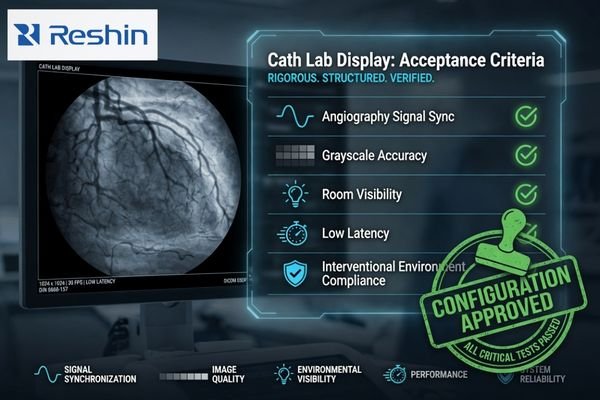
In cath lab and interventional imaging projects, the display is part of a larger imaging chain. The signal may come from angiography equipment, fluoroscopy output, a DSA workstation, a video router, or an integrated room system. If these conditions are not reviewed before testing, the sample result may not represent the final installation.
That is why I treat cath lab monitor approval as an engineering validation process, not a simple product check. I first confirm what the sample must prove, then connect the result to documentation, procurement, and supply planning. A safer angiography display sample validation process should confirm the project baseline, test the signal chain, review image and workflow stability, record user-side acceptance, and freeze the approved configuration before order expansion. This begins with defining acceptance criteria before the sample arrives.
Why Acceptance Criteria Should Be Defined Before Cath Lab Display Sample Testing
Cath lab display sample testing should not begin with subjective image preference alone. The team should define what must pass before the display can move toward approval.
Acceptance criteria should be defined before cath lab display sample testing so angiography system output, interventional workflow, room conditions, signal routing, documentation, and batch procurement risk are judged under the same standard. This helps engineering, procurement, and user-side teams make a shared decision.
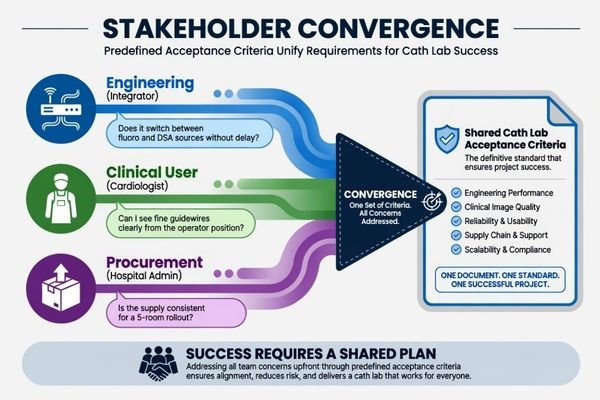
When I support a cath lab monitor sample testing project, I first separate visual acceptance from procurement readiness. A display may look acceptable during a short test but still fail if signal routing changes, the mounting method is different, or documentation is incomplete. Early acceptance criteria reduce this gap.
A practical angiography monitor acceptance test should usually follow this sequence: project baseline confirmation, signal-chain validation, image and workflow stability testing, user-side acceptance review, and approved configuration freeze before batch procurement. This structure helps the team avoid approving a display from a narrow test condition that cannot be repeated during installation.
Acceptance Criteria Reduce Subjective Approval Risk
A sample should not pass only because the image appears clear during one review. The team should define the source device, input signal, resolution, cable condition, switching behavior, brightness visibility, grayscale behavior, mounting method, and documentation expectation before testing starts. This makes approval more repeatable and reduces disagreement between engineering teams, biomedical teams, integrators, and procurement teams.
Sample Approval Should Connect to Batch Risk
Cath lab display validation should also consider what happens after the first sample. If the approved configuration is not recorded, batch procurement may introduce different cables, accessories, labels, packaging, or documentation. For medical display OEM/ODM solutions, sample acceptance should support both engineering validation and future supply control.
What Project Conditions Should Be Confirmed Before Evaluating a Cath Lab Display
Cath lab display evaluation should start from the project environment. I do not recommend testing the monitor alone before the source, signal route, room condition, and deployment plan are understood.
Before evaluating a cath lab display, the team should confirm imaging source, signal type, resolution, refresh rate, cable length, video routing, PACS or workstation connection, room lighting, viewing distance, mounting method, multi-source workflow, cleaning requirements, documentation needs, replacement quantity, and procurement schedule.
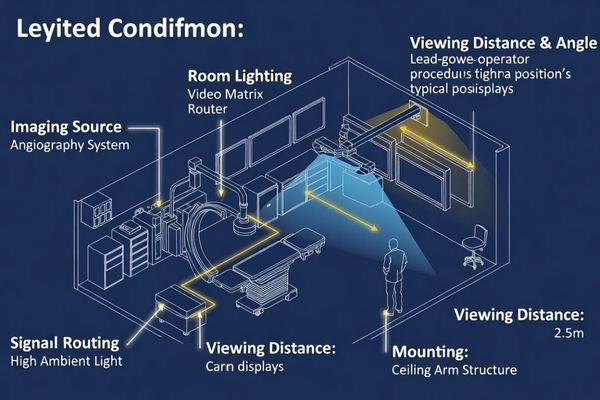
The imaging source is the first condition I review. The display may receive output from an angiography system, fluoroscopy source, DSA workstation, PACS workstation, room integration platform, or video router depending on project requirements. The team should confirm the signal list, resolution, refresh rate, input interface, cable length, and switching path before sample testing. If the final system uses routing equipment, the display should not be approved only from a direct connection test.
Room and workflow conditions are also important. Viewing distance, procedure-room lighting, mounting height, arm or wall structure, cleaning expectations, multi-source use, and documentation needs can all affect acceptance. At Reshin, I usually review the source device, signal list, I/O requirements, routing method, room layout, intended display size, batch quantity, procurement schedule, and documentation needs before recommending a cath lab display validation direction. This makes the sample test closer to the real installation environment and helps the customer prepare a clearer engineering inquiry.
Cath Lab Display Acceptance Criteria Matrix for Angiography and Interventional Imaging Projects
A structured acceptance matrix helps the project team connect technical testing with procurement risk. I use it to define what should pass before the display moves toward batch approval.
A cath lab display acceptance criteria matrix should cover signal compatibility, image stability, grayscale behavior, brightness visibility, low latency, multi-source switching, PIP/PBP workflow, mounting, cleaning surface, documentation, sample repeatability, and batch consistency. Each area should have a clear pass direction.
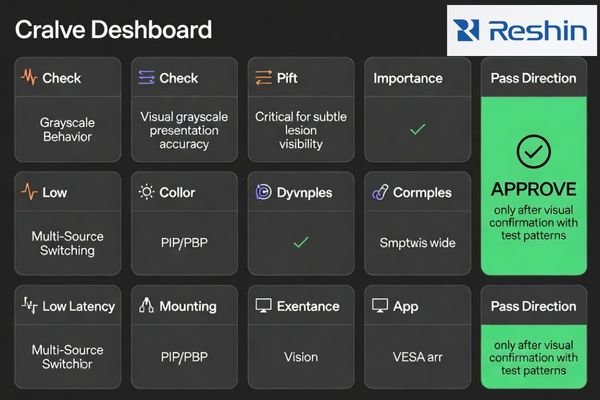
The matrix below is a practical validation framework. It should be adjusted depending on the angiography system, room integration design, workstation connection, viewing role, and procurement scale. This matrix is a project acceptance framework, not a substitute for system-level regulatory validation or hospital-specific approval requirements. The goal is to prevent a sample from passing one narrow test while leaving deployment risk open.
| Acceptance Area | What to Check | Why It Matters | Pass Direction |
|---|---|---|---|
| Signal compatibility | Source device output, input interface, signal format, cable type, and cable length | The display must work with the intended angiography or interventional imaging source | Pass when the tested source, input, cable, resolution, refresh rate, and signal format are documented and repeatable |
| Image stability | Signal lock, flicker, interruption, image loss, and behavior during source changes | Unstable image behavior can create field troubleshooting and user rejection | Pass when image behavior remains stable under the planned direct or routed signal path |
| Grayscale behavior | Visual grayscale presentation under agreed source and display settings | Interventional imaging review depends on controlled visual behavior | Pass when the agreed grayscale presentation is stable under the defined source, display setting, and room condition |
| Brightness visibility | Visibility under procedure-room lighting and expected viewing distance | Room lighting can affect whether the display is practical in use | Pass when image visibility is acceptable under representative cath lab lighting and viewing distance |
| Low latency | Perceived delay through direct and routed signal paths | Added processing or routing may affect workflow acceptance | Pass when latency perception does not create user-side workflow rejection under the intended signal chain |
| Multi-source switching | Switching between angiography, fluoroscopy, workstation, or external sources | Cath lab displays may support more than one input source | Pass when all required sources switch without signal loss, unexpected layout change, or mode reset |
| PIP/PBP workflow | Picture-in-picture or picture-by-picture layout when required | Multi-source viewing may be part of the room workflow | Pass when the required PIP/PBP layout matches the intended clinical room workflow and remains stable during source switching |
| Mounting | Arm, wall, ceiling, cart, or equipment integration method | Physical fit affects safety, viewing position, cable routing, and service access | Pass after confirming structure, viewing position, cable route, service access, and installation repeatability |
| Cleaning surface | Surface expectation, cleaning routine, and installation environment | Cleaning requirements affect long-term usability and maintenance | Pass when the surface expectation and cleaning routine are confirmed for the intended installation environment |
| Documentation | Datasheet, user guide, packing list, service notes, configuration record, and project documents | Procurement and installation teams need consistent references | Pass when datasheet, user document, packing list, configuration record, and service notes are available for procurement review |
| Sample repeatability | Whether the tested result can be reproduced with the same configuration | One successful test may not represent future units if conditions are unclear | Pass when the same test result can be reproduced with the recorded source, cable, input, display setting, and room condition |
| Batch consistency | Accessory set, labeling, packaging, supply plan, and change communication | Batch differences can create installation and replacement risk | Pass when the approved configuration, accessory set, labeling, packaging, and change-control method are frozen before order expansion |
This matrix helps engineering, biomedical, procurement, and supplier-side teams discuss acceptance with the same structure. At Reshin, I use this type of acceptance matrix to separate visual approval from procurement approval. I usually group the review into signal-chain behavior, room-side usability, mounting and cleaning conditions, documentation readiness, and batch repeatability before discussing order expansion.
For angiography system manufacturers, I focus on source output, interface requirements, and signal-chain repeatability. For cath lab integrators, I focus on routing behavior, mounting, room layout, and multi-source workflow. For biomedical teams, I focus on service access, cleaning expectation, and documentation. For procurement teams, I focus on approved configuration, packaging, labeling, batch consistency, and supply continuity. Once the sample result is recorded, the next step is to validate signal, image, and workflow stability before batch procurement begins.
How to Validate Signal, Image and Workflow Stability Before Batch Procurement
Sample validation should use the real angiography system, fluoroscopy source, DSA workstation, video routing chain, or a representative setup. A simplified bench test may not reveal integration risk.
Before batch procurement, the team should validate signal lock, image stability, resolution recognition, input switching, latency perception, brightness under procedure-room lighting, grayscale behavior, mounting fit, user-side acceptance, documentation readiness, and approved configuration repeatability using the intended or representative imaging chain.
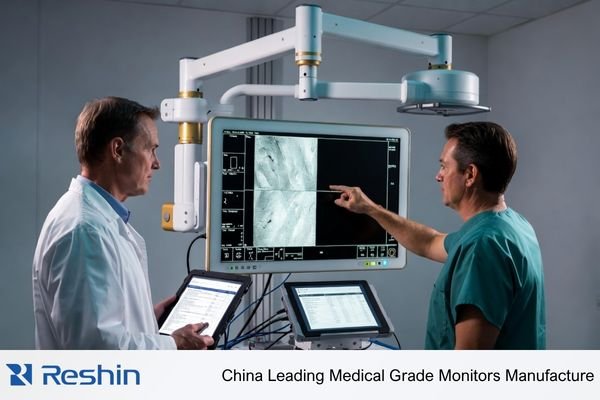
I prefer to test the display under the signal path that will be used in the room. This includes the source device, router or switcher, cable type, input interface, display settings, and expected viewing layout. At Reshin, I usually separate cath lab display sample validation into source signal review, interface and routing confirmation, image behavior observation, mounting review, documentation check, and approved configuration freeze. For engineering review before cath lab display sample approval, send the signal source, interface list, routing method, target display size, mounting condition, room layout, documentation needs, and procurement quantity to info@reshinmonitors.com.
Signal and Image Tests Should Match the Installed Chain
If the final room uses a video routing system, the sample should be tested through that route. If the display will switch between multiple sources, switching behavior should be checked during validation. Resolution recognition, signal lock, image stability, brightness visibility, grayscale behavior, and latency perception should be reviewed under agreed conditions. This helps the team avoid approving a display from a test setup that does not match the real cath lab workflow.
Procurement Approval Should Include Configuration Freeze
After the sample passes, the approved configuration should be frozen before batch order. This includes the display direction, input configuration, cable requirements, mounting method, accessories, power setup, labels, packaging, documentation, QC reference, delivery schedule, and service communication process. For projects that require procurement documents, labeling control, or registration preparation, I also connect the approval record with compliance and registration support before order expansion. For longer projects, I also connect the approval with long-term supply and model consistency because replacement and expansion can become difficult if the approved configuration changes later.
Recommended Cath Lab Display Directions for Different Interventional Imaging Projects
After acceptance criteria and validation conditions are clear, product direction becomes easier to control. I prefer to connect each cath lab display direction to a project role instead of presenting one display type as suitable for every angiography or interventional imaging environment. Final approval should depend on source compatibility, room layout, signal routing, mounting, documentation, and batch procurement requirements.
The following product directions can support sample testing and procurement planning when they are validated under the intended project conditions. They are not universal recommendations and do not replace system-level project validation. Each direction should be reviewed with the imaging source, signal interface, viewing distance, room lighting, physical installation method, documentation needs, and acceptance criteria before procurement expands.
| Clinical Role / Application | Usage Pattern | Display Requirements | Recommended Display Direction | Key Integration Considerations |
|---|---|---|---|---|
| Compact cath lab workstation display | Equipment-side review, limited-space workstation, or focused display role | Compact cath lab display direction depending on source output and room role | Compact cath lab display direction | Confirm signal input, resolution recognition, mounting fit, brightness visibility, and documentation needs |
| Interventional imaging main display | Angiography, fluoroscopy, or DSA image viewing where higher-resolution direction is required | 4K interventional imaging display direction depending on workflow and source capability | 4K interventional imaging display direction | Validate 4K signal path, cable length, routing behavior, grayscale behavior, and user acceptance |
| Large-room cath lab visualization | Room-wide viewing, team awareness, or integrated interventional imaging display role | Large-screen cath lab display direction depending on room layout | Large-screen cath lab display direction | Review viewing distance, mounting structure, signal routing, power configuration, and room visibility |
| OEM/ODM cath lab integration project | Customized angiography, hybrid OR, or interventional imaging system integration | Customized cath lab monitor direction depending on project requirements | Customized cath lab monitor direction | Confirm I/O needs, mechanical design, documentation, labeling, packaging, batch consistency, and supply period |
FAQ
What should be included in cath lab display acceptance criteria? Acceptance criteria should include signal compatibility, image stability, grayscale behavior, brightness visibility, latency perception, multi-source switching, PIP/PBP workflow, mounting, cleaning surface, documentation, sample repeatability, and batch consistency.
Should angiography displays be tested with the real imaging system before approval? Yes, whenever possible. Testing with the real angiography system, fluoroscopy source, DSA workstation, or representative routing chain helps confirm whether the display behaves correctly under intended project conditions.
Is 4K always required for cath lab and interventional imaging projects? No. A 4K direction should be considered when the imaging source, routing path, viewing role, room layout, and validation requirements support it. Some projects may need compact, large-screen, or customized display directions instead.
What documentation should be reviewed before cath lab display batch procurement? The team should review datasheets, user documents, packing lists, service notes, configuration records, labeling requirements, QC references, and any project-specific documentation needed for installation, procurement control, or registration preparation.
How can project teams reduce integration risk during cath lab display validation? They can reduce risk by defining acceptance criteria early, testing with the intended signal chain, documenting approved settings, confirming mounting and room conditions, freezing accessories and documentation, and controlling batch consistency before procurement expands.
What information should be prepared before requesting cath lab display validation support? The project team should prepare the signal source, interface list, routing method, target display size, mounting condition, room layout, expected viewing distance, documentation needs, batch quantity, and procurement schedule. These details help the supplier review validation risk more accurately.
Conclusion
Cath lab display acceptance criteria help turn sample testing into a controlled procurement decision. I do not treat a sample as ready for batch use only because it displays an angiography or interventional image. The project team should confirm project baseline, signal compatibility, image stability, grayscale behavior, brightness visibility, input switching, mounting fit, documentation readiness, repeatability, approved configuration, and batch consistency before procurement expands.
At Reshin, I support cath lab display projects by connecting sample validation, signal-chain review, room-condition assessment, documentation control, OEM/ODM coordination, approved configuration freeze, and long-term supply planning. This helps angiography system manufacturers, cath lab integrators, hybrid OR integrators, biomedical teams, distributors, and procurement teams reduce avoidable integration risk before batch deployment. Share your cath lab display validation requirements for engineering review.
✉️ info@reshinmonitors.com