Surgical monitor sample testing becomes unreliable when approval depends only on whether the image looks acceptable. A practical sample approval process should define acceptance criteria, test with the real or representative video chain, record pass/fail evidence, freeze the approved configuration, and control batch procurement changes before order expansion.
Surgical monitor acceptance criteria should define signal compatibility, image stability, color output, brightness behavior, mounting fit, installation conditions, documentation, approved configuration, and batch consistency before sample testing starts. Sample approval confirms one tested condition, while batch procurement approval confirms whether that condition can be repeated across units, accessories, documentation, packaging, delivery, and future change control.
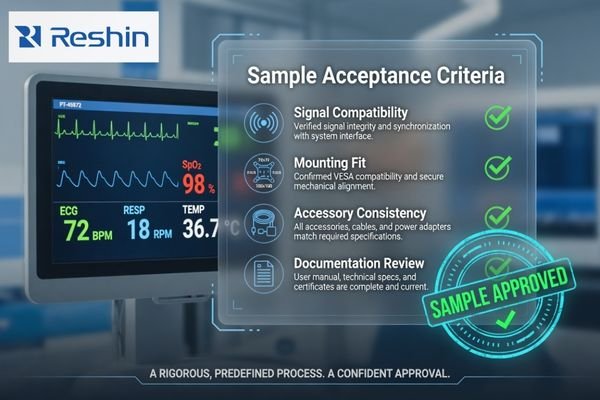
In surgical display projects, a sample may pass a quick visual check but still fail procurement readiness. The video source may change, the mounting method may not match the real system, or the accessories may not be suitable for batch delivery. These risks are easier to control before purchasing expands.
That is why I treat surgical monitor approval as a structured engineering process. I separate sample validation, user acceptance, configuration freeze, documentation review, and batch procurement control. This keeps the decision practical and repeatable before the team moves from one sample to multiple units.
Why Surgical Monitor Acceptance Criteria Should Be Defined Before Sample Testing
A surgical monitor sample should not be judged only by a subjective visual impression. Acceptance criteria help the project team decide what must pass before the sample can move toward procurement.
Surgical display acceptance criteria should be defined before sample testing so signal compatibility, image stability, color output, brightness behavior, mounting fit, cleaning and installation conditions, documentation, approved configuration, and batch consistency are reviewed under the same decision logic.
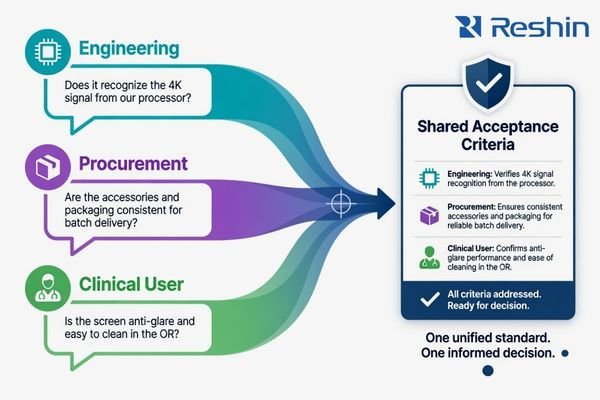
A surgical monitor sample may be reviewed by several teams at the same time. Engineering teams may focus on signal input, procurement teams may focus on delivery and accessories, and user-side teams may focus on viewing comfort and installation fit. If the acceptance criteria are unclear, each team may approve or reject the sample for different reasons.
Acceptance Criteria Reduce Subjective Approval Risk
A sample that “looks good” during a short review may still create problems during integration or batch delivery. The team should define what signal source will be used, which resolution should be recognized, what image behavior is acceptable, which mounting method is expected, and which accessories must be included. This makes approval less dependent on personal preference and more dependent on repeatable test conditions.
The Same Criteria Should Support Engineering and Procurement
For medical display OEM/ODM solutions, sample approval should connect engineering validation with procurement control. A monitor may pass video testing, but the batch order can still fail if labeling, packaging, power configuration, documentation, or accessory requirements are not frozen. A good acceptance framework should support both technical approval and procurement readiness.
What Should Be Checked During Surgical Monitor Sample Testing
Sample testing should reproduce the real use condition as closely as possible. Surgical monitor risk often appears inside the video chain, installation environment, accessory set, or user-side workflow rather than only on the display panel.
During surgical monitor sample testing, the team should check video input compatibility, resolution recognition, image stability, color and grayscale behavior, brightness behavior, viewing angle, real video source response, input switching behavior, cable route, mounting, power, accessories, screen surface expectations, OR installation conditions, and user feedback.
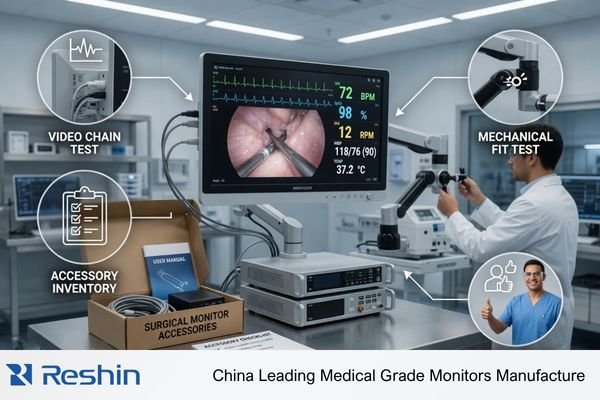
For endoscopy monitor sample testing, the video source is one of the first conditions to confirm. The sample should be tested with the actual camera processor, video source, or a representative system depending on project requirements. The team should confirm input interface, expected resolution, image stability, color and grayscale behavior, brightness behavior, and viewing angle under agreed settings. If cable length, routing devices, switchers, converters, or adapters will be used in the final system, they should be included in the sample test instead of being added later without validation.
The physical condition should also be reviewed. Mounting method, stand or arm compatibility, VESA requirement1, power configuration, accessory set, cable routing, screen surface expectations, installation space, and user feedback can all affect approval. In Reshin sample discussions, I usually ask the customer to provide the camera processor output, preferred input interface, target resolution, mounting method, expected quantity, use scenario, and batch timeline before recommending a sample direction. This helps avoid approving a sample that cannot be repeated in batch procurement.
Surgical Monitor Sample Acceptance Matrix for Batch Procurement
A sample acceptance matrix helps the team convert test results into procurement decisions. It separates what passed, what remains conditional, and what must be frozen before batch orders.
A surgical monitor sample acceptance matrix should connect each acceptance area with the sample test condition, batch procurement risk, and acceptance decision. This prevents the team from treating one successful visual test as full approval for production, rollout, or OR display sample validation.
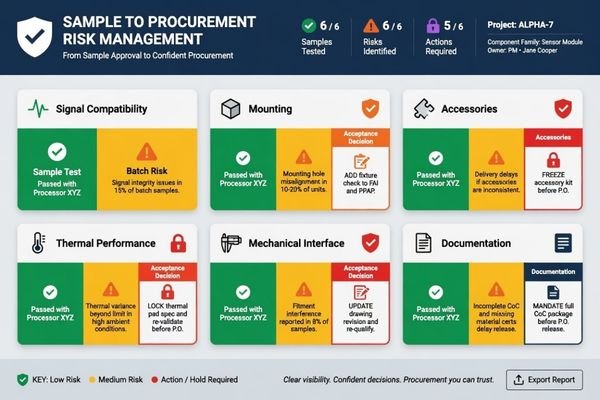
The matrix below is a practical structure for sample review. It should be adjusted according to the video source, installation plan, product role, user environment, and procurement quantity. The purpose is to make batch approval traceable.
| Acceptance Area | Sample Test Condition | Batch Procurement Risk | Acceptance Decision |
|---|---|---|---|
| Signal compatibility | Test the sample with the intended camera processor or representative video source | Batch units may fail with the real input interface or signal format | Approve only the tested input configuration |
| Resolution recognition | Confirm expected resolution, scaling behavior, and display mode | Wrong scaling or unstable recognition may appear after delivery | Freeze the approved resolution and source setting |
| Image stability | Review live video behavior, flicker, interruption, or signal loss | Field teams may face repeated troubleshooting2 | Retest if instability appears under the planned signal path |
| Input switching and recovery | Test planned input switching, signal recovery, and reconnect behavior when applicable | Batch units may create black screen, delay, or workflow interruption during source changes | Approve only the tested switching condition or define retest requirements |
| Color output | Compare color behavior under agreed processor and display settings | User feedback may become subjective or inconsistent | Document approved settings and acceptance conditions |
| Brightness behavior | Check brightness setting, visual consistency, and operating condition | Units may require repeated manual adjustment | Define acceptable setting range before procurement |
| Viewing angle | Review visibility from intended user positions | The display may be accepted on a bench but rejected in the room | Validate from real viewing distance and position |
| Mounting and installation | Confirm stand, arm, VESA, cart, or OR mounting method | Mechanical mismatch may delay installation | Approve the exact mounting condition |
| Cleaning and screen surface expectation | Review screen surface, enclosure handling, and cleaning instruction under the intended installation condition | User-side rejection may occur if surface handling does not match OR expectations | Confirm surface expectation and cleaning instruction before procurement |
| Accessory consistency | Check cables, power supply, adapters, and mounting parts | Missing or inconsistent accessories may disrupt batch setup | Freeze the approved accessory list |
| Documentation | Review datasheet, user guide, packing list, and service notes | Installation and service teams may lack consistent reference material | Approve documentation before order release |
| Packaging | Check protection, labels, carton content, and unpacking process | Batch delivery may create inspection or handling issues | Confirm packaging requirements before procurement |
| Test record and approval evidence | Record tested source, settings, accessories, photos, notes, and acceptance result | Later teams may not know what condition was actually approved | Keep a sample approval record as part of the procurement baseline |
| Approved configuration | Record model version, input setting, power, accessories, and labels | Later batches may differ from the tested sample | Use the approved configuration as the procurement baseline |
| Long-term model continuity | Confirm supply plan and change communication | Replacement or expansion may become difficult later | Confirm continuity expectations before batch order |
At Reshin, I use this type of matrix to separate engineering validation, user acceptance, procurement approval, and batch configuration control. I do not treat one successful image display test as full procurement approval. I usually separate signal approval, user-side viewing feedback, accessory confirmation, documentation review, packaging requirements, and batch configuration control before discussing order expansion. This helps the project team avoid a common mistake: approving the image test but leaving accessories, documentation, packaging, or supply conditions undefined.
How to Move from Approved Sample to Batch Procurement
A passed sample does not automatically mean batch procurement should start immediately. The approved configuration should be frozen first, and the batch plan should confirm whether the tested condition can be repeated.
Before batch procurement, the approved sample configuration should be frozen, including model version, input configuration, accessories, power supply, mounting method, labeling, packaging, documentation, QC records, delivery schedule, supply continuity, spare unit planning, and change communication.
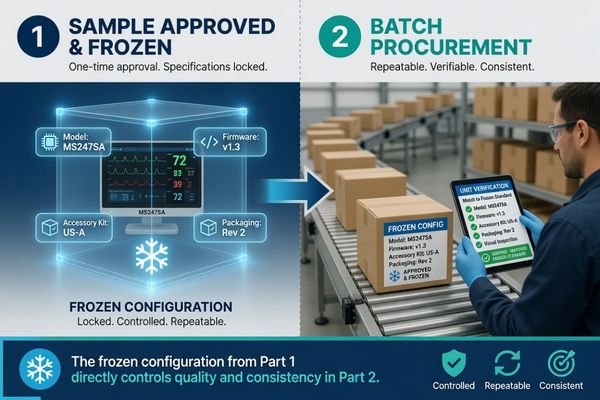
The procurement baseline should describe the same condition that passed the sample test. This includes the input interface, cable requirement, power supply, mounting method, accessory list, documentation package, labeling, packaging, QC reference, delivery schedule, and service expectation. If your team needs engineering review before surgical monitor batch procurement, send the camera processor or video source, input interface, target resolution, mounting method, sample quantity, batch quantity, and procurement timeline to info@reshinmonitors.com.
Configuration Freeze Should Happen Before Purchase Expansion
Configuration freeze prevents the batch order from drifting away from the approved sample. The team should record the tested video source, input setting, resolution, cable type, power configuration, mounting method, accessories, documents, labels, packaging, and QC reference. If any item changes after approval, the team should decide whether retesting is required. This sample-to-production drift control is especially important for OEM/ODM projects, distributor orders, and integrated surgical systems.
Batch Procurement Should Include Supply and Change Control
Batch procurement should also confirm spare unit planning, delivery schedule, inspection records, and future change communication. A project may need the same monitor direction for repeat orders, regional deployment, or later replacement. This review should be connected with long-term supply and model consistency because supply control can become as important as the first sample result when the project expands.
At Reshin, I usually convert the approved sample condition into a procurement baseline before batch discussion. This includes the tested input configuration, accessory list, mounting condition, labeling, packaging, documentation package, QC reference, delivery schedule, and change communication process. This makes it easier for the customer to compare the approved sample with later batch deliveries and reduces avoidable mismatch between engineering approval and procurement execution.
Recommended Surgical Monitor Models for Sample Testing and Procurement Planning
After acceptance criteria are defined, model evaluation becomes more controlled. Each sample direction should be connected to a practical validation role instead of presenting one monitor as suitable for every surgical project. Final approval should depend on the video source, signal interface, mounting method, image behavior, documentation needs, and batch procurement plan.
The following model directions can support sample testing and procurement planning when they are validated under the intended project conditions. They are not universal recommendations. Each model should be tested with the real or representative video chain, physical installation method, accessory requirements, and approval criteria before the team moves into batch procurement.
| Clinical Role / Application | Usage Pattern | Display Requirements | Recommended Model | Key Integration Considerations |
|---|---|---|---|---|
| 24-inch FHD endoscopy sample validation | Routine endoscopy system testing or sample approval before batch order | FHD surgical display direction depending on video source and workflow | MS247SA | Confirm signal input, color behavior, mounting method, accessories, and approved configuration |
| 27-inch FHD surgical workstation sample testing | Larger FHD viewing setup for surgical imaging or equipment-side review | FHD surgical monitor direction where larger screen size is required | MS270P | Validate viewing distance, power setup, cable route, user feedback, and documentation needs |
| 31.5-inch 4K arthroscopy or minimally invasive surgery sample testing | High-resolution surgical video chain evaluation under agreed conditions | 4K surgical monitor direction depending on processor output | MS321PB | Test 4K signal stability, mounting, brightness behavior, cable condition, and batch repeatability |
| 32-inch 4K surgical display sample evaluation | Integrated surgical imaging system or premium workflow sample review | 4K surgical display direction after system-level validation | MS322PB | Confirm input configuration, color output, OR integration condition, accessories, and QC reference |
| 55-inch 4K OR observation display planning | Large-format OR observation, team viewing, or room display planning | Large 4K OR display direction depending on installation role | MS550P | Review signal routing, mounting structure, power plan, room visibility, packaging, and service process |
FAQ
What should be included in surgical monitor acceptance criteria? Acceptance criteria should include signal compatibility, resolution recognition, image stability, color output, brightness behavior, viewing angle, mounting, power configuration, accessories, documentation, packaging, approved configuration, test evidence, and batch consistency.
Should surgical monitor samples be tested with the actual camera processor or video source? Yes, whenever possible. Testing with the actual or representative video source helps confirm input behavior, resolution recognition, image stability, color output, input switching behavior, and workflow acceptance under realistic conditions.
What is the difference between surgical monitor sample approval and batch procurement approval? Sample approval confirms one tested configuration. Batch procurement approval confirms whether the same configuration can be repeated across units, accessories, documentation, packaging, QC records, delivery schedule, and change communication.
What should be frozen before moving from sample approval to batch order? The team should freeze the model version, input configuration, cable and accessory list, power supply, mounting method, labeling, packaging, documentation, QC reference, delivery schedule, and change communication process.
How can OEM/ODM teams reduce risk before surgical monitor batch procurement? OEM/ODM teams can reduce risk by defining acceptance criteria early, testing the sample in representative conditions, documenting the approved configuration, confirming accessory and packaging consistency, keeping approval evidence, and reviewing supply continuity before order expansion.
Conclusion
Surgical monitor acceptance criteria help turn sample testing into a controlled procurement decision. A sample should not be treated as ready for batch order only because it displays an image. The project team should confirm signal compatibility, image stability, color and brightness behavior, input switching behavior, mounting, accessories, documentation, packaging, approval evidence, approved configuration, and long-term continuity before procurement expands. This reduces avoidable mismatch between engineering approval and batch delivery.
At Reshin, I support surgical monitor projects by connecting sample validation, configuration freeze, documentation review, accessory control, batch consistency, and supplier-side engineering support. This helps endoscopy system manufacturers, OR integrators, OEM/ODM teams, distributors, procurement teams, and product managers reduce risk before surgical monitor procurement. Share your surgical monitor sample testing plan for engineering review.
✉️ info@reshinmonitors.com
-
"VESA Mount Compatibility: Your Guide to Secure Monitor Setup", https://eurekaergonomic.com/blogs/eureka-ergonomic-blog/what-is-vesa-mount-compatibility?srsltid=AfmBOopBTcGDBv942I6PVaWfY5ZPt7sJZ67nuOn8VW83h0hBOkhvLFL2. The IEC 60601-1 standard for medical electrical equipment specifies mechanical mounting requirements and recognizes standard VESA patterns to facilitate safe and repeatable installation. Evidence role: definition; source type: other. Supports: Mounting method, stand or arm compatibility, VESA requirement, power configuration, accessory set, cable routing, screen surface expectations, installation space, and user feedback can all affect approval.. Scope note: Addresses medical electrical equipment in general and does not discuss endoscopy monitors specifically. ↩
-
"Field Service Solutions – SightCall Remote Visual Support Improves …", https://sightcall.com/solutions/field-service/. Field service metrics indicate that unstable video installations often lead to multiple on-site support visits before resolution. Evidence role: statistic; source type: research. Supports: Field teams may face repeated troubleshooting. Scope note: Metrics typically aggregate various hardware issues and may not isolate video signal stability as the sole cause. ↩