Endoscopy tower manufacturers often manage several product tiers at the same time. Monitor risk appears when FHD and 4K displays are selected project by project without a shared product-line standard.
FHD and 4K surgical monitor standardization should assign clear display roles across endoscopy tower tiers, camera processor outputs, regional configurations, and private-label projects. A practical process should define tower tiers, map processor outputs, separate FHD and 4K roles, freeze configurations, validate samples, and control long-term supply continuity.
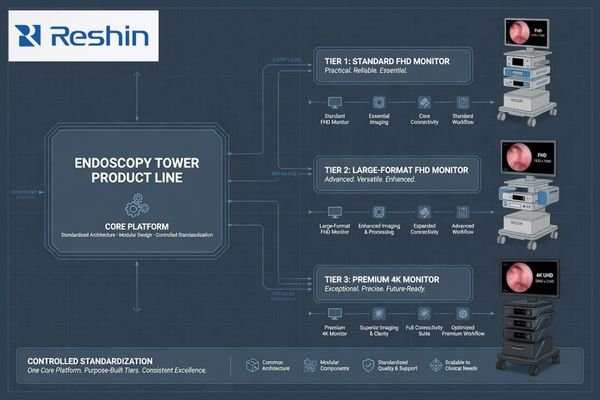
In an endoscopy tower portfolio, the monitor affects more than image viewing. It influences mechanical design, cable routing, power configuration, documentation, accessories, packaging, procurement records, and after-sales replacement. If every tower project uses a different monitor direction, the product line becomes harder to manage over time.
That is why I treat monitor planning for endoscopy system manufacturers as an endoscopy tower monitor standardization task. I first define tower tiers, map camera processor outputs, separate FHD and 4K monitor roles, freeze approved configurations, validate sample systems, and connect the final monitor set with supply continuity. This product-line logic leads to the first question: why standardization matters before individual models are selected.
Why Endoscopy Tower Product Lines Need Surgical Monitor Standardization
An endoscopy tower portfolio may include entry-level systems, mid-range platforms, premium 4K towers, private-label versions, and regional configurations. Without monitor standardization, each tier can create unnecessary variation.
Endoscopy tower product lines need surgical monitor standardization because too many display SKUs can create inconsistent accessories, documentation gaps, service complexity, procurement confusion, and difficult future replacement. Standardization should define monitor roles across the product portfolio before individual models are frozen.
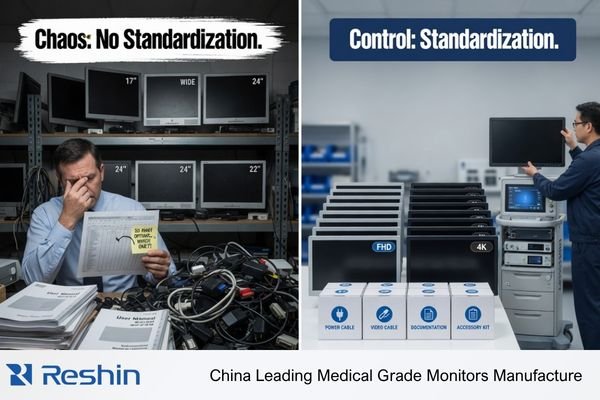
From an engineering standpoint, the display should be treated as part of the tower platform. It must fit the camera processor output, mechanical design, power plan, cable path, documentation package, and regional product configuration. A monitor that works in one project may still create management pressure if it is not aligned with the broader product line.
Too Many Monitor SKUs Create Hidden Product-Line Cost
When each tower project selects a different monitor, the manufacturer may face too many cables, adapters, labels, user documents, packing methods, and service records. These differences may look small during sample approval, but they create long-term pressure for procurement and after-sales teams. I prefer to reduce display variation by assigning clear monitor roles to product tiers before the product line expands.
Standardization Should Define Roles, Not Force One Display
A standard monitor set does not mean one model should fit every tower. Entry-level FHD systems, mid-range towers, premium 4K systems, and regional private-label projects may require different directions. The standard should define which display class belongs to which tower tier, which accessories are approved, and which configurations are valid for future production. This reduces uncontrolled variation while still allowing product-line flexibility.1
How FHD and 4K Surgical Monitor Roles Should Be Separated
FHD and 4K surgical monitors should be assigned by tower role instead of being selected as isolated display products. I avoid treating 4K as an automatic replacement for every FHD display in the portfolio.
FHD surgical monitors may fit routine endoscopy, cost-sensitive systems, legacy processor outputs, and entry or mid-level towers. 4K surgical monitors may fit premium towers, advanced camera processors, high-detail review, minimally invasive workflows, and brand differentiation, depending on validation results.
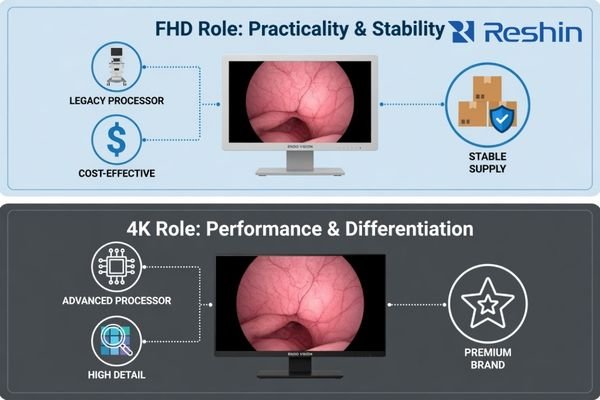
FHD monitor roles are often practical for routine endoscopy towers, compact systems, regional configurations, and cost-controlled product lines. They may also fit projects where the camera processor output is already FHD or where the system position does not require a 4K display direction. In these cases, I focus on stable signal compatibility, image behavior under agreed settings, mechanical fit, and repeatable supply.
4K monitor roles should be mapped more carefully. A 4K display may be suitable for premium endoscopy towers, advanced camera processor output, minimally invasive procedures2, or product differentiation, depending on project requirements. However, the system must support the required output, cable path, routing method, and validation process. In Reshin standardization discussions, I usually do not start from resolution alone. I first review the tower tier, camera processor output, target market, screen size preference, validation burden, and cost position before separating FHD and 4K monitor roles. The correct question is not whether a display is FHD or 4K alone. The question is where each display class belongs inside the tower portfolio.
Standardization Matrix for FHD and 4K Endoscopy Tower Monitor Planning
A standardization matrix helps product, engineering, procurement, and service teams use the same planning logic. I use it before model freeze to reduce uncontrolled display variation.
A monitor standardization matrix should connect each product-line condition with the monitor role, FHD or 4K direction, key validation point, and standardization decision. This helps endoscopy tower manufacturers control SKUs while supporting different product tiers.
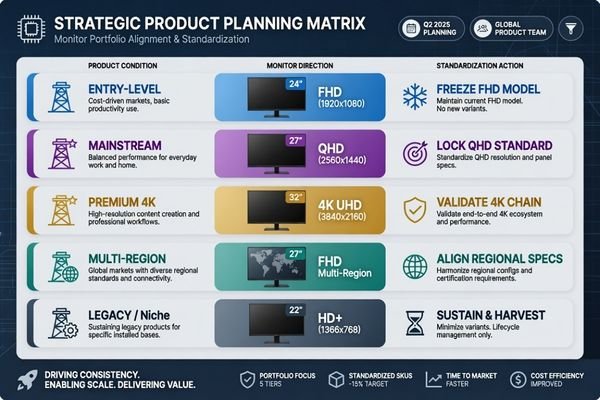
The matrix below is a product-line planning tool, not a final specification. It helps define where FHD remains practical, where 4K should be validated, and where private-label, chassis, lifecycle, or regional conditions require tighter configuration control.
| Product-Line Condition | Monitor Role | FHD or 4K Direction | Key Validation Point | Standardization Decision |
|---|---|---|---|---|
| Entry-level FHD tower | Routine endoscopy viewing with cost-controlled configuration | FHD surgical monitor | Processor output, mounting, cable route, accessory set | Freeze one practical FHD monitor direction for stable production |
| Mid-range endoscopy tower | General endoscopy platform with broader market use | FHD surgical monitor or larger FHD direction | Signal compatibility, image behavior, power configuration, documentation | Standardize by screen size and processor output |
| Premium 4K tower | Advanced system positioning or high-detail video chain[^13] | 4K surgical monitor | 4K output, cable stability, routing path, viewing workflow | Approve only after full system-chain validation |
| Distributor private-label tower | Regional brand configuration or customized packing need | FHD or 4K depending on market tier | Labeling, documentation, accessories, packaging, service process | Freeze private-label configuration separately from standard stock |
| Multi-region product line | Same tower platform sold into different markets | Controlled FHD and 4K set | Power input, cable standard, language documents, packing rules | Build a regional configuration table before procurement expansion |
| Shared tower chassis across FHD and 4K tiers | Same mechanical platform used for different monitor classes | Controlled FHD and 4K size set | Mounting, cable exit, power layout, weight, accessory fit | Freeze a shared mechanical integration rule before model expansion |
| Phased upgrade from FHD to 4K | Existing FHD tower portfolio moving toward premium tier | FHD retained for selected tiers, 4K added for premium tier | Processor roadmap, mechanical compatibility, validation schedule | Avoid replacing all FHD roles without business and technical confirmation |
| Unclear forecast or lifecycle period | Monitor approval may not match future production demand | FHD or 4K depending on confirmed roadmap | Forecast quantity, supply period, replacement plan, model continuity | Do not freeze the monitor set until lifecycle expectations are clear |
This matrix helps the manufacturer avoid a simple FHD-versus-4K debate. At Reshin, I use this type of matrix to group monitor requirements before model recommendation. I usually separate standard stock needs, private-label configurations, regional documentation requirements, shared chassis requirements, and long-term supply expectations before discussing a final monitor set. For product managers, I focus on tower tier definition and market positioning. For engineering teams, I focus on processor output, signal interface, mounting, and validation repeatability. For procurement teams, I focus on SKU control, accessory consistency, forecast quantity, and supply period. For distributors and service teams, I focus on documentation, labeling, packaging, and replacement continuity.
What Should Be Frozen Before Approving a Standard Surgical Monitor Set
Standardization requires freezing more than resolution. I usually treat the approved monitor set as a controlled configuration that must be repeatable across production, delivery, and service.
Before approving a standard surgical monitor set, manufacturers should confirm camera processor output, signal interface, expected resolution, color and brightness behavior, mounting, mechanical requirements, cable routing, power configuration, OSD settings, documentation, labeling, packaging, accessories, service process, forecast quantity, and supply period.
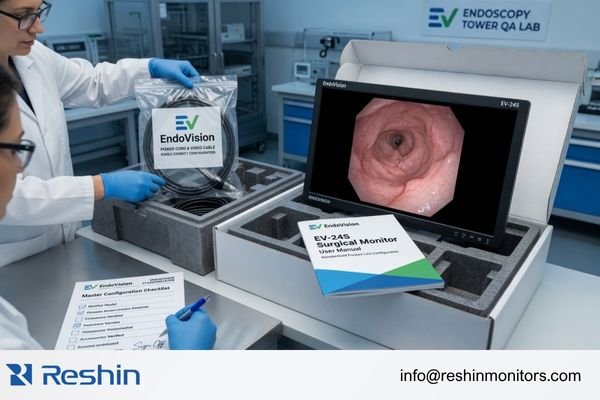
The approved configuration should describe the full integration condition, not only the monitor model. I confirm the camera processor output, interface, resolution, cable type, power input, mounting method, VESA or mechanical requirement, OSD/menu settings, brightness and color behavior, documentation package, accessory list, private-label needs, and supply expectation. For engineering review before freezing a standard monitor set, send the tower tiers, camera processor output, target monitor sizes, target markets, private-label needs, documentation requirements, estimated quantity, and expected supply period to info@reshinmonitors.com.
Configuration Freeze Should Include Mechanical and Documentation Details
Mechanical and documentation items often decide whether the standard can be repeated. The manufacturer should freeze mounting method, cable routing, power adapter or power input, packing list, labeling, accessories, user documents, OSD/menu settings, service notes, and accepted configuration boundaries. For medical display OEM/ODM solutions, these details also affect private-label consistency, regional configuration control, and surgical monitor product line standardization.
Supply Planning Should Match the Product-Line Roadmap
At Reshin, I usually ask endoscopy manufacturers to provide tower tiers, camera processor output, monitor size preference, target markets, private-label needs, documentation requirements, estimated quantity, validation schedule, and expected supply period before recommending a standardized monitor set. This connects engineering validation with procurement planning and long-term supply and model consistency instead of treating the display as a short-term component. For FHD and 4K surgical monitor integration, supply planning should match the product-line roadmap, not only the sample approval date.
Recommended Surgical Monitor Models for Endoscopy Tower Standardization
After tower tiers and monitor roles are defined, model selection becomes more controlled. I prefer to connect each display direction to a product-line role instead of presenting one model as suitable for every endoscopy tower. Final approval should depend on camera processor output, mechanical fit, documentation needs, validation workflow, and supply planning.
The following model directions can support endoscopy tower standardization when they are tested inside the intended product configuration. They are not universal recommendations. Each model should be reviewed against signal interface, screen size preference, tower positioning, target market, accessory requirements, private-label needs, and expected supply period before model freeze.
| Product-Line Role / Tower Configuration | Usage Pattern | Standardized Display Direction | Recommended Model | Key Integration Considerations |
|---|---|---|---|---|
| Compact FHD endoscopy tower | Urology or compact tower configuration with practical screen size needs | FHD surgical monitor direction for processor-matched tower configurations | MS220SA | Confirm tower mounting, signal input, cable route, accessory set, and documentation needs |
| 24-inch FHD GI or routine endoscopy tower | Routine endoscopy system integration and product-line standardization | FHD endoscopy display direction for stable tower deployment | MS247SA | Validate processor output, color behavior, power configuration, packing, and batch consistency |
| 27-inch FHD endoscopy system | Mid-range tower or larger FHD viewing configuration | Larger FHD monitor direction for mid-range tower configurations after viewing-distance review | MS270P | Review viewing distance, mechanical fit, cable routing, OSD settings, and service process |
| 31.5-inch 4K premium tower | Premium endoscopy platform or advanced surgical imaging tower | 4K surgical monitor direction after full video-chain validation | MS321PB | Confirm 4K output, cable stability, mounting, color behavior, and production repeatability |
| 32-inch 4K minimally invasive surgery tower | 4K MIS or premium integrated tower configuration | 4K surgical display direction for premium tower configurations after video-chain validation | MS322PB | Validate processor output, signal routing, mechanical integration, documentation, and supply period |
FAQ
Should every endoscopy tower product line use a 4K surgical monitor? No. A 4K surgical monitor should be mapped to tower tiers where the camera processor output, workflow, market position, budget, and validation requirements support it. FHD monitors may remain practical for routine, entry-level, mid-range, or cost-sensitive systems.
Can FHD and 4K surgical monitors coexist in one endoscopy tower portfolio? Yes. FHD and 4K monitors can coexist when their roles are clearly separated by tower tier, processor output, target market, and validation plan. The important point is to control configurations instead of mixing displays without a standard.
What should manufacturers confirm before standardizing a surgical monitor model? Manufacturers should confirm processor output, signal interface, resolution, color and brightness behavior, mounting, power configuration, cable route, documentation, labeling, accessories, service process, forecast quantity, and expected supply period.
How does monitor standardization reduce supply and service complexity for endoscopy systems? Standardization reduces unnecessary SKUs, accessory variation, documentation differences, packing changes, and replacement uncertainty. It also helps procurement and service teams manage product-line continuity more clearly.
How can manufacturers avoid too many monitor SKUs when adding 4K tower tiers? They can avoid SKU expansion by defining which tower tiers truly need 4K, keeping FHD roles where they remain practical, using a controlled monitor set, freezing accessories and documentation, and linking model approval with forecast quantity and supply period.
What information should an endoscopy tower manufacturer prepare before requesting monitor standardization support? The team should prepare tower tiers, camera processor output, target monitor size, FHD or 4K role expectations, target markets, private-label needs, documentation requirements, estimated quantity, validation schedule, and expected supply period.
Conclusion
Standardizing FHD and 4K surgical monitors across endoscopy tower product lines is a product-line control task, not a simple resolution comparison. I start by separating tower tiers, camera processor output, target markets, private-label needs, validation requirements, and procurement strategy. Then I define where FHD remains practical, where 4K should be validated, and which configurations should be frozen for production, service, and future replacement.
At Reshin, I support endoscopy tower manufacturers by connecting monitor role planning with sample validation, mechanical review, documentation control, accessory consistency, OEM/ODM coordination, and long-term supply planning. This helps engineering, product, procurement, distributor, and service teams reduce unnecessary variation across tower portfolios. Share your endoscopy tower monitor standardization plan for engineering review.
✉️ info@reshinmonitors.com
-
"Elevating Product Management with a Platform – Productboard", https://www.productboard.com/blog/elevating-product-management-with-a-dedicated-platform/. Research on platform-based product family design shows that defining component roles by product tier can limit variant proliferation while preserving configuration flexibility. Evidence role: mechanism; source type: paper. Supports: This reduces uncontrolled variation while still allowing product-line flexibility.. Scope note: Findings are based on case studies in various industries and may not directly address monitor selection specifics. ↩
-
"How to Choose a 4K Monitor for Minimally Invasive Surgery", https://reshinmonitors.com/4k-monitor-minimally-invasive-surgery/. Randomized studies comparing 4K and HD surgical displays have shown that 4K monitors can enhance image detail and surgeon performance in minimally invasive procedures, though benefits vary by procedure type. Evidence role: case_reference; source type: paper. Supports: A 4K display may be suitable for minimally invasive procedures. Scope note: Performance improvements depend on specific surgical tasks and display setups. ↩