The sample passed. The supplier evaluation or audit was completed. The display model direction looks acceptable.
At this point, many OEM medical equipment programs are ready to move toward pilot production or repeat purchasing. This is also where a new type of risk begins: the supplier may be approved, but the quality responsibilities between the two parties may still be unclear.
A Supplier Quality Agreement for a medical display OEM program should define the approved product scope, quality responsibilities, inspection and release rules, nonconformance handling, deviation approval, quality escalation, change notification, traceability, critical supplier controls, and ongoing supplier performance expectations.
Supplier approval answers whether a supplier is acceptable. It does not automatically answer what happens when a production batch differs from the approved configuration, a deviation is requested, a field complaint appears, a critical component changes, or inspection evidence does not meet the agreed requirement.
Those decisions should not depend on an urgent email discussion after production has already started.
A Supplier Quality Agreement, or SQA, provides a practical framework for defining those responsibilities before routine production becomes difficult to control.
For OEM equipment teams working with a medical display manufacturer for OEM equipment, the purpose is not to create more paperwork. The purpose is to convert supplier approval into a controlled working relationship for pilot production, repeat orders, quality events, field support, and long-term supply.
This article is not a legal contract template and does not replace the buyer’s quality management system. It is a practical framework for identifying the quality responsibilities that should be considered after supplier approval.
What Is a Supplier Quality Agreement in a Medical Display OEM Program?
A Supplier Quality Agreement defines how the medical device organization and the medical display supplier will manage quality-related responsibilities during the approved supplier relationship.
It is different from a purchase order, technical specification, NDA, or supplier audit.

A technical specification answers:
What should the product be?
A purchase order or commercial contract answers:
What is being purchased and under what commercial conditions?
An NDA answers:
How will confidential information be protected?
A supplier audit answers:
Does the supplier’s quality system and manufacturing capability meet the organization’s supplier qualification requirements?
A Supplier Quality Agreement answers a different question:
When quality-related events occur after supplier approval, who is responsible and how will those events be controlled?
For a medical display OEM program, this distinction matters because the approved display may involve more than a model number.
The controlled project configuration may include the LCD panel or panel family, signal board, firmware, interfaces, power supply, enclosure, mounting structure, front glass, optical bonding, OSD settings, calibration-related configuration, labeling, accessories, and packaging.
If responsibility for these items is unclear, both sides may interpret the approved product differently once pilot or repeat production begins.
The SQA should therefore be specific enough to support real project decisions without becoming a duplicate of every technical drawing, specification, commercial agreement, or internal quality procedure.
Quality-System Context: Why Supplier Controls Matter
Supplier quality agreements should be understood as part of a broader supplier-control system rather than as an isolated document.
The U.S. FDA’s Quality Management System Regulation (QMSR), effective February 2, 2026, incorporates ISO 13485:2016 into the medical device quality-system framework.
The FDA-hosted MDSAP Audit Approach also addresses supplier evaluation, supplier monitoring, re-evaluation, purchasing requirements, acceptance activities, documented purchasing information, and written arrangements for suppliers to communicate relevant product changes.
Quality agreements are identified as one form through which purchasing information may be documented.
This does not mean every medical device organization must use the same Supplier Quality Agreement format.
The exact supplier-control method depends on the organization’s quality management system, supplier risk, project structure, supplied product, and applicable regulatory requirements.
The practical point is simpler:
Supplier approval should be followed by controls that are proportionate to the impact the supplied medical display may have on the finished medical equipment.
When Should the Supplier Quality Agreement Be Defined?
There is no single project sequence that every OEM organization must follow.
One practical sequence may look like this:
Supplier Screening
↓
Technical Evaluation
↓
Sample Evaluation
↓
Supplier Approval / Conditional Approval
↓
Supplier Quality Agreement
↓
Pilot Production
↓
Repeat / Volume Production
↓
Field Support & Lifecycle Management
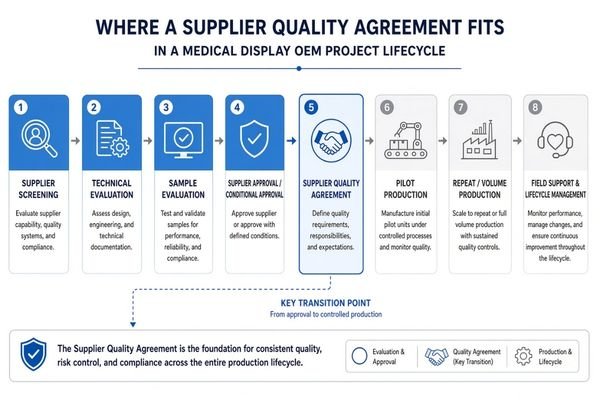
Some organizations may complete the quality agreement as part of final supplier approval. Others may define it after conditional approval but before pilot or volume production.
The timing may depend on supplier classification, product risk, customization level, target market, existing supplier history, and the organization’s own quality procedures.
The important point is not the exact position of the document in a flowchart.
The important point is:
Quality responsibilities should be defined before routine production begins to depend on informal assumptions.
If a project has not yet reached supplier approval, the team should first clarify application, size, resolution, interfaces, signal source, mounting, target market, sample purpose, customization scope, specification freeze, and volume expectations.
Those are project-startup questions rather than Supplier Quality Agreement questions.
For that earlier stage, see the OEM Medical Display Project Checklist.
After supplier approval, the central question changes from:
Can this supplier make the display we need?
to:
How will both parties control the approved display program when real production and quality events occur?
That is the problem the Supplier Quality Agreement should solve.
What Should Be Defined in a Supplier Quality Agreement for Medical Display OEM Programs?
Before drafting detailed clauses, it is useful to map the major responsibility areas.
| SQA Area | Medical Display OEM Example | Main Question |
|---|---|---|
| Product & Configuration Scope | Model, approved revision, firmware, interfaces | Exactly what approved product does the agreement cover? |
| Responsibility Matrix | Supplier QA, medical device organization QA, engineering, procurement | Who owns each quality decision? |
| Inspection & Release | Production inspection and agreed acceptance criteria | What must be confirmed before shipment? |
| Nonconformance & Deviation | Failed inspection or temporary deviation | What happens when the product does not meet the approved baseline? |
| Quality Escalation / CAPA | Repeated defect, batch issue, field complaint | When does an issue require formal investigation? |
| Change Control | Panel, PCB, firmware, enclosure, critical component | Which changes require notification, review, or approval? |
| Traceability & Records | Serial number, lot, revision, inspection records | What evidence should remain retrievable? |
| Critical Supplier Controls | Panel, power supply, PCBA, optical parts | How are important upstream changes controlled? |
| Supplier Performance Review | Nonconformance, corrective action, change discipline | How is supplier performance monitored after approval? |
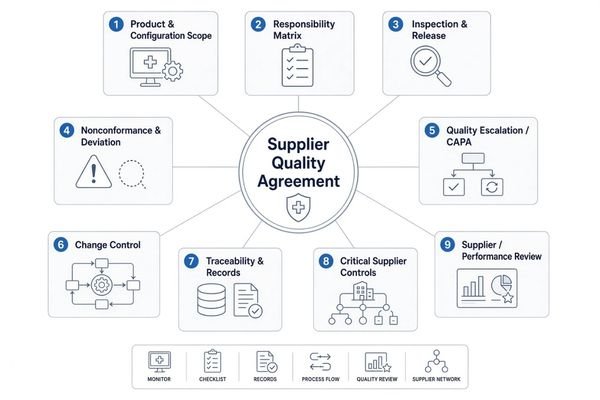
This prevents the SQA from becoming only a document checklist.
Certificates, drawings, manuals, specifications, compliance documents, and technical files may already be reviewed during supplier qualification. That topic is covered separately in what documentation buyers usually request from a medical display supplier.
The Supplier Quality Agreement should focus on how the approved relationship works when production and quality decisions actually occur.
1. Define the Product and Approved Configuration Scope
The first question should be:
When the agreement refers to the "approved medical display," what exactly does that mean?
For an OEM project, a model name alone may not define the full approved configuration.
Depending on the project, the controlled scope may include:
- display model;
- LCD panel or approved panel family;
- signal or main board;
- firmware or controlled software configuration;
- power supply;
- input/output interface configuration;
- enclosure;
- mounting structure;
- front glass or optical bonding;
- OSD defaults;
- calibration-related configuration;
- labeling;
- project-specific accessories;
- packaging configuration.
The SQA does not need to reproduce every drawing, BOM line, firmware specification, or packaging instruction.
Instead, it should identify which controlled documents define the approved product and how both parties recognize the current approved revision.
For example, the SQA may reference an approved product specification, configuration sheet, controlled drawing, BOM revision, firmware record, labeling requirement, or project-specific technical agreement.
This creates a common baseline.
If the approved configuration later changes, the detailed review should follow the project’s change-control procedure rather than being recreated inside the SQA.
For a deeper discussion of that process, see controlled change planning for OEM medical display projects.
2. Define Quality Responsibilities Between the Medical Display Supplier and the Medical Device Organization
Supplier approval does not eliminate the need for responsibility boundaries.
It makes those boundaries more important.
Once production begins, supplier QA, customer QA, engineering, procurement, and project teams may all participate in quality decisions. The agreement should make clear which party owns which activity.
A practical responsibility matrix may look like this:
| Activity | Medical Display Supplier | Medical Device Organization / System Owner |
|---|---|---|
| Manufacturing process control | Primary responsibility | Review or audit as agreed |
| Controlled product information | Provide and maintain supplier-controlled information | Review and approve project baseline as applicable |
| Routine production inspection | Perform according to controlled processes and agreed requirements | Review evidence or perform receiving verification as applicable |
| Temporary deviation | Identify, assess, and request where customer approval is required | Review and approve/reject as agreed |
| Supplier-driven change | Identify, assess, document, and notify as required | Evaluate impact and approve/reject where required |
| Field complaint investigation | Support display-level technical investigation | Provide system and field information |
| Finished medical device validation | Support display-related evidence | Responsibility of the medical device organization / legal manufacturer, as applicable |
This last boundary is especially important.
The medical display supplier can support:
- display-level specifications;
- production inspection records;
- approved configuration information;
- component or revision information;
- display-level testing;
- failure investigation;
- change information;
- technical documentation.
However, responsibility for the quality, performance, validation, and regulatory conformity of the finished medical device remains with the medical device organization or legal manufacturer, as applicable to the project structure.
For example, a display integrated into an ultrasound system, endoscopy tower, surgical system, C-arm, imaging workstation, or other medical equipment becomes part of a larger system.
The display supplier can help evaluate the display.
The medical device organization must evaluate the finished equipment.
A strong SQA should make that boundary visible rather than creating unrealistic responsibility assumptions on either side.
3. Define Production Inspection, Acceptance, and Shipment Release
The Supplier Quality Agreement should establish how product acceptance is controlled before shipment.
It does not need to reproduce the supplier’s entire manufacturing quality system.
Instead, both parties should agree on which project-level acceptance expectations matter.
Depending on the display program, these may include:
- functional acceptance;
- signal and interface behavior;
- required resolution recognition;
- display or image-related acceptance criteria;
- cosmetic acceptance;
- labeling;
- accessories;
- mounting components;
- packaging configuration;
- project-specific configuration checks;
- shipment release evidence.
The agreement should also identify when a deviation requires customer review before shipment.
The supplier may operate internal controls such as IQC, IPQC, FQC, and OQC according to its own controlled quality procedures. The medical device organization may use incoming inspection, supplier records, certificates, sampling, audits, or other verification activities depending on project risk.
These systems do not have to be identical.
They need to be aligned enough that both parties understand:
What confirms that an approved production unit or batch can be released?
For additional information about the supplier-side production system, buyers can separately review Reshin’s medical display manufacturing and quality controls.
The SQA should define the relationship between those controls and the project-specific acceptance expectations rather than duplicating every factory procedure.
4. Define How Nonconforming Product and Deviations Are Handled
One of the most valuable functions of an SQA is defining what happens when a product does not meet the approved requirement.
Consider several examples:
- a signal test fails;
- an incorrect firmware version is found;
- a label differs from the approved requirement;
- a mounting component differs from the approved configuration;
- cosmetic condition exceeds the agreed limit;
- packaging is incorrect;
- a project-specific display setting is wrong.
The key question is not only:
Is this a defect?
The more important operational question is:
What happens next, and who has authority to make the disposition decision?
A practical process may look like this:
Nonconformance Detected
↓
Containment / Segregation
↓
Impact Assessment
↓
Customer Notification if Required
↓
Deviation Approval / Rejection where Applicable
↓
Rework / Replace / Accept Under Controlled Deviation
↓
Record and Trend Review
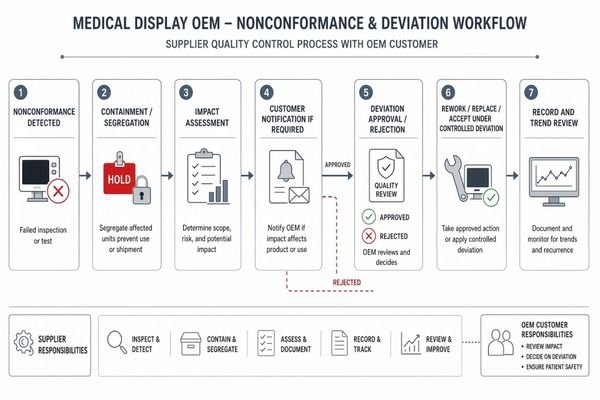
Product that does not meet the approved requirement should first be controlled so it is not unintentionally mixed with conforming product.
The supplier should then determine whether the issue is isolated, repeated, batch-related, configuration-related, or potentially relevant to already produced units.
Not every internal manufacturing nonconformance requires customer notification. A supplier may identify and correct routine process issues before release under its normal quality system.
However, a different level of control may be needed if the issue affects:
- the approved configuration;
- agreed acceptance criteria;
- shipment release;
- functionality;
- labeling;
- project-specific image or signal behavior;
- critical components;
- requirements important to the finished equipment.
The agreement should also distinguish a temporary deviation from a new approved baseline.
A deviation is a controlled exception.
It should not quietly become the new production standard.
5. Define Quality Escalation and CAPA Expectations
The SQA should identify when a routine nonconformance needs to become a formal quality investigation.
Possible escalation triggers may include:
- repeated failures;
- batch-level issues;
- field complaints;
- recurrence after corrective action;
- issues affecting multiple shipments;
- significant configuration errors;
- issues with potential safety or compliance relevance.
The exact triggers should reflect the medical device organization’s supplier-control process and the significance of the supplied display to the finished equipment.
The agreement can also define basic expectations for:
- initial containment;
- escalation contacts;
- information exchange;
- investigation responsibility;
- corrective action;
- effectiveness verification;
- closure.
The purpose is not to force every defect into a complex CAPA process.
The purpose is to ensure that both teams know when routine defect handling is no longer sufficient.
A separate formal investigation method, such as an 8D process, may be appropriate for certain repeated or significant quality problems. That process should be addressed in its own procedure rather than fully embedded in the Supplier Quality Agreement.
6. Define Change Notification and Re-Approval Triggers
Change control belongs in the SQA, but the agreement should focus on governance rather than reproducing the entire change-review process.
The central question is:
Which supplier-driven changes must not happen silently?
Depending on the approved program, examples may include changes to:
- LCD panel or approved panel family;
- signal board or PCB;
- firmware;
- power supply;
- connector or interface configuration;
- enclosure or mechanical structure;
- front glass or optical structure;
- important manufacturing processes;
- relevant production location;
- project-critical upstream supplier;
- label or packaging where controlled by the project.
Different changes may require different levels of action.
Some may require internal supplier evaluation only.
Others may require:
- notification;
- impact assessment;
- updated documentation;
- sample verification;
- customer review;
- prior approval.
The Supplier Quality Agreement should define the trigger and responsibility.
The detailed evaluation process should remain in the project’s controlled change planning process.
This keeps the two documents from overlapping.
The SQA answers:
Which changes require control between the parties?
The change process answers:
How will the change be evaluated and approved?
7. Define Traceability and Record Availability
The Supplier Quality Agreement should also clarify what level of traceability is expected and what records should remain retrievable.
A practical medical display traceability path may include:
Finished Unit Serial Number
↓
Production Batch
↓
Approved Product Revision
↓
Relevant Critical Components
↓
Firmware / Configuration
↓
Inspection or Test Records
↓
Shipment Record
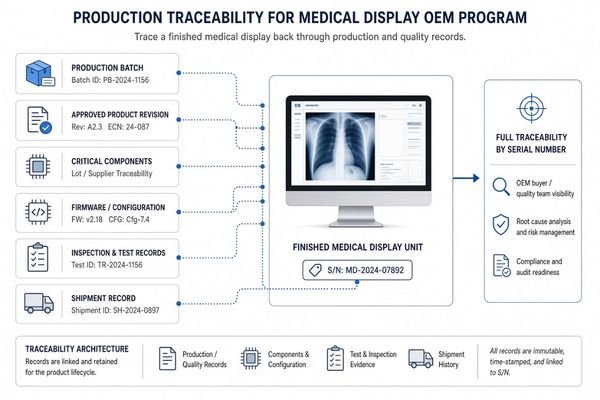
The required depth should be proportionate to the project and the significance of the display within the finished equipment.
The SQA does not need to list every internal production record.
Instead, it should answer three practical questions:
- What must remain traceable?
- Who maintains the records?
- What information should be retrievable when a quality investigation requires it?
For example, if a field issue is reported against a serial number, the supplier may need to determine which production batch and approved revision the unit belongs to and retrieve relevant configuration, inspection, or shipment information.
The detailed structure of individual production records can remain inside the supplier’s controlled QMS.
During supplier qualification, buyers may also review medical display supplier evaluation evidence to understand manufacturing, quality, documentation, and traceability capability.
The SQA then defines how those capabilities support the approved program after qualification.
8. Define Controls for Critical Upstream Suppliers and Components
Medical display manufacturers normally depend on upstream suppliers for components such as:
- LCD panels;
- power supplies;
- PCBAs;
- ICs;
- optical materials;
- mechanical parts;
- cables;
- labels;
- packaging materials.
The OEM’s concern is usually not whether every upstream supplier remains permanently unchanged.
The real concern is:
Can an upstream change affect the approved medical display without an appropriate evaluation?
The SQA should therefore identify categories of critical upstream change that may require supplier-side evaluation, documentation, validation, customer notification, or approval.
The required level of control should depend on the effect of the component on the approved display and finished equipment.
For example, a change affecting signal behavior, mechanical fit, power characteristics, image performance, calibration-related configuration, labeling, or service continuity may justify stronger controls than a low-risk change with no meaningful effect on the approved product.
This becomes especially important in multi-year OEM programs.
Component availability will change over time. The objective is not to promise that nothing will ever change.
The objective is to ensure that important changes are identified, evaluated, and communicated through a controlled process.
For programs where configuration consistency must be maintained across repeat orders and replacement cycles, this should also connect with a long-term medical display supply continuity strategy.
9. Define Ongoing Supplier Performance and Re-Evaluation
Supplier approval is not permanent proof of supplier capability.
Supplier performance must continue to be evaluated after approval.
The FDA-hosted MDSAP Audit Approach specifically treats supplier evaluation as more than a one-time activity and discusses supplier monitoring and re-evaluation based on the significance of the supplied product and actual supplier performance.
For a medical display OEM program, supplier performance may be reviewed from several perspectives:
| Area | Example Review Point |
|---|---|
| Product Quality | Rejection trends, repeated nonconformance, shipment quality |
| Configuration Consistency | Whether repeat production matches the approved baseline |
| Corrective Action | Response quality, root-cause discipline, recurrence control |
| Change Discipline | Whether required notifications and approvals occur before implementation |
| Documentation | Accuracy and revision alignment |
| Responsiveness | Escalation, technical response, investigation, closure |
The Supplier Quality Agreement may define which events trigger additional review, escalation, audit, corrective action, or supplier re-evaluation.
Examples may include:
- repeated quality problems;
- significant field complaints;
- uncontrolled changes;
- poor corrective-action closure;
- recurring documentation mismatch;
- inconsistent production evidence.
This does not mean every production problem indicates supplier failure.
Real manufacturing programs will experience issues.
The stronger indicator of supplier maturity is whether the issue is detected, contained, communicated, investigated, corrected, and prevented from recurring through an agreed process.
For equipment manufacturers requiring configuration control, project coordination, customization, and repeat production support, Reshin also provides OEM medical display manufacturing support.
What Should Not Be Put Into a Supplier Quality Agreement?
A Supplier Quality Agreement should not replace every other project document.
When an SQA tries to include technical specifications, pricing, customization requirements, confidentiality, regulatory responsibilities, and all factory procedures in one document, it becomes difficult to maintain.
A practical division may look like this:
| The SQA Should Not Replace | Better Controlled Through |
|---|---|
| Detailed technical specifications | Product specification / controlled drawing |
| Price, MOQ, or payment terms | Commercial agreement / purchase order |
| Detailed customization requirements | Technical agreement / configuration specification |
| Finished-device regulatory responsibilities | Medical device organization’s regulatory and QMS framework |
| Confidentiality obligations | NDA / confidentiality agreement |
| Every supplier operating procedure | Supplier’s controlled internal QMS procedures |
The SQA should reference controlled documents where appropriate rather than copying their entire contents.
This has an important practical benefit.
If a technical specification changes, the technical document can be revised through its controlled process without rewriting unrelated quality responsibilities.
If price or delivery terms change, the commercial agreement can be updated without changing the quality framework.
If an internal supplier SOP changes without affecting the customer’s approved product, the supplier can manage that procedure within its own QMS.
The SQA remains focused on the interface between the two organizations:
Responsibility, approval, communication, quality-event control, and supplier oversight.
For the same reason, a generic online article should not be treated as a ready-to-sign legal SQA template.
Each medical device organization has its own supplier procedures, risk classification, regulatory responsibilities, legal requirements, and quality-system structure.
The useful starting point is identifying which responsibilities need to be defined.
Practical Supplier Quality Agreement Review Before Pilot or Repeat Production
Before routine production, the project team can use a simple review to identify gaps.
| Question | Defined? |
|---|---|
| Is the approved medical display configuration clearly identified? | Yes / No |
| Are supplier and medical device organization responsibilities clear? | Yes / No |
| Are production acceptance and shipment-release expectations defined? | Yes / No |
| Is deviation approval ownership clear? | Yes / No |
| Are quality escalation contacts and triggers defined? | Yes / No |
| Are relevant supplier-driven change triggers defined? | Yes / No |
| Is the required traceability scope clear? | Yes / No |
| Are record availability expectations defined? | Yes / No |
| Are critical upstream changes controlled appropriately? | Yes / No |
| Is supplier performance and re-evaluation logic defined? | Yes / No |
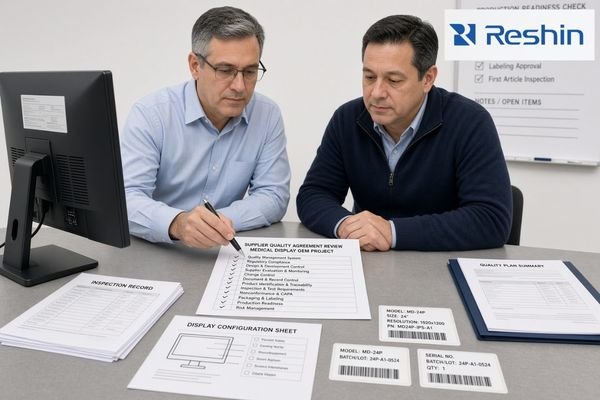
The checklist is deliberately simple.
Its purpose is not to replace a formal supplier quality process.
Its purpose is to reveal whether the supplier relationship still depends on assumptions.
A buyer may already have:
- completed supplier screening;
- reviewed quality-system evidence;
- approved samples;
- selected a product direction;
- agreed on commercial conditions.
That does not automatically mean the production relationship is fully controlled.
If the approved configuration is unclear, deviation authority is undefined, field investigation responsibility is uncertain, or supplier-driven changes have no communication rule, avoidable risk remains.
The SQA should close those gaps before they become urgent production problems.
FAQ
Is a Supplier Quality Agreement the same as a purchase contract?
No.
A purchase contract or purchase order normally controls commercial matters such as quantity, price, delivery, and payment.
A Supplier Quality Agreement focuses on quality responsibilities such as approved configuration, acceptance, deviations, nonconformance, change notification, traceability, escalation, and supplier performance.
The two documents may reference each other, but they serve different purposes.
Should the Supplier Quality Agreement be completed before or after sample approval?
There is no universal sequence for every organization.
Some medical device organizations may establish the quality agreement as part of final supplier approval. Others may complete it after technical or conditional approval and before pilot or repeat production.
The important point is that quality responsibilities should be defined before routine production depends on informal assumptions.
Does every medical display change require customer approval?
Not necessarily.
The project should define which changes require supplier-side evaluation only and which require notification, review, sample verification, or prior approval.
The level of control should depend on the effect of the change on the approved display and finished medical equipment.
Who is responsible for final system validation when a medical display is integrated into medical equipment?
The medical display supplier can support display-level evidence, controlled configuration information, production records, and technical investigation.
Responsibility for the finished medical device, including its system-level validation and applicable regulatory obligations, remains with the medical device organization or legal manufacturer, as applicable to the project.
How often should a Supplier Quality Agreement be reviewed?
The review approach should follow the medical device organization’s supplier-management procedures and project risk.
The agreement does not necessarily require a complete annual rewrite if its responsibilities remain current and appropriate.
However, review may be appropriate when significant product or process changes occur, supplier performance deteriorates, repeated quality problems appear, project requirements change, or the existing agreement no longer reflects the actual supplier relationship.
Building a Quality Agreement Around Real OEM Medical Display Risk
Supplier approval is the beginning of a controlled supplier relationship, not the end of supplier control.
A useful Supplier Quality Agreement helps the medical device organization and medical display supplier define:
- what approved product configuration is being controlled;
- who owns each quality responsibility;
- how production is accepted and released;
- how nonconforming product and deviations are handled;
- when quality issues require escalation;
- which supplier-driven changes require notification or approval;
- what must remain traceable;
- how critical upstream changes are controlled;
- how supplier performance will continue to be reviewed.
The objective is not to create the longest possible quality document.
The objective is to make quality decisions predictable before a real production problem forces both parties to make them under pressure.
For OEM medical display programs, this becomes particularly important when the same approved display platform must support pilot builds, repeat purchasing, technical documentation, system integration, field support, and multi-year supply continuity.
Reshin supports OEM medical display programs with display configuration review, manufacturing quality controls, documentation coordination, traceability support, change communication, sample evaluation, and long-term supply planning.
If your team is preparing an OEM medical display program after supplier evaluation or approval, share your equipment type, selected display direction, current project stage, target market, expected quantity, and supplier quality requirements to discuss your OEM medical display project.