Medical Display Insights for OEM Buyers, Distributors, and System Integrators

Explore practical articles on medical display sourcing, OEM cooperation, diagnostic and surgical workflows, compliance preparation, and long-term supply planning.

Medical monitor showing PACS, CT, and OR feeds in a control room.

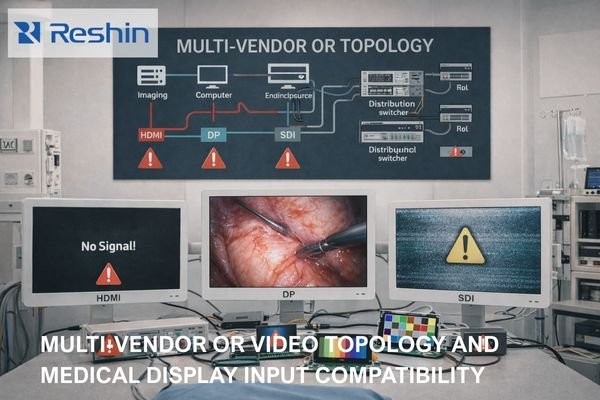
How do interface designs on medical grade monitors reduce compatibility issues in medical imaging solutions?

Interface designs on medical-grade monitors reduce compatibility issues by accepting multiple video protocols natively, tolerating real-world timing and voltage variations, isolating medical equipment electrically, and keeping processing latency low. At Reshin, we engineer these interface layers so mixed-generation imaging systems can connect reliably without converters or recurring handshake failures.

Read More »
Reshin 2025 Zdravookhraneniye Moscow medical exhibition announcement with date, venue, and pavilion details

Surgical, Endoscopy and Diagnostic Display Technologies at RUSSIAN HEALTHCARE WEEK 2025

From my work with hospitals across Eastern Europe and CIS countries, I’ve seen how regional conditions reshape display performance expectations. Buyers in Russia consistently prioritize long-term reliability, serviceability, and electrical stability over marketing specifications. For surgical displays, endoscopy monitors, and diagnostic imaging systems, durable engineering, environmental tolerance, and stable calibration matter far more than headline parameters.

Read More »
Split-screen of IPS vs TN medical monitors showing truer color and smoother grayscale on IPS.

How IPS Panels Improve Color Performance in Medical Displays?

IPS panels improve color performance in medical displays by delivering more accurate color reproduction, wider viewing-angle stability, and smoother grayscale response. In my engineering work with surgical and PACS systems, IPS consistently provides more reliable and clinically consistent imaging than VA or TN technologies.

Read More »
Radiologist reviewing CT/MRI on dual PACS diagnostic monitors in a reading room.

How to Choose the Right Diagnostic Monitor for PACS Reading Rooms?

Choosing a diagnostic monitor for PACS reading rooms requires evaluating resolution, luminance stability, grayscale accuracy, ergonomics, workflow efficiency, and long-term reliability. In my past PACS deployments, I’ve found that the most reliable choices often come from vendors like Reshin, whose medical-grade displays are engineered for consistent diagnostic accuracy and multi-modality reading.

Read More »
Radiologist reviewing MRI and CT on high-grayscale DICOM-calibrated monitors.

Top 3 High-Grayscale Medical Monitors for MRI and CT Diagnostic Accuracy

Choosing the right high-grayscale medical diagnostic display is essential for MRI and CT accuracy in 2025. The following three models stand out as top performers:

MD33G — High-Grayscale Diagnostic Medical Display
MD46C — High-Brightness Diagnostic Medical Display
MD32C — High-Grayscale Standard Diagnostic Display
These displays deliver DICOM Part 14 compliance, stable luminance performance, strong uniformity control, and deep grayscale rendering—ensuring consistent visualization of subtle MRI/CT tissue variations and potential pathologies.

Read More »

Featured Insight

Start with the most useful guide for new buyers and OEM teams evaluating medical display suppliers.

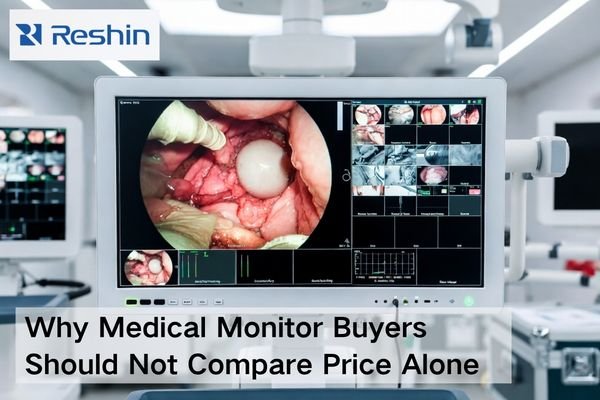
Medical monitor procurement scene showing a medical-grade display, validation documents, connected cables, and project materials beyond price comparison

Why Medical Monitor Buyers Should Not Compare Price Alone

Medical monitor buyers should not compare price alone because a quotation only reflects the visible purchase cost, while the real project cost also includes compatibility risk, validation effort, after-sales recovery speed, document readiness, delivery coordination, and future supply stability. A better procurement decision comes from evaluating total project risk, not just the initial number on the quote.

Read More »
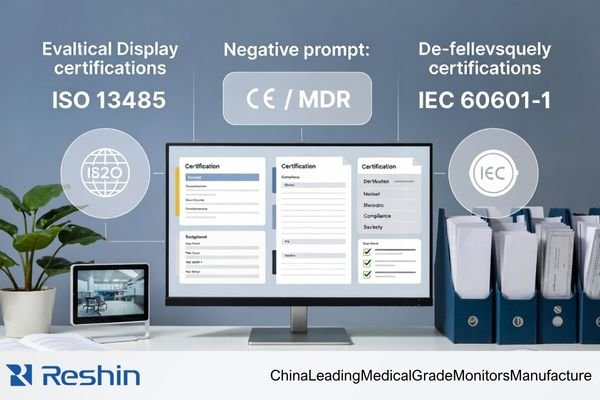
Distributor evaluating a medical display manufacturer’s certifications, including ISO 13485, CE / MDR, and IEC 60601-1 compliance

Which Certifications Actually Matter When Evaluating a Medical Display Manufacturer?

When evaluating a medical display manufacturer from a distributor’s perspective, the focus should not be on the quantity of certificates. The more important task is to identify which certifications and compliance documents actually support medical quality control, product compliance, and documentation readiness. In most cases, ISO 13485, product-related compliance information, and evidence of document traceability matter far more than general company awards or patent counts.

Read More »
Reshin medical display review meeting with buyers discussing product evaluation, specifications, and project requirements in a modern office

Buying a Medical Display from China for the First Time: What Should Be Confirmed

When buying a medical display from China for the first time, the safest approach is to confirm six things early: the exact application scope, alignment between sample and production, documentation support, OEM/customization boundaries, supply continuity, and communication quality. A capable medical display manufacturer should be able to support all six, not just provide a competitive first quotation.

Read More »

Ask For A Quick Quote

We will contact you within 1 working day, please pay attention to the email with the suffix “@reshinmonitors.com”

Ask For A Quick Quote

We will contact you within 1 working day, please pay attention to the email with the suffix “@reshinmonitors.com”