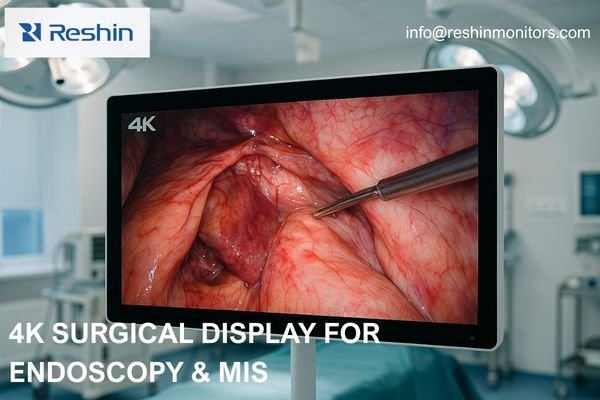
What happens if surgical displays lag by just 1 second?

Glass-to-glass latency test on an endoscopic video system in the OR; technician triggers a light signal at the camera, monitor shows synthetic endoscopic view, with a latency meter and “Latency Test Matrix” sheet

A one-second lag in a surgical display creates a catastrophic disconnect between action and perception, leading to instrument overshoot, tissue damage, and increased complication rates. True real-time performance is a non-negotiable safety requirement.

Why Mammography Demands Stricter Displays Than CT?

Mammography reading workstation with a single diagnostic monitor showing bilateral mammograms—high resolution and GSDF grayscale for micro-calcification detection

Mammography must visualize tiny, low-contrast targets like micro-calcifications, demanding superior spatial resolution, luminance, and grayscale uniformity. CT imaging, focused on broader anatomical structures and density trends, is more forgiving of display variations.

Top 3 Mistakes OEMs Make When Choosing Diagnostic Monitors

Engineer compares two displays at a desk: consumer 8K panel showing grayscale banding vs. 5MP diagnostic monitor labeled GSDF and controlled environment; selection checklist in hand

OEMs most often stumble in three places: choosing by marketing pixels instead of modality needs; skipping DICOM GSDF, luminance stabilization, and uniformity QA; and neglecting the end-to-end signal path (10-bit/4:4:4, EDID) and controlled reading environment.