Medical Display Insights for OEM Buyers, Distributors, and System Integrators

Explore practical articles on medical display sourcing, OEM cooperation, diagnostic and surgical workflows, compliance preparation, and long-term supply planning.

Side-by-side comparison of chest X-rays showing the effect of high contrast versus low contrast on medical image clarity.

What happens when a monitor’s contrast ratio declines?

When a monitor’s contrast ratio declines, images appear washed out, and the ability to distinguish between subtle shades of gray or color diminishes significantly. This flattening of visual depth particularly compromises grayscale-heavy modalities like X-rays and CT scans, potentially leading to missed diagnoses or misinterpretations.

Read More »
Comparison between UHD (3840x2160) and 4K (4096x2160) resolutions in surgical monitors, featuring a high-resolution surgical image and resolution diagrams.

How is UHD different from 4K in surgical monitor marketing?

While often used interchangeably, “4K” traditionally refers to the cinema standard of 4096×2160 pixels, whereas “UHD” (Ultra High Definition) specifies 3840×2160 pixels. For surgical monitors, UHD is the technically accurate term for this class of high-resolution displays, providing four times the pixels of Full HD.

Read More »
Comparison of IPS and VA panel technology for radiology, showing a medical monitor with brain MRI and Doppler ultrasound, and diagrams of liquid crystal alignment.

IPS vs VA Panels: Which Display Technology Is Better for Radiology?

For radiology, IPS (In-Plane Switching) panels are generally better than VA (Vertical Alignment) panels. IPS technology offers superior color accuracy, wider and more consistent viewing angles, and better grayscale fidelity when viewed off-axis. These characteristics are crucial for accurate diagnostic interpretation and maintaining DICOM compliance, areas where VA panels can exhibit limitations like gamma shift and color distortion at wider angles.

Read More »
Radiologist using a Reshin medical monitor with built-in sensors and DICOM grayscale chart for consistent diagnostic image brightness

Do professional medical monitors maintain screen brightness for long periods of time?

Yes, professional medical monitors are designed to maintain screen brightness for extended periods. They achieve this through integrated technologies such as automatic brightness stabilization (ABS) systems, high-quality LED backlights with minimal decay characteristics, ambient light sensors, and often internal front sensors for continuous calibration. These features work together to counteract the natural dimming that can occur with prolonged use, ensuring reliable diagnostic image quality.

Read More »
Side-by-side comparison of a consumer monitor and a medical surgical monitor displaying surgical images.

What are the risks of using consumer monitors in operating rooms?

The risks of using consumer monitors in operating rooms are substantial, encompassing compromised patient safety due to inadequate hygiene and electrical standards, potential for diagnostic errors from inconsistent image quality and lack of medical-specific calibrations, and non-compliance with stringent healthcare regulations. These displays are simply not built for the demanding, sterile environment of surgery, nor do they offer the reliability or precision required for critical procedures.

Read More »
Vascular surgeon operating with microsurgical tools, guided by a 4K Reshin monitor displaying high-resolution vessel imagery and patient vitals

What resolution is optimal for vascular surgery monitors?

For vascular surgery, 4K Ultra HD (3840×2160 pixels) resolution is generally considered optimal. This high pixel density provides exceptional detail, allowing surgeons to clearly visualize fine vessels, subtle tissue changes, and the precise placement of sutures or stents. This clarity is paramount for enhancing surgical accuracy and patient safety in complex vascular interventions.

Read More »
43-inch Reshin surgical monitor in a modern operating room displaying multi-source medical visuals including 4K endoscopy, robotic surgery, CT scans, and vitals

Top 10 Use Cases for 43-inch Surgical Displays

A 43-inch surgical display offers a versatile solution for various procedures. It enhances visualization in laparoscopy, robotic surgery, hybrid ORs, teaching, and collaborative case reviews. It balances a large, clear view with practical OR integration.

Read More »

Featured Insight

Start with the most useful guide for new buyers and OEM teams evaluating medical display suppliers.

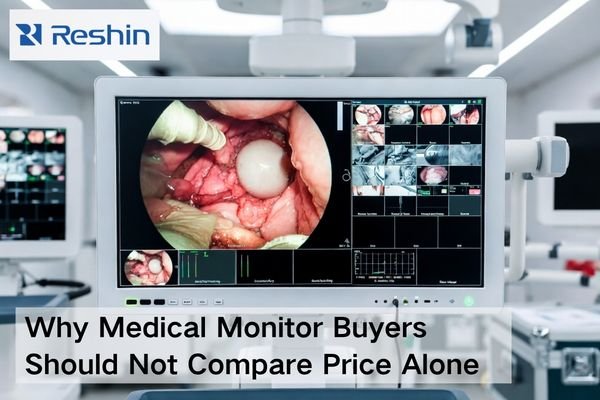
Medical monitor procurement scene showing a medical-grade display, validation documents, connected cables, and project materials beyond price comparison

Why Medical Monitor Buyers Should Not Compare Price Alone

Medical monitor buyers should not compare price alone because a quotation only reflects the visible purchase cost, while the real project cost also includes compatibility risk, validation effort, after-sales recovery speed, document readiness, delivery coordination, and future supply stability. A better procurement decision comes from evaluating total project risk, not just the initial number on the quote.

Read More »
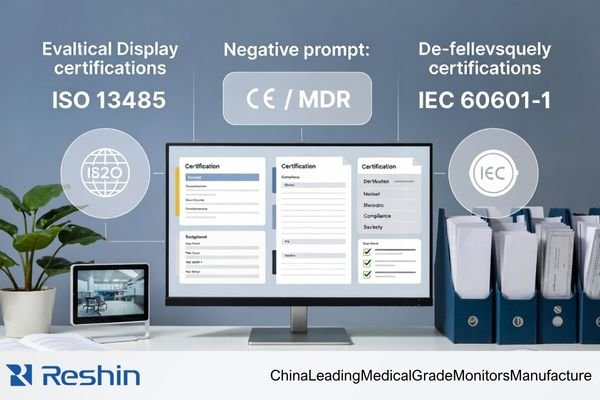
Distributor evaluating a medical display manufacturer’s certifications, including ISO 13485, CE / MDR, and IEC 60601-1 compliance

Which Certifications Actually Matter When Evaluating a Medical Display Manufacturer?

When evaluating a medical display manufacturer from a distributor’s perspective, the focus should not be on the quantity of certificates. The more important task is to identify which certifications and compliance documents actually support medical quality control, product compliance, and documentation readiness. In most cases, ISO 13485, product-related compliance information, and evidence of document traceability matter far more than general company awards or patent counts.

Read More »
Reshin medical display review meeting with buyers discussing product evaluation, specifications, and project requirements in a modern office

Buying a Medical Display from China for the First Time: What Should Be Confirmed

When buying a medical display from China for the first time, the safest approach is to confirm six things early: the exact application scope, alignment between sample and production, documentation support, OEM/customization boundaries, supply continuity, and communication quality. A capable medical display manufacturer should be able to support all six, not just provide a competitive first quotation.

Read More »

Ask For A Quick Quote

We will contact you within 1 working day, please pay attention to the email with the suffix “@reshinmonitors.com”

Ask For A Quick Quote

We will contact you within 1 working day, please pay attention to the email with the suffix “@reshinmonitors.com”