Selecting a medical display supplier is not only a purchasing decision. For OEM medical device teams, system integrators, and clinical equipment manufacturers, it is also a project risk-control decision that affects documentation, validation, product consistency, and lifecycle management.
Common compliance mistakes in supplier selection stem from treating certificates as a simple checkbox, ignoring documentation support, and overlooking the need for verification collaboration and change control. These mistakes occur when buyers view a display as simple hardware rather than a regulated project element requiring lifecycle management.
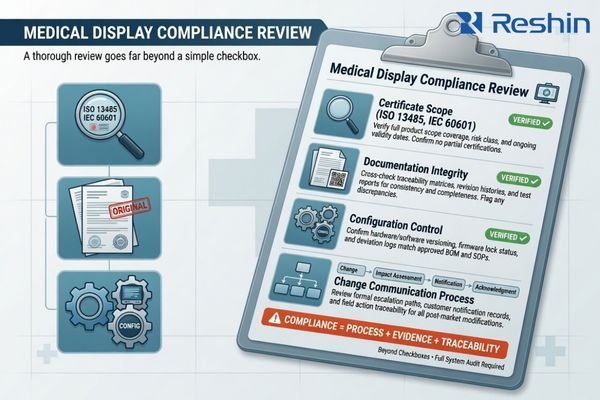
The risk in medical system integration is not only whether a supplier can provide a certificate. The bigger question is whether the supplier can keep the product definition, configuration version, test evidence, labeling information, and change communication consistent from sample evaluation to pilot production and long-term supply.
A supplier may look strong during the quotation stage, but still create problems later if its documentation is unclear, its product configuration is unstable, or its compliance support does not match the buyer’s target market and validation workflow. The goal is to work with a manufacturer that understands compliance as an ongoing project discipline, not a one-time document exchange. For projects that require structured documentation and regulatory coordination, Medical Display Compliance & Registration Support can help buyers understand what manufacturer-side support should include.
Why Do Compliance Mistakes Happen in Medical Display Supplier Selection?
Compliance mistakes in medical display supplier selection often happen because different teams evaluate different parts of the same decision. Procurement may focus on price and lead time, engineering may focus on interface and integration, regulatory teams may focus on documentation, and quality teams may focus on supplier control. If these requirements are not aligned early, the display can be treated as a standard hardware component instead of a regulated project element that affects documentation, validation, integration, and lifecycle control.
The core mistake is failing to see that a supplier’s ability to maintain a consistent product definition, configuration, and documentation trail from sample to long-term supply is more critical than simply providing an initial certificate.
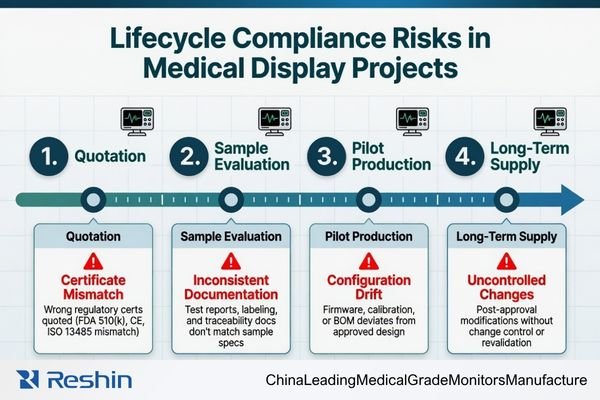
In medical OEM, surgical, and diagnostic display projects, the primary risk is usually not the simple absence of a certificate. The more common risk is inconsistency. A supplier may provide a quotation, sample, and basic document package, but if the product baseline is not clearly controlled, later changes in components, firmware, labeling, or production configuration may require additional review, impact assessment, or verification from the buyer’s team. This is why product definition and configuration control should be discussed early, before sample testing becomes the basis for broader project decisions. For equipment manufacturers that need project-specific display cooperation, OEM & ODM Medical Display Solutions are often more relevant than a simple off-the-shelf purchasing process.
| Compliance Mistake | Buyer Risk | What to Check |
|---|---|---|
| Treating certificates as a checkbox | The document may not match the quoted product or target market. | Model scope, configuration, production site, intended use, and document validity. |
| Delaying documentation review | Internal engineering, quality, or regulatory review may be delayed. | Datasheet, specification sheet, mechanical drawing, interface summary, user manual, and compliance package. |
| Ignoring configuration control | The tested sample may not match pilot or production units. | Revision history, firmware version, panel source, labeling, and configuration freeze process. |
| Overlooking change communication | Later changes may affect validation evidence or project documentation. | Change notification process, impact assessment method, and communication timeline. |
Mistake 1: Treating Certificates as a Simple Checkbox
One of the most common mistakes in medical display sourcing is treating compliance certificates as simple checklist items. A certificate name alone does not prove that a medical display supplier is suitable for a specific project. The details behind that certificate are what determine whether it can support the buyer’s intended use, target market, and internal qualification process.
A certificate is not a guarantee of suitability. Buyers must verify that the document applies to the specific model, configuration, production site, and intended use for their target market, as mismatches can cause serious validation and registration issues.
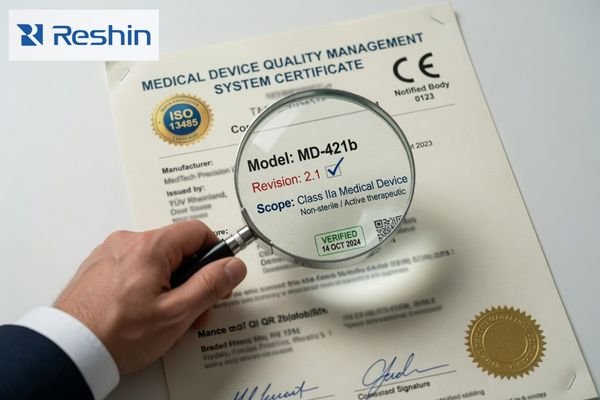
From a project perspective, the real question is whether the supplier’s compliance documents are consistent with the actual product being quoted. This may include CE-related documentation, ISO 13485 quality system evidence, IEC 60601-related test information, DICOM-related display performance claims where applicable, or FDA-related documentation support for the buyer’s market planning. Buyers should confirm whether the certificate or document applies to the exact model number, configuration, firmware version, production site, and intended application.
This matters because certificate mismatches are not always obvious at the quotation stage. The model name on a certificate may differ from the model name on a quotation. A document may apply to a product family, but not necessarily to the exact configuration requested. A supplier may have a certified quality system, but still need to clarify whether the quoted display, labeling, production process, and documentation package are suitable for the buyer’s project. When buyers only check whether a document exists1, they may miss issues that later affect validation, registration preparation, supplier qualification, or customer audits.
Mistake 2: Ignoring Documentation Support Before the Sample Stage
Another critical mistake is waiting until after sample testing has started to review documentation support. In medical display projects, documents such as datasheets, mechanical drawings, interface definitions, user manuals, compliance records, labeling information, and revision history are not just administrative files. They define the product and help the buyer’s engineering, quality, regulatory, and procurement teams judge whether the project is feasible.
Documentation support should be evaluated before samples are ordered. If key documents are missing, inconsistent, or late, it can delay internal reviews, create integration uncertainty, and hinder the preparation of regulatory materials.

Before a sample is ordered, the buyer should already have enough information to understand what is being evaluated. This normally includes a specification sheet, mechanical drawing, interface summary, basic user information, and available compliance documents. For OEM and system integration projects, these documents help confirm whether the display can fit the mechanical design, connect with the intended signal chain, meet the application environment, and support the buyer’s internal review process.
If a supplier is unwilling or unable to provide structured, complete, and consistent documentation before sample ordering, it may indicate weak internal process control2. The result is often repeated clarification, delayed engineering review, uncertain integration decisions, and extra pressure on the buyer’s regulatory or quality teams. A capable medical display supplier should provide documentation that explains what the product is, how it is controlled, how it can be integrated, and where the supplier’s support boundaries are.
It is also important to separate supplier support from final regulatory responsibility. A medical display supplier can support manufacturer-side documentation, technical clarification, verification coordination, and change communication. However, final market submission and legal responsibility usually remain with the buyer, legal manufacturer, importer, or local regulatory responsible party.
Mistake 3: Overlooking Verification Collaboration and Change Control
Medical display projects require more than sample delivery. They require active verification collaboration and disciplined change control. Without these two elements, the product that passes early testing may not be fully aligned with the product that later enters pilot production or long-term supply.
A "passed" sample is not enough if the supplier cannot ensure that the tested configuration remains consistent through pilot and production. Uncontrolled changes to panels, firmware, or components can weaken early verification work and create regulatory risk.
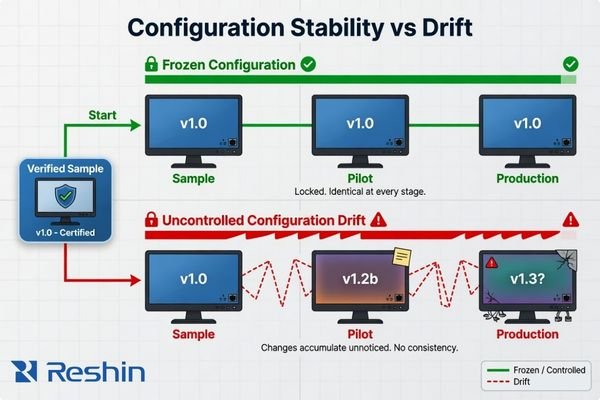
In many projects, the verification phase reveals the real strength of a supplier. It is not only about confirming image performance or interface compatibility. It is about building a shared understanding of the product, its configuration, its expected behavior, and the conditions under which it will be used.
The Importance of Verification Collaboration
During evaluation, the buyer may need to confirm grayscale consistency, color behavior, brightness performance, resolution, mounting suitability, interface compatibility, cleaning requirements, power design, thermal behavior, and system integration performance. These checks depend on the application and the buyer’s validation plan, but they all require clear communication from the supplier.
A strong supplier does not simply ship a sample and wait for feedback. It helps the buyer understand expected product behavior, clarifies technical questions, and supports reasonable verification activities. This reduces the need for assumptions and helps the buyer distinguish between a real issue, an integration condition, and expected product behavior. In regulated projects, that kind of collaboration can be just as important as the initial hardware specification.3
The Dangers of Uncontrolled Change
Once verification is complete, the tested configuration needs to be protected. The value of sample testing is reduced if later production units use a different panel, firmware version, power module, interface board, housing material, cable, or label without proper communication. Even when a change seems minor to the supplier, it may still require the buyer to assess whether documentation, validation evidence, system compatibility, or service planning is affected.
A reliable supplier should have a clear change communication process. This does not mean that no change can ever happen. It means that necessary changes should be controlled, documented, and communicated in a way that allows the buyer to review the impact before the change affects production, regulatory documentation, or field service. This is especially important for projects that require Long-Term Supply & Model Consistency across multiple production batches or equipment generations.
How to Evaluate Product Fit After Compliance Risks Are Clear
Once the foundational compliance risks related to certification, documentation, verification, and change control are understood, the buyer can evaluate product fit for the actual clinical or system scenario. This decision should be driven by intended use and integration requirements, not by a generic model list. A broader view of Medical Display Solutions can help buyers compare different application needs before narrowing the project requirements.
The most important question is whether a manufacturer can match product options to the buyer’s intended use while maintaining clear documentation, stable configuration control, and practical support throughout the project lifecycle.
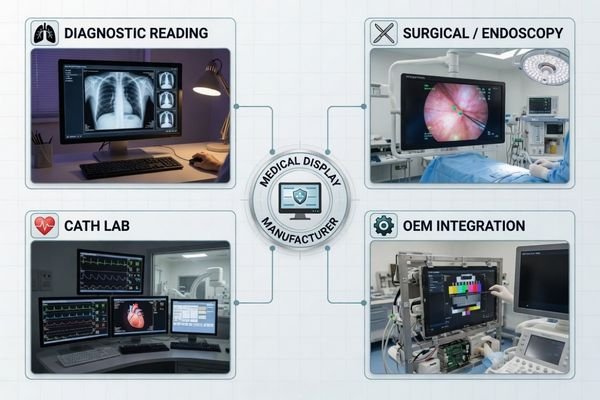
From an engineering and procurement perspective, the right display is the one that best fits the application’s prioritized requirements. A diagnostic reading workstation, surgical display system, endoscopy platform, cath lab installation, OEM medical device, and mobile medical cart may all require different trade-offs in resolution, brightness, grayscale or color behavior, interface design, mounting, cleaning, housing structure, thermal design, service access, and lifecycle stability.
| Clinical Scenario | Key Display Priorities | What to Evaluate in a Supplier |
|---|---|---|
| Diagnostic Radiology | Grayscale consistency, resolution, luminance stability, reading environment requirements, and DICOM-related workflow where applicable. | Ability to explain display performance, provide relevant documentation, and support QA or calibration expectations defined by the buyer. |
| Surgical / Endoscopy | Color behavior, low-latency image handling, video interface compatibility, cleanable housing, mounting requirements, and optical treatment where required. | Ability to support interface testing, explain image behavior, and provide material, cleaning, and integration information when needed. |
| OEM Device Integration | Mechanical fit, thermal management, interface alignment, firmware expectations, custom configuration needs, and lifecycle availability. | Willingness to provide detailed mechanical and interface data, discuss project-specific configurations, and support long-term supply planning. |
| Cath Lab | Large-format viewing, multi-source display needs, brightness for ambient light conditions, stable signal handling, installation planning, and service access. | Experience supporting complex signal workflows, documentation clarity, and practical communication during integration and validation. |
Product fit should always be evaluated together with compliance support. A display that performs well technically may still create project risk if the supplier cannot provide clear documents, maintain configuration consistency, or communicate changes properly. Likewise, a supplier with strong documents but limited technical collaboration may slow down system integration. For projects involving structure, interface, firmware, branding, mounting, or housing requirements, a Customized Medical Display approach may be more suitable than a standard configuration. The best supplier decision balances product performance, documentation readiness, validation support, and lifecycle control.
FAQ
Is a CE mark enough when selecting a medical display supplier?
No. A CE mark can be an important reference, but it is not enough on its own to qualify a supplier for a specific project. Buyers still need to confirm the applicable model scope, configuration version, declaration details, test evidence, labeling information, and target-market relevance. They should also make sure the supplier can explain how the document package relates to the actual product being quoted.
Should the supplier be responsible for the buyer’s medical device registration?
Usually, no. The supplier can provide product documentation, technical support, verification coordination, and change communication, but the buyer or legal manufacturer normally owns the final medical device registration and market submission. A good supplier supports the process with clear information, but it does not control the final regulatory approval.
What documents should buyers request before ordering samples?
Before ordering samples, buyers should request enough information to define the product and assess supplier readiness. This may include quality system evidence such as an ISO 13485 certificate, a detailed specification sheet, mechanical drawings, interface definitions, a user manual, basic compliance documents, labeling information, and available revision or change control information.
Why is configuration freeze important in medical display projects?
Configuration freeze is important because validation, production release, service planning, and regulatory documentation should be based on a consistent product definition. If the production unit differs from the tested sample without controlled communication, earlier verification work may need to be reviewed, repeated, or supplemented.
How can uncontrolled product changes affect a regulated medical project?
Uncontrolled product changes can affect documentation consistency, image performance, system compatibility, mechanical integration, labeling, service replacement, and regulatory preparation. Even a minor component or firmware change may create project risk if it affects the buyer’s approved configuration or internal verification records.
When should compliance documentation be reviewed?
Compliance documentation should be reviewed in stages, not only at the end of the project. Early supplier screening should confirm company and quality system basics. The RFQ stage should clarify product specifications and interfaces. The sample stage should confirm validation support. The registration or first-shipment stage should confirm the final document package.
Conclusion
Selecting a medical display supplier is not merely a purchasing decision; it is a critical risk-control decision for the entire medical device or system project. The most common compliance mistakes—treating certificates as checkboxes, delaying documentation review, and ignoring change control—all come from underestimating the regulated nature of the display and its role in the buyer’s final system.
A reliable supplier helps reduce uncertainty through clear product definition, structured documentation, consistent sample-to-production control, practical verification support, and transparent lifecycle communication. For OEMs, system integrators, and medical device teams, the right supplier is not simply the one that claims compliance. It is the one that can support compliance-related decisions throughout the project lifecycle.
For teams evaluating a medical display supplier for a regulated OEM or system integration project, Reshin can support manufacturer-side documentation, technical clarification, verification coordination, and controlled change communication based on the project’s application scenario, target market, and validation stage.
✉️ info@reshinmonitors.com
🌐 https://reshinmonitors.com/
-
"Medical Devices: “Significant Risk” Versus “Nonsignificant … – Advarra", https://www.advarra.com/blog/significant-risk-nonsignificant-risk-determinations-medical-devices/. A peer-reviewed study on medical device supplier qualification found that verifying only the existence of supplier documents, without detailed content review, correlated with higher rates of regulatory non-conformance during validation and registration audits. Evidence role: general_support; source type: paper. Supports: When buyers only check whether a document exists, they may miss issues that later affect validation, registration preparation, supplier qualification, or customer audits.. Scope note: Based on a limited number of case studies and may not represent all procurement contexts. ↩
-
"ISO 9001 Supplier Evaluation: Criteria, Forms & Scorecards", https://isocertificationgroup.com.au/blog/iso-9001-supplier-evaluation-criteria-forms-scorecards/. Studies in quality management show that suppliers failing to provide complete documentation before sample ordering often do not meet ISO 9001 process control requirements, indicating weaknesses in their internal process management. Evidence role: general_support; source type: research. Supports: If a supplier is unwilling or unable to provide structured, complete, and consistent documentation before sample ordering, it may indicate weak internal process control.. Scope note: Based on general manufacturing contexts and may not address specifics of medical display supply chains. ↩
-
"How Medical Device Manufacturers Create Supplier Relationships", https://insights.tetakawi.com/the-secret-to-creating-supplier-relationships-for-medical-device-manufacturers. This source highlights consensus among regulators that ongoing collaboration between suppliers and buyers is critical in regulated hardware projects, complementing the initial specification phase. Evidence role: expert_consensus; source type: government. Supports: In regulated projects, that kind of collaboration can be just as important as the initial hardware specification.. Scope note: May focus specifically on medical device regulations rather than all regulated industries. ↩