Dual-screen imaging workstation with DisplayPort MST hub and two medical-grade monitors showing grayscale images for stable mode validation

What should you watch for when using multi-stream transport for a dual-screen imaging workstation?

Multi-Stream Transport (MST) allows one DisplayPort output to drive multiple displays through daisy-chaining or hubs, simplifying cabling for dual-screen imaging workstations while introducing extra negotiation steps and variables in the signal chain. Success depends on bandwidth management, stable EDID handling, consistent display enumeration, and validated mode sets that prevent silent downgrades affecting image quality and workflow consistency in demanding clinical environments.

Read More »
Cool-toned hybrid OR integration setup with three 31–32-inch 4K surgical monitors and a 12G-SDI routing box, illustrating low-latency workflow evaluation

Top 7 Most Recommended Surgical Monitors for Low-Latency OR Workflows (2026)

For 2026, the most recommended surgical monitors for low-latency OR workflows must combine true 4K clarity, optimized signal processing, robust 12G-SDI/HDMI/DP connectivity, and hygiene-focused design to keep surgical video in perfect sync with real-world movement. This Top 7 list compares how leading 31–32” class 4K surgical monitors from Sony, Reshin, LG, EIZO, and FSN perform in demanding OR environments.

Read More »
Endoscopic surgical monitor showing 1080i interlacing artifacts versus clean 1080p deinterlaced output for clear real-time viewing

How should an endoscopic monitor handle 1080i deinterlacing?

An endoscopic monitor should handle 1080i deinterlacing with a specialized video processing chip. This chip must convert the interlaced signal into a full 1080p progressive image in real-time. It does this by intelligently eliminating motion artifacts to provide a clear, stable, and lag-free view.

Read More »
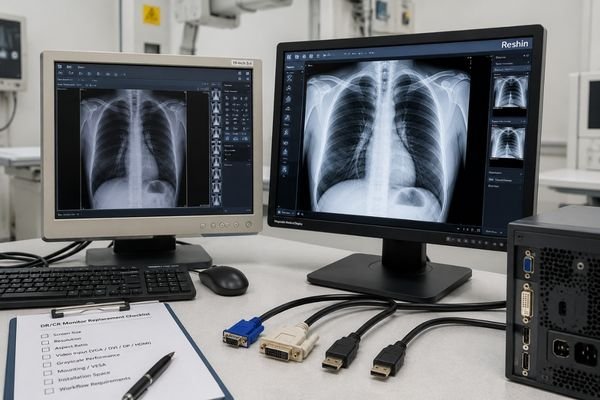
Medical-grade monitor beside a consumer display in a clinical room, showing consistent DICOM-style grayscale and a non-graphic endoscopy inset

A Brief Introduction to Medical Grade Monitors?

A medical-grade monitors is a specialized display built for clinical environments. It shows images from medical equipment like CT scanners or endoscopes with high accuracy and stability. This is essential for applications like surgery and radiology diagnosis, ensuring doctors see precise information to make critical decisions.

Read More »
Medical display with Composite and S-Video connectors beside a digital cable, illustrating legacy analog inputs and converter-based transition in OR video routing

Do Medical Displays Still Need Composite/S-Video Inputs?

Most modern OR workflows don’t need Composite/S-Video on every medical display. However, long-lifecycle legacy devices can still justify analog support at specific endpoints or through converters. The decision should be inventory-driven: identify which sources are still analog, estimate the downtime impact if they fail, and standardize on digital while keeping a validated fallback for critical legacy feeds.

Read More »

Ask For A Quick Quote

We will contact you within 1 working day, please pay attention to the email with the suffix “@reshinmonitors.com”

Ask For A Quick Quote

We will contact you within 1 working day, please pay attention to the email with the suffix “@reshinmonitors.com”