Buyer Guides

Explore practical articles on medical display sourcing, OEM cooperation, diagnostic and surgical workflows, compliance preparation, and long-term supply planning.

Medical display with Composite and S-Video connectors beside a digital cable, illustrating legacy analog inputs and converter-based transition in OR video routing

Do Medical Displays Still Need Composite/S-Video Inputs?

Most modern OR workflows don’t need Composite/S-Video on every medical display. However, long-lifecycle legacy devices can still justify analog support at specific endpoints or through converters. The decision should be inventory-driven: identify which sources are still analog, estimate the downtime impact if they fail, and standardize on digital while keeping a validated fallback for critical legacy feeds.

Read More »
Hospital procurement team reviewing a medical-grade monitor RFP contract and compliance checklist in a conference room with surgical displays on the wall, ensuring compliance, lifecycle control and consistent clinical performance.

When Procuring Medical-Grade Monitors, What Key Clauses Should an RFP Include?

Medical-grade monitor RFPs should include enforceable clauses covering compliance traceability, measurable performance acceptance criteria, documented baseline configurations, and lifecycle controls that prevent drift after updates and replacements. Strong RFP language converts operational requirements into verifiable deliverables with defined test methods and pass/fail criteria.

Read More »
Medical engineer reviewing integration risk diagram for OR, endoscopy, PACS and KVM medical-grade monitors in a hospital control room

What integration-focused capabilities should global distributors evaluate in medical grade monitors brands?

Global distributors must evaluate medical-grade monitor brands beyond basic specifications by assessing their integration capabilities across five critical dimensions: signal interface compatibility, multi-source visualization, calibration consistency, control interoperability, and lifecycle documentation. These elements determine the true total cost of ownership and project success rates in complex medical visualization projects.

Read More »
Split-screen of IPS vs TN medical monitors showing truer color and smoother grayscale on IPS.

How IPS Panels Improve Color Performance in Medical Displays?

IPS panels improve color performance in medical displays by delivering more accurate color reproduction, wider viewing-angle stability, and smoother grayscale response. In my engineering work with surgical and PACS systems, IPS consistently provides more reliable and clinically consistent imaging than VA or TN technologies.

Read More »
Radiologist compares the same CT study on two displays with different grayscale; calibration probe and lux meter show GSDF calibration and luminance stability

Same CT image, different rooms – why displays look different

The same CT study should present the same grayscale—room to room. If it doesn’t, the issue isn’t the scan; it’s the display pipeline: calibration, luminance stability, signal path, and ambient light. This guide maps the risks and a practical, auditable fix—GSDF calibration, stabilized luminance, 20–40 lux reading rooms, matched viewer presets, and routine QA—so one CT has one look everywhere.

Read More »

Featured Insight

Start with the most useful guide for new buyers and OEM teams evaluating medical display suppliers.

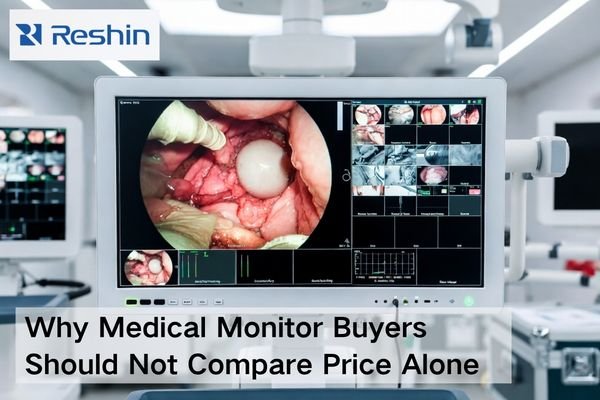
Medical monitor procurement scene showing a medical-grade display, validation documents, connected cables, and project materials beyond price comparison

Why Medical Monitor Buyers Should Not Compare Price Alone

Medical monitor buyers should not compare price alone because a quotation only reflects the visible purchase cost, while the real project cost also includes compatibility risk, validation effort, after-sales recovery speed, document readiness, delivery coordination, and future supply stability. A better procurement decision comes from evaluating total project risk, not just the initial number on the quote.

Read More »
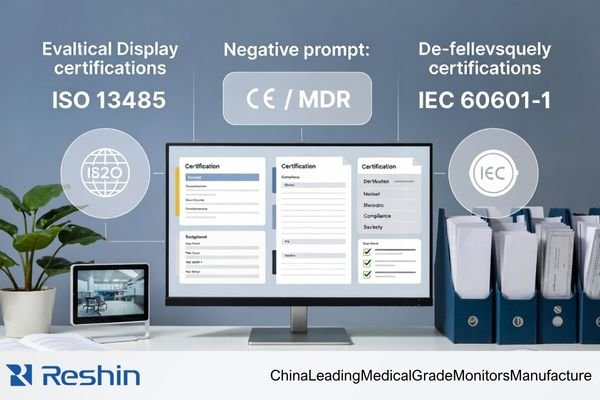
Distributor evaluating a medical display manufacturer’s certifications, including ISO 13485, CE / MDR, and IEC 60601-1 compliance

Which Certifications Actually Matter When Evaluating a Medical Display Manufacturer?

When evaluating a medical display manufacturer from a distributor’s perspective, the focus should not be on the quantity of certificates. The more important task is to identify which certifications and compliance documents actually support medical quality control, product compliance, and documentation readiness. In most cases, ISO 13485, product-related compliance information, and evidence of document traceability matter far more than general company awards or patent counts.

Read More »

Ask For A Quick Quote

We will contact you within 1 working day, please pay attention to the email with the suffix “@reshinmonitors.com”

Ask For A Quick Quote

We will contact you within 1 working day, please pay attention to the email with the suffix “@reshinmonitors.com”