Technology Insights

Explore practical articles on medical display sourcing, OEM cooperation, diagnostic and surgical workflows, compliance preparation, and long-term supply planning.

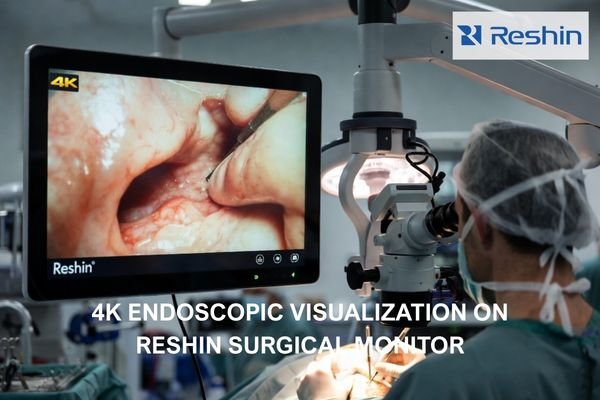
Reshin 4K surgical monitor displaying high-resolution endoscopic image of otologic microsurgery

Why Does Otologic Microsurgery Rely More on Low-Latency Surgical Monitors?

Otologic microsurgery relies more on low‑latency surgical monitors because even minimal delays of 50–100 milliseconds can cause surgical instruments to overshoot intended movements during high‑magnification operations within tight anatomical spaces. These procedures require instantaneous visual–motor synchronization, and latency disrupts precision, reduces surgeon confidence, and increases the risk of unintended trauma to delicate structures such as ossicles, cochlea, and facial nerve pathways.

Read More »
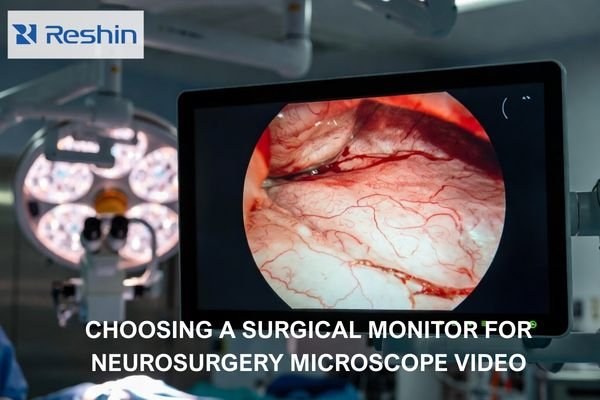
Neurosurgery OR scene with a surgical microscope and an articulated surgical monitor displaying a non-graphic microscope-view image with fine microvascular detail.

How Should You Choose a Surgical Monitor for Neurosurgery Microscope Video Output?

Choosing surgical monitors for neurosurgery microscope video output requires preserving micro-detail and maintaining repeatability across real OR signal chains rather than pursuing headline specifications. Prioritize clean scaling with minimal artifacts, confirm delivered formats and latency behavior, and lock stable brightness and picture modes that prevent drift during long cases to support both surgical precision and consistent team communication.

Read More »
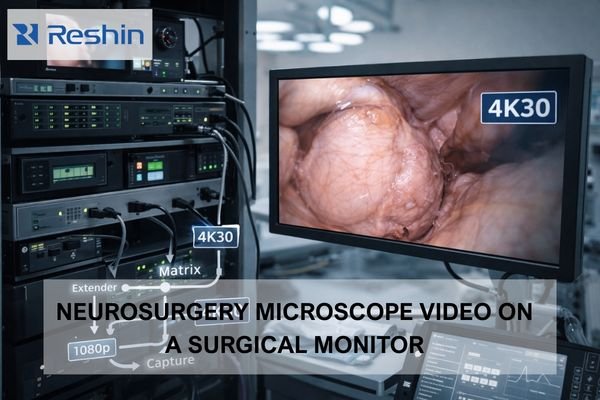
4K30 endoscopy surgical monitor connected to an OR routing rack, showing how the signal chain can downgrade to 1080p.

When an Endoscopy System Outputs 4K30, How Can a Surgical Monitor Avoid Forced Downgrade?

When endoscopy systems output 4K30, surgical monitors can avoid forced downgrade by stabilizing the negotiated mode across the full chain: lock one known-good 4K30 format (resolution + refresh + chroma + bit depth + timing), manage EDID/handshake behavior across routing devices, and validate switching, recording on/off, and power-cycle responses so the system does not fall back to a lower mode. This article provides a practical downgrade “cause map,” a pre-go-live stress test routine, and a baseline package you can reuse across rooms.

Read More »
Ophthalmic operating room with dual surgical monitors showing anterior eye surgery and posterior retinal imaging.

How should one select surgical monitors for ophthalmic procedures (anterior and posterior segments)?

Selecting surgical monitors for ophthalmic procedures requires matching display behavior to segment-specific visibility risks: smooth highlight handling and stable brightness for anterior segment work, predictable color and tonal mapping with stable low-level detail for posterior segment procedures. Prioritize clean scaling, consistent low latency, and validated picture modes that prevent drift during procedures.

Read More »
Photorealistic radiology workstation showing a neutral grayscale medical image with a subtle warm Night Mode shift on half the display.

Does Night Mode or “Eye Comfort” Affect Medical Image Viewing?

Night Mode and Eye Comfort features can affect medical image viewing by shifting white point, reducing blue output, and sometimes dimming displays, which can change visual adaptation and perceived contrast. For diagnostic reading, maintain validated baselines and avoid comfort transforms during clinical interpretation, using separation and policy controls for mixed-use workstations. This article explains what changes in the rendering pipeline, how to validate impact in your actual viewer, and how to control the setting so it cannot persist unintentionally.

Read More »
Dual medical imaging monitors on a clinical workstation showing grayscale CT and MRI scans on one screen and ICC color calibration curves and test patterns on the other, illustrating ICC profile management for diagnostic display consistency.

Should You Disable ICC Profiles on Medical Display Monitors?

ICC profile decisions for medical displays depend on your clinical workflow and calibration approach. Prefer disabling or neutralizing OS-level ICC transforms when diagnostic applications and monitors already use validated internal calibration, but consider keeping ICC for color-managed workflows. The key is preventing competing transforms that reduce repeatability across applications and system states.

Read More »
Technician troubleshooting medical-grade monitor signal dropouts in a hospital control room, checking cables while a laptop shows a signal chain diagnosis flowchart and wall displays show surgical video and no-signal warnings.

How to Check Whether Random Dropouts on a Medical grade Monitors Come from the Cable or the Device?

Random dropouts on Medical grade monitors can be diagnosed by testing with direct, short cable connections first to isolate cable issues, then rebuilding the signal chain incrementally to identify device-specific problems. Cable issues typically show physical sensitivity and bandwidth stress patterns, while device issues correlate with specific states, negotiations, and switching events.

Read More »
Operating room endoscopy tower connected to a medical-grade surgical monitor, illustrating timing, color encoding, and EDID/handshake compatibility issues.

What Are the Three Most Common Compatibility Problems When Matching Surgical Monitors with Endoscopy Systems?

The three most common compatibility problems when matching surgical monitors with endoscopy systems are timing mismatch (resolution/refresh/scan format), color encoding and range mismatch (RGB vs YCbCr, full vs limited), and negotiation instability through EDID/handshake behavior via intermediate devices. These issues often appear after switching or rebooting rather than during initial setup.

Read More »
Operating room display showing side-by-side white-light and fluorescence-guided surgery images with mode switching panel

What Special Requirements Does Fluorescence-Guided Surgery Put on Surgical Monitors?

Fluorescence-guided surgery requires surgical monitors to support stable low-level contrast discrimination, consistent color handling across white-light and fluorescence modes, minimal switching latency, and predictable behavior during the frequent state transitions that occur throughout procedures. These requirements extend beyond basic image quality to include system-level reliability, repeatable modes, and stable overlay presentation.

Read More »

Featured Insight

Start with the most useful guide for new buyers and OEM teams evaluating medical display suppliers.

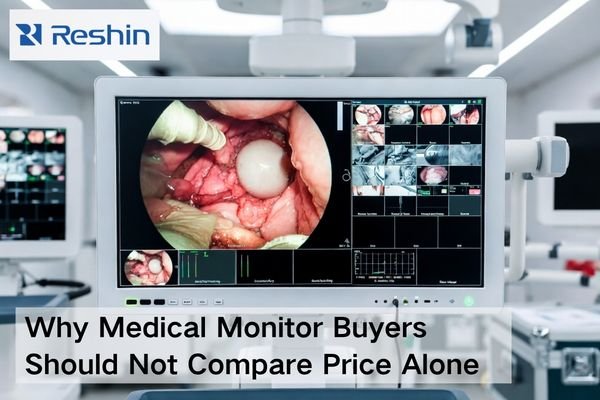
Medical monitor procurement scene showing a medical-grade display, validation documents, connected cables, and project materials beyond price comparison

Why Medical Monitor Buyers Should Not Compare Price Alone

Medical monitor buyers should not compare price alone because a quotation only reflects the visible purchase cost, while the real project cost also includes compatibility risk, validation effort, after-sales recovery speed, document readiness, delivery coordination, and future supply stability. A better procurement decision comes from evaluating total project risk, not just the initial number on the quote.

Read More »
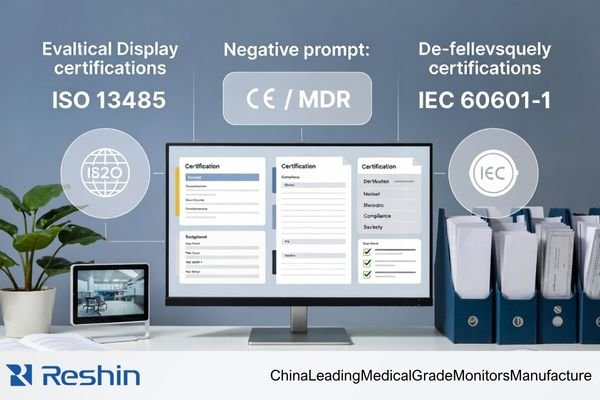
Distributor evaluating a medical display manufacturer’s certifications, including ISO 13485, CE / MDR, and IEC 60601-1 compliance

Which Certifications Actually Matter When Evaluating a Medical Display Manufacturer?

When evaluating a medical display manufacturer from a distributor’s perspective, the focus should not be on the quantity of certificates. The more important task is to identify which certifications and compliance documents actually support medical quality control, product compliance, and documentation readiness. In most cases, ISO 13485, product-related compliance information, and evidence of document traceability matter far more than general company awards or patent counts.

Read More »
Reshin medical display review meeting with buyers discussing product evaluation, specifications, and project requirements in a modern office

Buying a Medical Display from China for the First Time: What Should Be Confirmed

When buying a medical display from China for the first time, the safest approach is to confirm six things early: the exact application scope, alignment between sample and production, documentation support, OEM/customization boundaries, supply continuity, and communication quality. A capable medical display manufacturer should be able to support all six, not just provide a competitive first quotation.

Read More »

Ask For A Quick Quote

We will contact you within 1 working day, please pay attention to the email with the suffix “@reshinmonitors.com”

Ask For A Quick Quote

We will contact you within 1 working day, please pay attention to the email with the suffix “@reshinmonitors.com”